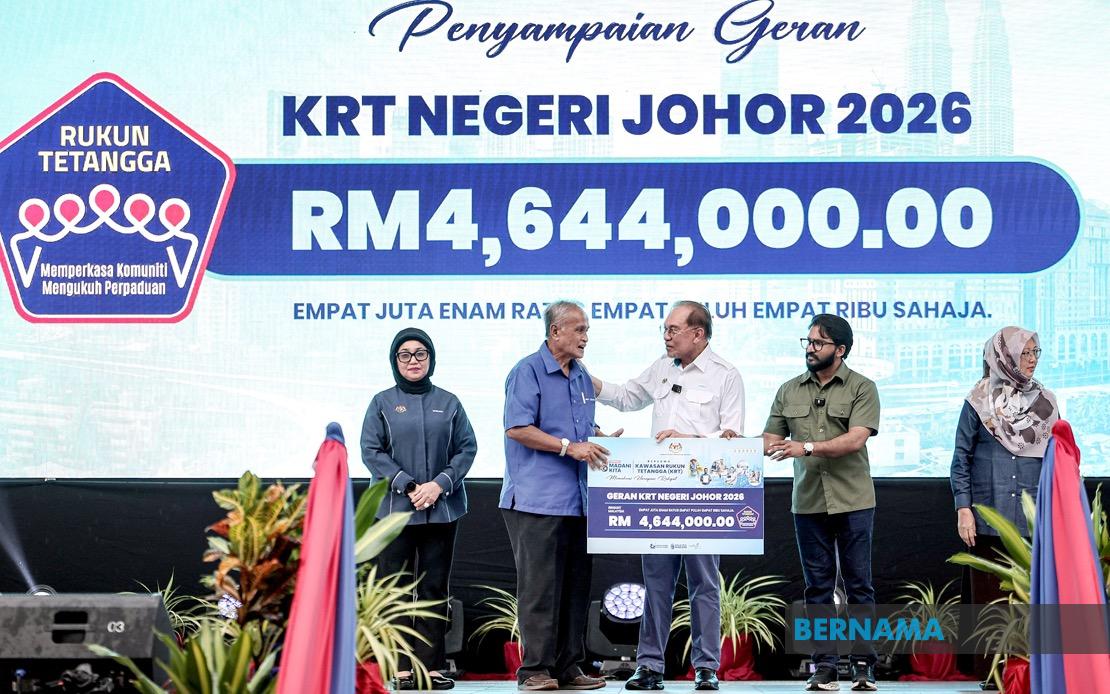
Prime Minister Datuk Seri Anwar Ibrahim has endorsed a significant boost to grassroots community policing by approving an increase in annual grants for Neighbourhood Watch Areas (KRT) nationwide, raising the allocation from RM6,000 to RM10,000 per organisation. The enhanced funding will commence on January 1, 2027, and applies to all KRT bodies that maintain active reporting on their development and community engagement activities. The announcement came during the MADANI KITA Programme event held at Dataran Segamat, attended by Deputy Minister of National Unity R. Yuneswaran and Deputy Minister of Domestic Trade and Cost of Living Datuk Dr Fuziah Salleh.
The timing of this financial uplift reflects recognition of a prolonged funding stasis that had lasted an entire decade. Throughout the past 10 years, the government had maintained the KRT grant at RM6,000 despite the acknowledged importance of these neighbourhood watch organisations in supporting government objectives at the community level. The Prime Minister's decision to elevate the grant by approximately 67 per cent signals a renewed commitment to empowering these grassroots institutions, which serve as crucial intermediaries between residents and official security and welfare agencies. This adjustment represents the first meaningful increase in KRT funding since the original allocation was set, and comes at a time when inflationary pressures have eroded the real value of fixed grants across many government programmes.
According to Anwar, the decision to increase KRT funding stems from the organisation's vital contributions to maintaining social cohesion and democratic values at neighbourhood level. He emphasised that KRTs play a foundational role in fostering consensus, strengthening democratic participation, and reinforcing national unity across communities. Beyond their traditional community-watching functions, these groups assist both security personnel and government departments in addressing localised security concerns and welfare matters affecting residents. The Prime Minister underscored that Malaysia's comparative advantage as a stable, multi-ethnic nation depends fundamentally on the continuous revival and maintenance of consensus-building mechanisms at all levels of society, from national leadership down to street-level neighbourhood organisations.
The Prime Minister used the Segamat event to articulate a broader philosophical position regarding Malaysia's multicultural fabric. He stressed that the nation's resilience since independence has stemmed directly from its ability to preserve harmony among people of different racial, cultural, and religious backgrounds. Rather than permitting such differences to become vectors for division, Anwar argued that these distinctions should be recognised and celebrated as intrinsic sources of national strength. This messaging carries particular significance given ongoing social tensions and periodic communal sensitivities that have marked recent years in Malaysian public discourse. By linking KRT funding increases to this vision of consensus and unity, the government appears to be signalling that community-level organisations will remain instrumental in pursuing its broader social cohesion agenda.
Beyond the KRT funding announcement, the Segamat programme revealed additional government investment in complementary areas of community development and public sector welfare. The Prime Minister approved an immediate allocation of RM3.205 million designated for basic infrastructure repairs and upgrades at Islamic educational institutions throughout Johor. The projects encompass 16 separate initiatives targeting religious schools, madrasahs, study centres, and tahfiz institutions located in districts including Batu Pahat, Muar, and Segamat itself. The government framed these facility improvements as essential to creating more comfortable and conducive learning environments for students enrolled in Islamic education programmes, reflecting the administration's commitment to strengthening the physical infrastructure supporting religious education across the state.
The announcement of infrastructure funding for Islamic educational institutions extends the government's emphasis on institutional support beyond security and community watch functions into the realm of religious education provision. These allocations suggest recognition that physical learning conditions directly impact educational outcomes and student welfare. For Johor residents and parents of students attending these institutions, the immediate availability of repair funding addresses longstanding maintenance backlogs that have accumulated across religious schools and centres. The specificity of the allocation—naming particular districts and types of institutions—indicates that the government has conducted detailed assessments of infrastructure needs rather than distributing funds through generic formulas.
Complementing these community and educational investments, the Prime Minister also approved RM1.0 million in immediate funding for critical and urgent repair work at Royal Malaysian Police (PDRM) quarters throughout Johor. This welfare-focused allocation directly targets housing conditions for law enforcement personnel stationed in the state. Anwar justified the investment by referencing the government's responsibility to maintain personnel welfare as an integral component of national security maintenance. The PDRM quarters funding acknowledges that adequate accommodation conditions constitute part of the broader effort to retain and support security sector workers, whose physical and psychological well-being directly influences their capacity to perform demanding public safety roles effectively.
The three-pronged funding announcement—KRT grants, Islamic educational infrastructure, and police quarters repairs—reflects a coordinated approach to addressing different elements of Malaysia's governance and welfare ecosystem through targeted financial commitments. Each allocation targets a distinct stakeholder group: community-level security volunteers, religious education providers and students, and frontline security personnel. Yet collectively, they advance a unified narrative about government investment in foundational institutions that underpin social stability, educational provision, and public security. For Malaysian residents, particularly those in Johor where the announcement occurred, these allocations signal tangible government presence in addressing community-level concerns that might otherwise remain neglected.
The KRT funding increase carries particular regional relevance for Southeast Asian readers observing Malaysia's approach to grassroots security and community policing. Many neighbouring countries face similar challenges in effectively reaching community level while managing costs, and Malaysia's decision to invest in neighbourhood watch organisations offers a model of institutional support that prioritises volunteer-based community participation. The emphasis on consensus-building and multicultural harmony as rationales for supporting KRTs reflects the particular political context of a multi-ethnic democracy managing diverse populations within a single national framework. This approach distinguishes Malaysia's community policing model from more militarised or top-down security arrangements found in some neighbouring jurisdictions.
Implementation of the elevated KRT grant from January 2027 will require government machinery to process and distribute increased funding to thousands of KRT organisations nationwide. The January 1 commencement date suggests intentional alignment with the new calendar year, potentially facilitating administrative processes and budget planning cycles. However, the gap between the announcement in June 2024 and implementation in January 2027 provides approximately 2.5 years for procedural preparation, organisational notification, and systems adjustments across relevant government departments. This timeline should enable smooth transition from the previous RM6,000 rate to the new RM10,000 allocation without disruption to neighbourhood watch activities.
The broader implications of this funding decision extend beyond immediate budgetary considerations to questions about the government's strategic priorities in coming years. By substantially increasing KRT allocations after a decade of stasis, the administration signals that grassroots institution-building and community-level security engagement constitute policy priorities worthy of material investment. This positioning suggests that the government views strengthening community watch organisations as preferable to, or complementary with, expanding formal security sector capacity. For Malaysian communities accustomed to increasingly centralised and professionalised policing, the revival of KRT funding may represent a partial return to neighbourhood-based collective security approaches that characterised earlier decades of community self-reliance.

