Navigating George Town as a first-time visitor often feels overwhelming, but breaking the heritage city into digestible zones and themed routes transforms the experience into something manageable and deeply rewarding. The obvious entry point for most tourists remains the George Town UNESCO Historic Site, anchored by iconic streets like Beach Street, Armenian Street, Lebuh Carnavon, Lebuh Chulia and Pengkalan Weld, where meticulously restored colonial buildings and shophouses line every corner. Yet venturing beyond these well-trodden pathways reveals equally compelling narratives, particularly along Jalan Burma, a nearly 5-kilometre arterial road that functions as a cultural and gastronomic spine running from the heritage zone's periphery all the way to the more affluent Pulau Tikus neighbourhood.
For food-focused travellers, George Town presents an embarrassment of riches that defies easy categorisation. While nasi kandar remains the city's most iconic export, with fiercely loyal devotees debating the merits of competing establishments, the broader dining landscape encompasses everything from halal specialists to pork-free options, casual street food courts and contemporary cafes. More recently, the Michelin Guide has provided an additional framework for navigation, recognising 74 eateries across Penang with varying accolades: two establishments holding one-star status, 33 claiming positions on the Bib Gourmand list, and 39 designated as Michelin Selected venues. For visitors prioritising culinary discovery, pursuing these officially endorsed spots across several days yields considerable satisfaction, particularly when focusing on the more casual Bib Gourmand stalls located within shared food courts and traditional coffeeshops rather than formal fine-dining establishments.
These humble eating spaces possess particular appeal because they compress multiple sensory experiences into confined quarters. The layered aromas from neighbouring stalls—fish stock simmering in one corner while chilli paste blackens in another—create an intoxicating olfactory environment that heightens anticipation before any dish arrives. The visual theatre of watching skilled cooks execute well-practiced choreography, tossing noodles with practiced flicks or ladling curry with precision, transforms meal consumption into genuine entertainment rather than mere sustenance. A visit to Jalan Burma's Duck Blood Curry Mee encapsulates this precisely: a simple bowl of white curry noodles becomes an event when consumed within this energy-charged ecosystem.
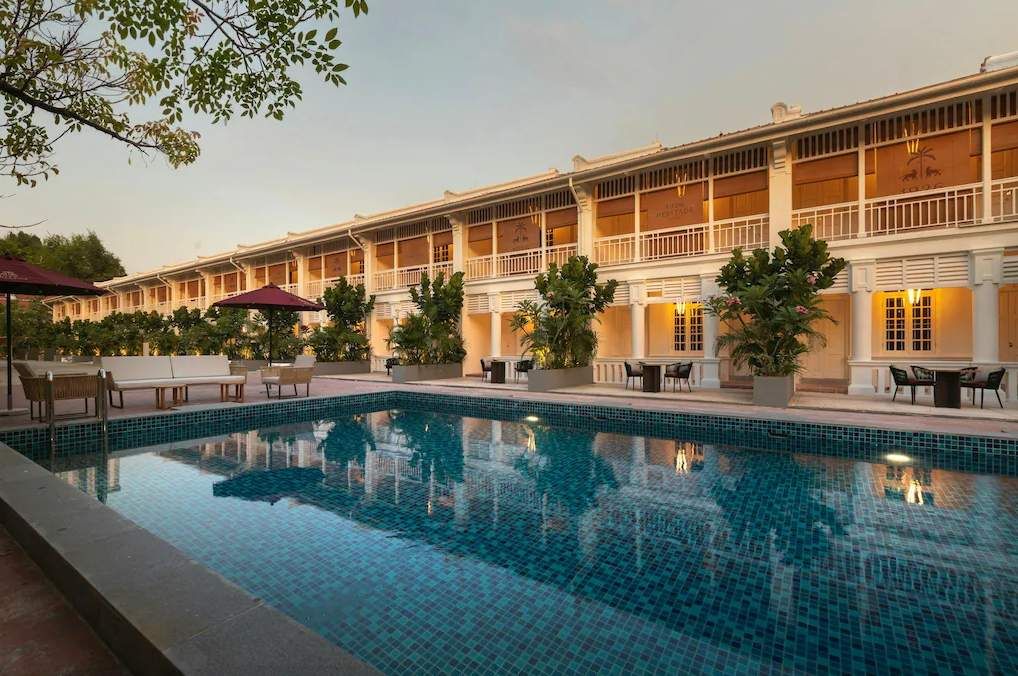
Just metres from this stall stands one of George Town's most significant recent hospitality additions, a heritage hotel marking its centenary in 2026. Originally constructed in 1926 as residential quarters for British and local government officials, the building exemplifies the Anglo-Malay architectural fusion characteristic of Penang's colonial period. The original structure comprised 24 interconnected link houses, a typology perfectly suited to the tropical climate while maintaining a distinctly imperial aesthetic. When the Penang Development Corporation acquired and converted the property into a hotel in 1999, this vernacular design proved remarkably adaptable; the 24 houses now contain 78 rooms and suites categorised across six distinct types, ranging from the Heritage Room ideal for solo travellers to the sprawling Straits Suite. Amenities reflect contemporary expectations while respecting historical authenticity, including high-tech water filtration systems in guest rooms that seem almost absurdly out of place in a building celebrating pre-war construction methods.
Just beyond this hotel lies Restoran Old Green House, headquarters of the Bib Gourmand-listed Green House Prawn Mee & Loh Mee operation. This establishment holds significance within the local gastronomic hierarchy, functioning as the acknowledged original location despite the existence of a competitor operating as Green House Prawn Mee/Law Mee Corner elsewhere on Jalan Burma. Local consensus consistently directs hungry visitors to Restoran Old Green House, a peculiarly Malaysian phenomenon where brand authenticity and location-based prestige sometimes matter more than consistent quality. The distinction between multiple establishments claiming similar culinary lineages reflects how George Town's food culture evolves: older spots gain mythologised status through longevity and local endorsement, while satellite branches remain eternally positioned as derivative, regardless of actual cooking skill or ingredient quality.
Jalan Burma itself warrants exploration independent of any single destination along its length. Extending approximately 5 kilometres, it qualifies as one of George Town's major arterial thoroughfares, offering reasonably safe pedestrian passage with only occasional sections lacking designated footpaths. The walk from the heritage zone's edge toward Pulau Tikus provides manageable urban strolling, particularly when undertaken with appropriate sun protection and hydration strategies essential for Penang's equatorial climate. The road's physical journey becomes more meaningful when contextualised through its etymological history: once called Burmah Road on colonial signboards and maps, the thoroughfare has accumulated numerous parallel names across different languages reflecting the communities it serviced. Malay designations like Jalan Tarek Ayer or Water Cart Road, alongside Hokkien appellations such as Gui Chia Chui, reference the bullock carts that historically transported water along this precise route.
The toponymy carries profound implications regarding Penang's nineteenth-century economic structure and community organisation. Water distribution via animal transport represented a crucial urban service before modern piping infrastructure, and the designation of an entire road around this function speaks to the commercial and logistical importance attached to the task. Subsequently, a substantial Burmese settlement emerged in the Pulau Tikus area, fundamentally altering the road's identity and generating new nomenclature rooted in Burmese geography rather than utilitarian function. This linguistic layering persists today in surrounding street names: Rangoon Road, Mandalay Road and Moulmein Close all reference major Burmese cities, anchoring the neighbourhood within a specific diasporic community's mental geography.
The Dhammikarama Burmese Temple, established two centuries ago, survives along one of Jalan Burma's lateral lanes as tangible proof of this historical settlement pattern. The temple's longevity and continued prominence within the local Buddhist community distinguish it as an exceptionally preserved example of early immigrant religious architecture, rivalling the more frequently photographed Chinese temples and Hindu shrines that dominate George Town's religious tourism landscape. Yet despite its historical significance and remarkable preservation, the temple remains relatively marginal within mainstream tourist itineraries, known primarily to locals and specialist heritage visitors rather than casual tourists following social media recommendations or Michelin guides. This absence from mainstream coverage represents a broader phenomenon within George Town tourism: certain heritage sites achieve disproportionate prominence through aggressive marketing or photogenic characteristics, while equally significant locations remain known primarily through direct experience and word-of-mouth endorsement.
Walking Jalan Burma toward the heritage zone's core, particularly heading toward the Komtar landmark that serves as a convenient navigation reference point for visitors unfamiliar with the street grid, one confronts the practical reality of Penang's contemporary urban character: colonial aesthetics coexist with modern commercial imperatives, heritage preservation competes with property development pressures, and carefully curated tourist experiences overlay working neighbourhoods where residents pursue quotidian routines. The best pedestrian experiences emerge not from guidebook recommendations but from serendipitous discoveries—the family-run stall producing superior rendang, the vintage bookshop tucked into a heritage shophouse, the weekend market showcasing local artisans. The Hin Bus Depot marketplace exemplifies this alternative tourism model, operating primarily on weekends and attracting predominantly local visitors rather than foreign tourists. Here, curio vendors, local artisans selling handmade clothing, caricature artists and homemade food producers create a genuinely community-focused gathering space where live music accompaniment transforms casual shopping into social occasion.
The tension between these two tourism modes—the guided, Michelin-approved itinerary versus the unstructured wandering yielding unexpected encounters—defines contemporary Penang travel. Jalan Burma functions as a practical meeting point between these approaches: the heritage hotel and Bib Gourmand restaurants provide legitimate anchor points for travellers seeking quality assurance and expert validation, while the road's length, historical complexity and everyday commercial character ensure that extended time spent traversing it yields genuine discovery independent of any prior planning. Visitors armed with Michelin guides and hotel reservations often report equally satisfying experiences as those prioritising spontaneous exploration, suggesting that Penang's layered urban character accommodates multiple travel philosophies simultaneously. The city rewards both strategically planned culinary pilgrimages and aimless wandering with considerable satisfaction, making George Town exceptional among Southeast Asian heritage destinations for its capacity to serve diverse visitor expectations simultaneously without sacrificing authenticity in either direction.

