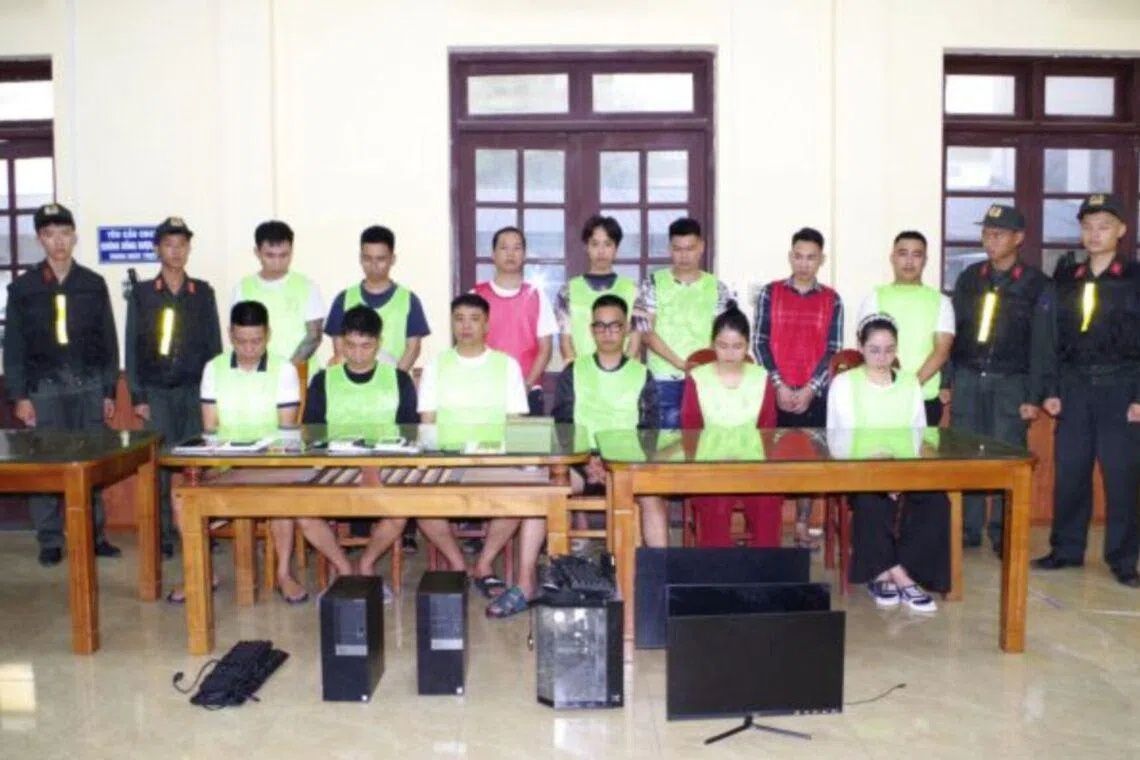
Law enforcement authorities in Vietnam's northern Ninh Binh province have successfully broken up an elaborate transnational cybercrime syndicate that orchestrated a sprawling fraud operation spanning multiple countries. The crackdown resulted in the arrest of 12 suspects and the recovery of substantial assets, marking a significant victory against organized online crime in Southeast Asia. The criminal network had allegedly defrauded approximately 500 victims of more than 250 billion Vietnamese dong, equivalent to RM39.2 million, since October 2024.
The investigation identified Nguyen Van Cuong, aged 28, and Nguyen Van Phuong, aged 34, as the primary architects of the criminal enterprise. Police operations yielded an extensive collection of evidence documenting the scope and sophistication of their activities. Officers recovered cash, vehicles, mobile devices, computers, fraudulent identity documents, jewellery, and comprehensive records detailing the network's operations. The sheer volume of seized materials underscores the scale and organized nature of the criminal undertaking, suggesting years of operational planning rather than a hastily assembled scheme.
A critical aspect of the investigation revealed the network's cross-border structure. The suspects had systematically recruited Vietnamese nationals and transported them to Cambodia, where they established an operational base for their criminal activities. This geographical distribution across Southeast Asia reflects a deliberate strategy to complicate law enforcement efforts and distance the operational headquarters from national authorities. The network maintained clearly delineated roles and responsibilities, indicating a sophisticated hierarchical structure typical of major organized crime enterprises rather than opportunistic fraud.
The syndicate's methodology demonstrated considerable technical expertise and psychological manipulation. Members posed as legitimate authority figures, impersonating police officers, prosecutors, judges, banking professionals, and tax officials. These impersonations exploited the natural deference citizens typically extend toward government representatives, leveraging cultural expectations to gain victim compliance. Equally sophisticated were the technological components of their operation, which included the creation of counterfeit websites and mobile applications designed to mirror authentic platforms operated by government agencies and recognized financial institutions. These digital replicas were sufficiently convincing to deceive victims into believing they were conducting legitimate transactions.
The fraud operations encompassed diverse schemes tailored to different victim vulnerabilities and circumstances. Employment-based scams targeted individuals seeking supplementary income through fraudulent part-time work opportunities. Investment fraud schemes exploited victims' aspirations for financial growth by promoting fictitious opportunities in finance, securities markets, and cryptocurrency ventures. Romance fraud operations, a particularly psychologically damaging category of crime, involved building romantic relationships online before requesting financial assistance for fabricated emergencies. The network also exploited social media vulnerabilities, hijacking established accounts to solicit loans from the victims' contacts, thereby leveraging existing trust relationships to facilitate deception.
One particularly audacious scheme revealed the perpetrators' willingness to engage in increasingly bold criminal activities. Network members would contact retail shops and commercial enterprises while posing as military officers, requesting substantial merchandise orders. They then manipulated business owners into purchasing additional inventory on their behalf, requesting deposits or advance payments to be transferred to designated bank accounts controlled by the fraudsters. This scheme brilliantly exploited both the commercial imperative to secure large orders and the respect accorded to military personnel, combining multiple psychological and social manipulation techniques into a seamless deceptive operation.
The scale of victimization painted a troubling picture of organized cybercrime's reach across Vietnam. Between October 2024 and the time of their arrest, the network successfully defrauded approximately 500 individuals, suggesting an average victim loss of approximately 500 million Vietnamese dong per person. The consistency of their success across such a large victim cohort indicates the effectiveness of their tactics and the vulnerability of ordinary citizens to sophisticated digital deception. Many victims likely did not immediately recognize they had been defrauded, as the scams were designed to appear legitimate throughout the transaction process.
Legal proceedings moved swiftly following the arrests. Six suspects faced formal charges of fraudulent appropriation of property and were remanded in temporary detention pending trial. The remaining six suspects experienced procedural measures consistent with Vietnamese criminal law, though they await determination of formal charges as investigations progressed. This bifurcated approach reflects the complexity of establishing comprehensive legal liability across the entire network, with investigations still ongoing to determine specific roles and culpability for each member of the organization.
Police investigations continued with expansion efforts directed toward identifying additional network members not yet apprehended. The preliminary arrests represented the initiation rather than the conclusion of enforcement efforts against this criminal organization. Authorities recognized that the 12 suspects already detained likely represented only the visible operational structure, with other individuals potentially involved in recruitment, technology development, money laundering, or asset management functions. The investigation's expansion phase would prove crucial in dismantling the entire network and preventing its reconstitution under different operational structures.
Asset recovery constituted an equally critical component of the enforcement response. Authorities initiated procedures to seize and freeze financial assets linked to the criminal network, recognizing that financial recovery would partially compensate defrauded victims and simultaneously impair the organization's capacity to continue operations. The frozen assets would support ongoing investigative and prosecutorial efforts while serving as evidence of the network's criminal proceeds. For Malaysian readers and broader Southeast Asian audiences, this case underscores the transnational nature of modern cybercrime, particularly how criminal organizations exploit cross-border mobility to evade capture while maintaining operational continuity.
The Ninh Binh police operation carries significant implications for regional cybersecurity. Malaysia, with its substantial population of internet users and growing digital economy, remains vulnerable to similar transnational fraud networks. The sophistication demonstrated by the Vietnamese network—particularly their creation of convincing digital replicas of government platforms and their psychological manipulation techniques—represents tactics potentially deployable in Malaysian contexts. The case highlights the necessity for coordinated international law enforcement cooperation, as individual national police forces cannot effectively combat organizations operating deliberately across multiple jurisdictions. Southeast Asian governments must strengthen bilateral and multilateral frameworks enabling rapid information sharing and joint operational capacity.
Likewise, the case emphasizes the critical role of public awareness in combating sophisticated cybercrime. The Vietnamese network's success depended substantially on victim vulnerability to deception, suggesting that educational campaigns highlighting common fraud tactics could significantly reduce victimization rates. Banking institutions, government agencies, and telecommunications companies should implement awareness initiatives specifically addressing the techniques demonstrated in this case: impersonation of authority figures, counterfeit applications, and social engineering. For Malaysia's financial sector and government institutions, developing protocols to verify legitimate communications and educate customers about authentication procedures could substantially mitigate similar fraud operations targeting Malaysian populations.

