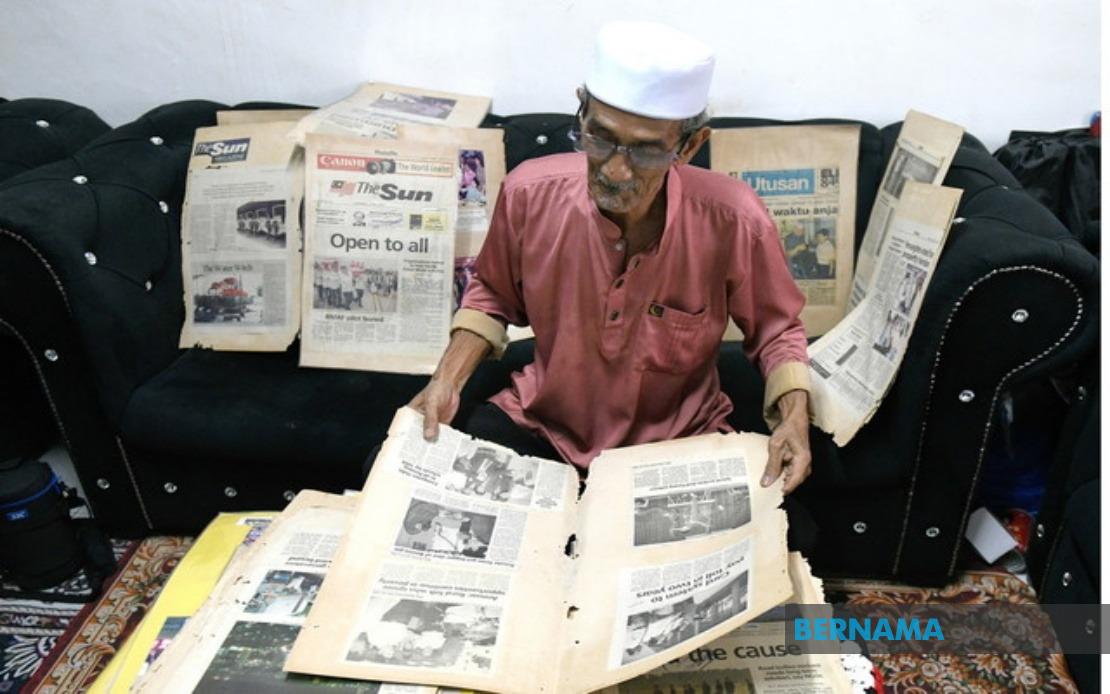
Veteran photographer and cameraman Azmi Sapiei carries with him the physical and emotional scars of a career spanning more than thirty years in Malaysian media. Among his most difficult memories is an incident around 2001 when a suspect kicked and spat at him while covering a court proceeding for The Sun newspaper. Such confrontations, he reflects, are simply part of the demanding reality of being on the front lines of news gathering—moments that test not only professional commitment but also personal resilience.
Azmi's journey through the evolution of Malaysian journalism began in the mid-1980s, long before he formally entered the news industry. After working in a factory, he relocated to Kuala Lumpur to pursue his passion for photography, initially collaborating with various independent agencies and women's magazines. This foundational experience equipped him with technical skills and an understanding of visual storytelling before he joined Bernama in 1993 as a photographer. His nearly three-year tenure at Malaysia's national news agency proved transformative, exposing him to the discipline and standards that would define his entire career.
During his time at Bernama, Azmi was granted exclusive access to one of the nation's most historically significant stories: the return of Shamsiah Fakeh, a former Malayan Communist Party member, from China in July 1994. Having worked independently to arrive early at her nephew's residence in Gombak before security restricted access, Azmi and a colleague captured photographs that would dominate newspaper front pages the following day. This breakthrough moment, however, came with an initial sting of rejection. When Azmi submitted three rolls of film, his editor immediately questioned the volume, dismissing the rolls as insufficient. Yet when the negatives were processed, the photographs proved invaluable, demonstrating how editorial judgment in a newsroom could sometimes miss what the camera had already captured.
The transition from film-based photography to digital technology fundamentally altered the profession Azmi had mastered. During the analogue era, every shot carried weight and consequence. Photographers could not immediately review their work; instead, they had to develop intuition about composition, timing, and news value before returning to the office. Azmi had to compose detailed captions for each photograph, ensuring editors possessed sufficient context for publication. This labour-intensive process demanded both technical precision and editorial awareness, forcing photographers to think critically about which moments mattered and why.
After leaving Bernama at the end of 1996, Azmi returned to his native Penang, where he continued his career at The Sun before transitioning to television work with Bernama TV and ultimately to RTM Penang as a part-time cameraman beginning in 2003. The shift from still photography to video journalism introduced new physical demands. Television cameramen operated significantly heavier equipment than their photojournalist counterparts, and Azmi recalls the era of Betacam cameras—devices nicknamed "junk iron" by colleagues—which weighed approximately twelve kilogrammes. Carrying such equipment on the shoulder for extended periods while maneuvering through crowds, crime scenes, and unpredictable environments required muscular endurance that extended well beyond the mental acuity demanded by the work itself.
Throughout his career, Azmi witnessed the maturation of Malaysian media standards and practices. He frequently credits Bernama with functioning as a professional "school" that instilled discipline and precision in visual journalism. The agency became known for developing photographers who understood that capturing images involved far more than technical proficiency; it demanded an awareness of news value, contextual importance, and the responsibility inherent in documenting events that shape public understanding. These principles proved essential when navigating difficult situations—from confrontations with uncooperative sources to the challenge of maintaining journalistic integrity under pressure.
Recognition for Azmi's contributions came in 2006 when he received the Penang State Media Award in the visual electronic media category, validating decades of work often undertaken without widespread acknowledgment. However, his most significant legacy extends beyond professional accolades. Azmi retired in mid-2020, and his second son, Muhammad Syafiq, now works as a cameraman with Media Prima Television Network, continuing the family's commitment to visual journalism. Muhammad Syafiq credits his father with teaching him not merely technical skills such as camera operation and compositional technique, but also the discipline and ethical foundations upon which credible journalism rests.
The relationship between Azmi and his son reflects broader transitions within Malaysian media. Where Azmi navigated the constraints of film, limited equipment, and geographic barriers, Muhammad Syafiq operates within an environment of digital abundance and immediate feedback. Yet the core challenge remains unchanged: discerning which moments deserve documentation and understanding why particular visual angles communicate truth more effectively than others. Azmi's mentorship has equipped his son with contextual awareness that technical training alone cannot provide—the accumulated judgment that comes from three decades of witnessing Malaysia's transformation through a camera lens.
Azmi's experience also illuminates the physical and personal costs of journalism that often remain invisible to audiences. The assaults, the heavy equipment, the rejection of significant work—these moments shaped not merely his individual career but also his understanding of what constitutes responsible news gathering. The profession demands simultaneous technical excellence and mental fortitude, requiring practitioners to remain focused on capturing truth even when facing hostility or exhaustion. For Malaysian journalism, figures like Azmi represent an institutional memory of how the profession evolved, adapted, and maintained standards through periods of technological and social upheaval.
Reflecting on his retirement and his son's continued work in the field, Azmi expresses satisfaction that his legacy persists within Malaysian media institutions. The transition from Bernama to RTM, from film to digital, and ultimately to the next generation represents both continuity and evolution. His career spanned an era when patience and discipline were prerequisites for success, when every photograph had to matter because film stock carried literal and financial cost. These principles, Azmi hopes, remain embedded in how his son approaches visual journalism—not as a technical exercise but as a meaningful contribution to public understanding. His three decades behind the camera, marked by both bruises and triumphs, testify to journalism's importance and the personal sacrifices required to maintain its integrity in Malaysia.