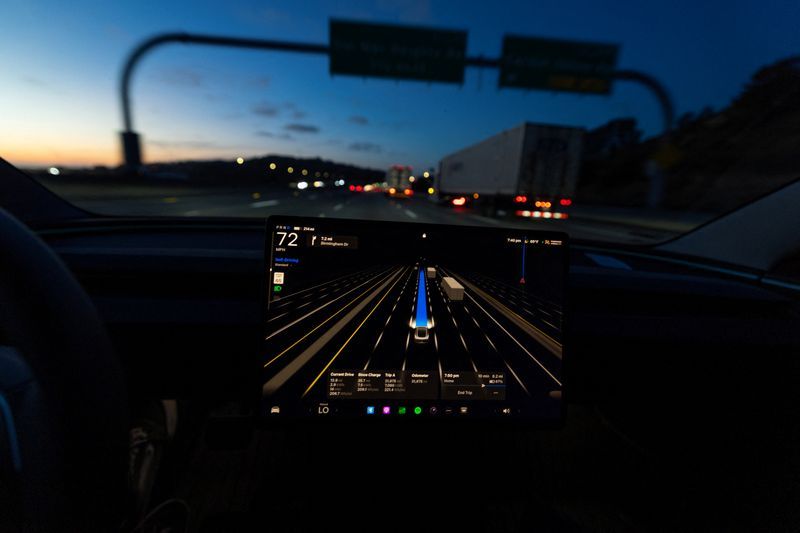
The credibility of Tesla's self-driving safety narrative faces fresh scrutiny from American lawmakers concerned that the electric vehicle manufacturer has misled consumers and regulators about its autonomous capabilities. Senators Edward Markey of Massachusetts and Richard Blumenthal of Connecticut have formally requested that the US National Highway Traffic Safety Administration examine Tesla's publicly shared crash statistics for its Full Self-Driving driver-assistance system, following a Reuters investigation that exposed substantial discrepancies in how the company presents its safety record.
The senators' letter, transmitted on Monday to the federal traffic safety regulator, directly references the Reuters report and characterises the analytical foundation underlying Tesla's Full Self-Driving safety metrics as "weak and misleading," describing the situation as creating an immediate risk to public safety. This intervention by prominent Democratic legislators signals growing official concern about the integrity of Tesla's marketing claims and the adequacy of current regulatory oversight in the rapidly evolving autonomous vehicle sector.
In their formal request, the senators have asked the NHTSA to respond by July 7 with answers to several critical questions about the agency's role in evaluating Tesla's assertions. Their queries focus on whether the regulator has independently assessed Tesla's Full Self-Driving safety claims or requested access to the underlying crash data that supports these statements. The letter further urges the NHTSA to enhance mandatory reporting standards for any company deploying self-driving technology or advanced driver-assistance systems comparable to Tesla's offering, arguing that current regulations provide no meaningful assurance that public safety statements bear any relationship to genuine real-world performance.
Tesla and the NHTSA have declined to provide responses to media inquiries about the senators' concerns. The silence from both parties underscores the sensitive nature of the dispute, particularly given Tesla's significant influence in the automotive market and the stakes involved in determining appropriate regulatory frameworks for autonomous vehicle technology.
The Reuters investigation conducted last month revealed that Tesla executives, including Chief Executive Elon Musk, have increasingly referenced statistics that they claim demonstrate Full Self-Driving technology operates up to ten times more safely than human drivers. However, independent researchers consulted by Reuters identified fundamental methodological problems with how Tesla constructs these comparisons. The company selectively compares crash rates involving airbag deployments in Tesla vehicles operating under Full Self-Driving to a broader national crash statistic that encompasses all severity levels, from minor fender-benders to catastrophic collisions. This approach systematically inflates Tesla's safety advantage by narrowing the denominator to only more serious incidents.
Additionally, Tesla's comparative analysis uses the overall American vehicle fleet as its baseline, a population that skews significantly older than the typical Tesla automobile. Since traditional automotive manufacturers have progressively incorporated new safety technologies over recent years that reduce accident frequency and severity, comparing a modern electric vehicle to this older fleet baseline inherently makes Tesla's cars appear substantially safer than a more methodologically sound comparison would demonstrate. This age differential in the comparison pools represents a fundamental flaw that renders Tesla's statistical claims unreliable as evidence of genuine safety superiority.
The controversy extends beyond American borders, as Reuters reported earlier this week that Tesla has presented these inflated safety statistics to European regulators while pursuing governmental approval to deploy Full Self-Driving capabilities across the European Union. This international dimension raises concerns among safety advocates that regulators in multiple jurisdictions may be making decisions about public technology deployment based on misleading information provided by the manufacturer.
For Malaysian and Southeast Asian observers, this regulatory challenge highlights the critical importance of establishing robust oversight frameworks before autonomous vehicle technology becomes widespread in the region. As countries across Asia consider their positions on self-driving and advanced driver-assistance systems, the Tesla controversy serves as a cautionary case study demonstrating how manufacturers may exploit information asymmetries and regulatory gaps to advance their commercial interests at potential risk to public safety.
The senators' intervention suggests that American regulatory institutions are beginning to respond to concerns that self-published safety data from manufacturers cannot serve as the sole basis for public trust in autonomous technologies. The outcome of the NHTSA's response to these congressional questions will likely influence how other regulators globally assess similar safety claims from Tesla and competing autonomous vehicle developers. The broader implication is that regulators worldwide must invest in independent testing and verification capabilities rather than relying on manufacturer-provided statistics when evaluating the safety performance of autonomous and semi-autonomous driving systems.
This dispute also reflects deeper tensions within the automotive industry about the appropriate speed of autonomous vehicle deployment. While Tesla has pursued an aggressive rollout strategy, prioritising rapid advancement of Full Self-Driving capabilities, federal lawmakers and safety advocates argue that more cautious approaches backed by transparent, independently verified data are necessary to protect public welfare. The coming months will reveal whether the NHTSA takes meaningful action to strengthen its oversight of autonomous vehicle safety claims or whether Tesla's influence permits it to continue operating under existing regulatory constraints.