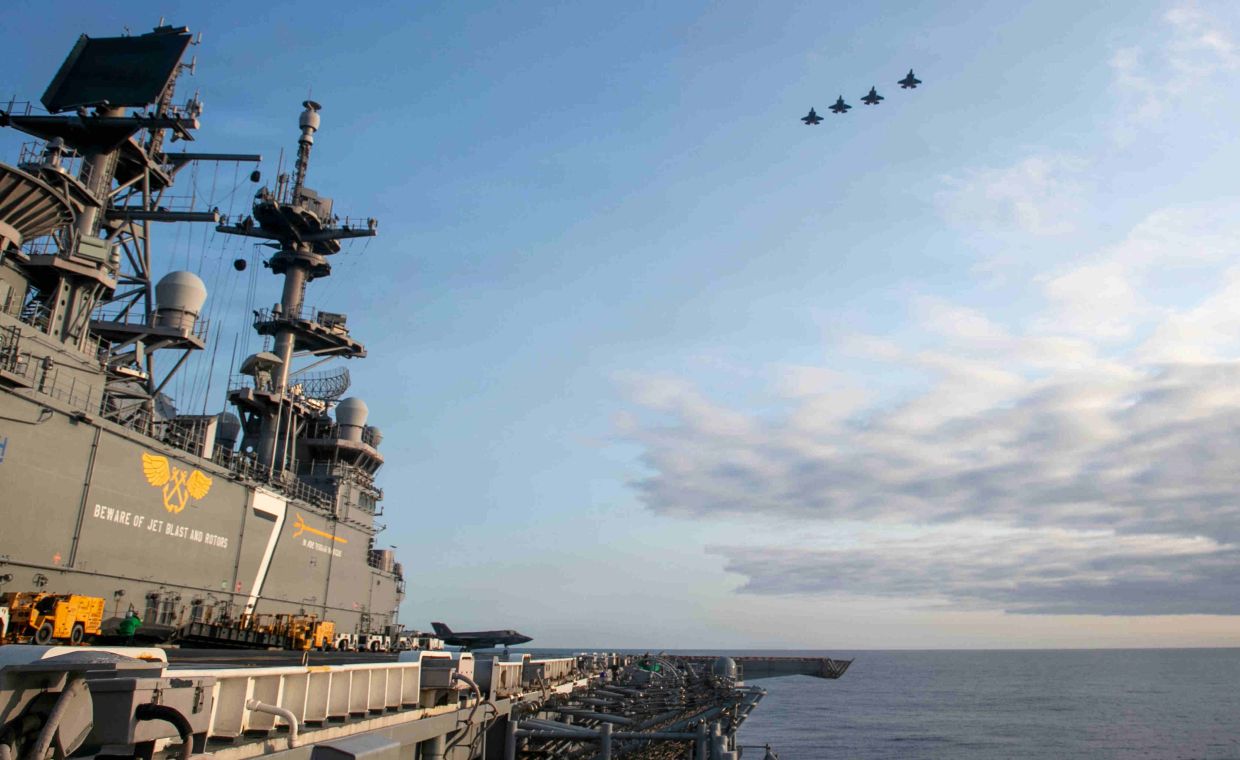
The United States has begun repositioning significant naval forces toward the Indo-Pacific, reversing months of military concentration in the Middle East as tensions with Iran show signs of abating. The USS Boxer amphibious assault ship, originally earmarked for deployment to the Persian Gulf region, has instead joined the Seventh Fleet operating in the South China Sea as of early June, accompanied by the amphibious transport dock USS Portland. This strategic reallocation carries important implications for Southeast Asia and the broader region, where concerns had grown about American commitment to regional security.
For much of this year, Washington pivoted substantial military resources from the Pacific theatre toward Iran, redirecting naval assets and logistical capacity to support operations and establish deterrence in the Middle East. This shift occurred even as China continued expanding its military capabilities and asserting greater control over strategic sea lanes vital to regional commerce. The departure of the USS Tripoli amphibious strike group from Pacific operations prompted quiet but genuine alarm among US allies across Asia, who had grown accustomed to consistent American naval presence as a counterweight to Beijing's growing assertiveness.
Collin Koh, a senior fellow specialising in maritime security at Singapore's Nanyang Technological University, emphasises that naval presence serves multiple purposes beyond combat capability. "The linchpin of US military force projection and presence has always been, mainly, the US Navy. So that has often been a source of assurance and a deterrence signal," he explained. When Washington diverted these assets westward over the preceding two months, the message sent to regional partners proved unsettling, raising questions about whether the United States would maintain its long-standing security commitments in the Indo-Pacific amid competing global demands.
The USS Boxer represents a formidable addition to Seventh Fleet capabilities. The amphibious assault ship carries a sophisticated array of military equipment, including F-35B stealth fighters capable of operating from her flight deck and MV-22B Osprey tiltrotor helicopters offering rapid mobility across contested waters. Additionally embarked is the 11th Marine Expeditionary Unit, a self-contained force comprising over 2,000 marines and sailors trained for rapid response across the region's vast geography. The Seventh Fleet, headquartered in Yokosuka, Japan, considers such deployments essential to maintaining "persistent, combat-credible" operations that support both deterrence and crisis response across waters stretching from Japan to the Indian Ocean.
A critical turning point emerged when Washington and Pakistan jointly announced a diplomatic breakthrough with Tehran, reopening the strategic Strait of Hormuz and ending the American naval blockade that had defined recent months. This development signals a potential de-escalation in Middle Eastern tensions, removing the immediate security imperative that had consumed military planners' attention. Analysts interpret the Boxer's deployment as an intentional signal that American naval force levels in the Pacific are normalising and that regional allies can expect restored commitment to the region's security architecture.
Koh characterises the redeployment as reassurance theatre, though one grounded in genuine military repositioning. "The deployment of the Boxer to the Pacific is to signal that the US naval force levels in the theatre have returned to some form of normalcy," he noted, adding that it represents "one way of trying to reassure allies and partners in the region." For nations like Japan, Australia, South Korea, and the Philippines, such signals matter considerably, as they influence strategic calculations regarding regional military balances and long-term security planning.
American concerns about resource constraints in maintaining simultaneous operations across multiple regions had reached congressional attention. During an April Senate hearing, Admiral Samuel Paparo, when questioned about the sustainability of munitions expenditure in Iran operations without impacting Indo-Pacific readiness, acknowledged that "there are finite limits to the magazine" and that available supplies were being employed "judiciously." Although he declined to specify timelines, the exchange reflected serious concerns among US defence establishment figures that excessive focus on the Middle East could degrade military readiness precisely where China presents the most substantial long-term challenge.
Chinese military analysts view these repositioning moves through a strategic lens focused on American priorities and signalling. Ni Lexiong, a Shanghai-based defence analyst, observes that both major American political parties have converged on viewing China as the nation's most significant long-term strategic competitor. "Other than military functions, pulling military assets is also a diplomatic stance that signals where its priority is," Ni stated, suggesting that force redeployment conveys clarity about Washington's assessment of which global region deserves maximum attention and resources.
Administrative changes accompanying the military reorientation reinforce this strategic pivot. The US Department of Defence has renamed the Indo-Pacific Command back to the US Pacific Command, a symbolic shift the Pentagon characterised as reflecting renewed focus on the Pacific theatre specifically. While the geographic area under the command's responsibility remains unchanged—spanning from American west coast waters to India's western border—the nomenclature alteration signals organisational and intellectual prioritisation. Defence officials declined to elaborate whether the name change would trigger specific policy or deployment modifications, though the timing and context suggest alignment with the broader naval repositioning underway.
For Malaysia and other Southeast Asian nations, these developments carry tangible implications for regional stability. Greater American naval presence in the South China Sea traditionally correlates with reduced Chinese adventurism, though deployment levels that satisfy Washington's interests may not satisfy all regional partners. The return of capable amphibious forces demonstrates sustained American ability to conduct expeditionary operations, conduct humanitarian assistance missions, or respond rapidly to crises across the region's maritime zones. Nations dependent on maintaining open sea lanes for trade and energy security, particularly those concerned about Chinese assertions in disputed waters, view such deployments as structural components of regional equilibrium.
The broader pattern suggests American policymakers have concluded that the Iran situation, while significant, does not justify sustained diversion of Pacific-focused military assets. This reassessment reflects confidence among defence planners that Middle Eastern tensions have moderated sufficiently to permit reallocation of scarce military resources toward what Washington increasingly frames as the critical theatre for great power competition. The redeployment thus marks not merely tactical repositioning but strategic reaffirmation that the Indo-Pacific remains central to American defence planning and alliance architecture in coming decades.

