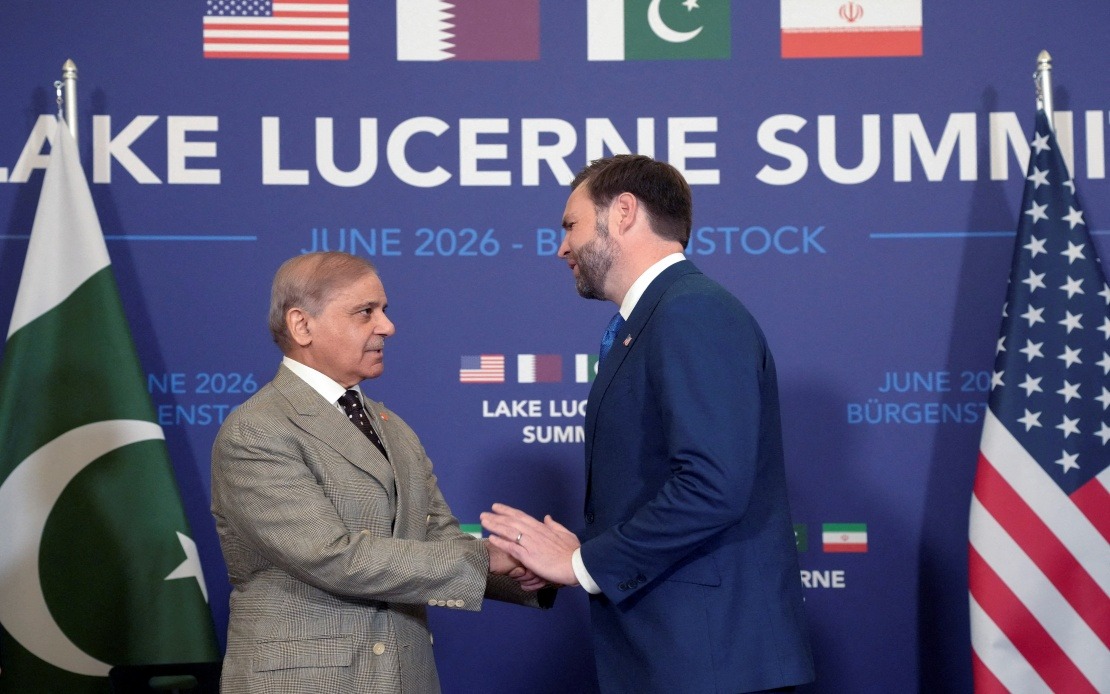
A significant diplomatic engagement between American and Pakistani leadership took place at the Burgenstock resort in Switzerland on Sunday, as both nations moved to coordinate responses to a newly brokered military accord between Washington and Tehran. The gathering brought together Vice President JD Vance alongside special envoys Steve Witkoff and Jared Kushner on the American side, while Pakistan dispatched Prime Minister Shehbaz Sharif and Army Chief Field Marshal Asim Munir to the negotiating table. The timing of this bilateral meeting, unfolding on the margins of broader multilateral technical discussions, underscores the interconnected nature of contemporary Middle Eastern diplomacy and the weight both countries place on collaborative crisis management.
The backdrop to these talks involves a memorandum between Iran and the United States that was executed remotely in the hours leading into June 18, establishing the framework for terminating military hostilities that had escalated since February 28. This document represents a watershed moment in regional stability, moving beyond rhetoric to concrete commitments with defined timelines and measurable outcomes. The agreement obligates Washington to lift its naval blockade—a crucial economic lever that has constrained Iranian maritime commerce—while Tehran commits to restoring full shipping operations through the Strait of Hormuz, one of the world's most strategically vital waterways through which roughly one-third of global maritime petroleum trade transits.
What makes this accord particularly consequential for Southeast Asian observers relates to maritime security and energy markets. Any disruption to Hormuz transit directly affects oil prices and shipping routes that regional economies depend upon for prosperity. Malaysia and other ASEAN nations import substantial energy volumes and maintain significant trading relationships with both Gulf states and Iran. The stabilisation of this chokepoint therefore carries immediate implications for regional inflation, investment confidence, and supply chain resilience across Southeast Asia. The accord's provisions for reopening Iranian shipping lanes suggest an easing of the economic strangulation that had generated unpredictable spikes in global energy costs.
The nuclear dimension adds another layer of complexity to these negotiations and explains why Pakistan's participation merits particular attention. Tehran has committed to abandoning pursuit of nuclear weapons, though the actual verification and implementation mechanisms remain subject to a separate comprehensive agreement that the parties will negotiate within a sixty-day window. Pakistan, itself a nuclear-armed nation with intimate understanding of proliferation dynamics and regional security calculations, brings invaluable expertise to discussions about monitoring and confidence-building measures. As a country that has navigated its own nuclear journey while managing relationships with both Western powers and Iran, Pakistan occupies a unique diplomatic position within the Muslim world.
For Pakistan specifically, this engagement reflects its broader strategic pivot toward regional stabilisation and economic recovery. Prime Minister Shehbaz Sharif has prioritised attracting foreign investment and normalising relationships with neighbours as essential components of his nation's fiscal rehabilitation. A more stable Middle East reduces sectarian pressures within Pakistan itself, where Sunni-Shia tensions have occasionally flared into violence, and it opens pathways for Pakistani workers remitting earnings from Gulf employment—a crucial foreign exchange source. The Army Chief's presence signals that security establishments in Islamabad view these developments through a strategic lens extending well beyond commercial interest.
The technical-level negotiations occurring simultaneously at Burgenstock involve not only Iran and the United States but also Pakistan and Qatar functioning as mediators. This multilateral structure reflects how the initial bilateral accord required intermediaries to bridge decades of mistrust and competing interests. Qatar, hosting American military installations and maintaining delicate diplomatic balance with both Washington and Tehran, brings its own perspective on Gulf stability. Pakistan's role as mediator rather than principal party underscores its evolution from frontline state in Cold War proxy conflicts toward architect of regional consensus. The closed-door nature of these discussions suggests confidentiality remains essential for negotiators to explore creative compromises without domestic political backlash.
The lifting of anti-Iran sanctions represents Tehran's primary objective from this process, reversing the economic isolation that American and international measures have imposed over multiple administrations. The scope of these sanctions extends across banking, oil sales, and access to international trade systems, creating cascading effects throughout Iran's domestic economy. Restoration of normal commercial relationships could theoretically allow Iranian oil to compete more actively in global markets, potentially exerting downward pressure on international crude prices—another consideration for energy-dependent Asian economies.
The sixty-day timeline for negotiating the separate nuclear agreement reflects pragmatic diplomacy acknowledging that such complex technical and political issues require intensive engagement but benefit from artificial deadlines creating pressure toward resolution. This period will likely involve detailed discussions about inspection protocols, enrichment limits, stockpile declarations, and verification mechanisms. International Atomic Energy Agency involvement in such monitoring would establish transparent oversight mechanisms that provide confidence to all parties. For Malaysia and Southeast Asia, the existence of credible verification reduces uncertainty about whether Iran might secretly pursue military applications while publicly accepting constraints.
The broader geopolitical implications of improved US-Iran relations extend throughout Asia's strategic calculations. For years, Sino-American competition has partly played out through competing alignments in the Middle East, with China cultivating relationships with Iran as part of its Belt and Road infrastructure initiative. Any warming between Washington and Tehran complicates Beijing's regional positioning and may recalibrate how regional powers calculate their own diplomatic orientations. Southeast Asian nations, increasingly caught between great power competition, benefit from reduced Middle Eastern tensions that might otherwise force closer alignment with either the American or Chinese orbit.
Pakistan's diplomatic role in facilitating these discussions also reflects its historical position as bridge between Western and Islamic worlds. Despite past tensions with Washington over Afghanistan, counterterrorism, and nuclear proliferation, Islamabad maintains institutional relationships with American security establishments and shares deep religious and cultural connections with Middle Eastern societies. This positioning makes Pakistani mediation more credible to both American and Iranian negotiators than either side might accept from explicitly partisan intermediaries. The dispatch of senior civilian and military leadership to Burgenstock signals that Islamabad considers successful implementation of this accord vital to its own regional interests and international standing.
Looking forward, the success or failure of these negotiations will significantly shape Asian geopolitics over the coming years. If the comprehensive nuclear agreement achieves ratification and implementation, Iran's gradual reintegration into international commerce could reshape energy markets, investment flows, and regional alignments throughout the continent. Conversely, breakdown in talks could trigger renewed military escalation with unpredictable consequences for shipping, oil prices, and regional stability. Malaysia, as ASEAN's economic hub and a major trading nation with interests spanning from the Middle East to East Asia, has substantial stakes in ensuring these negotiations produce durable, implementable outcomes that reduce rather than amplify systemic instability.

