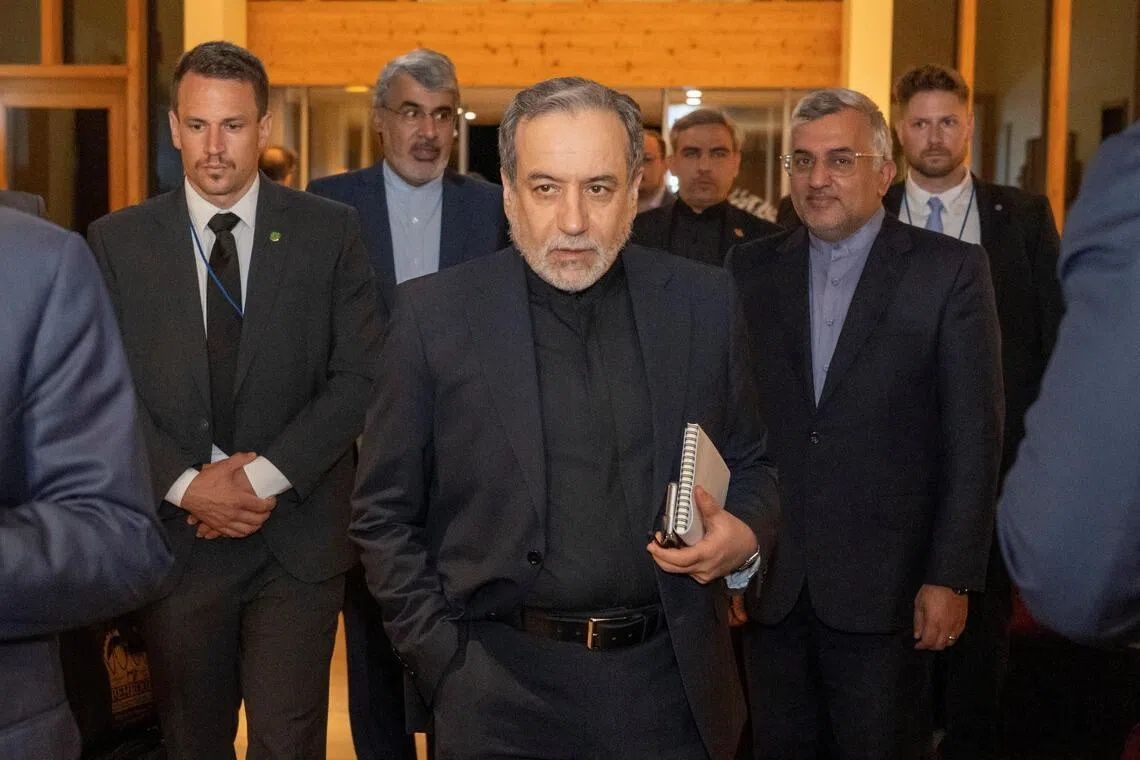
High-level negotiations between the United States and Iran began on Sunday morning at an exclusive Swiss mountain resort, marking the first direct talks between the two nations since they agreed to a ceasefire aimed at resolving their protracted military conflict. Vice President JD Vance led the American delegation to the Buergenstock resort, where Iranian chief negotiator Mohammad Baqer Qalibaf and senior officials from both countries gathered to work towards a comprehensive peace agreement. The talks represent a significant diplomatic moment for the Middle East region, particularly given the involvement of Pakistan as a key mediator and the participation of multiple international stakeholders seeking stability in one of the world's most volatile geopolitical zones.
The negotiations are grounded in an interim agreement brokered by Pakistan and signed on Wednesday by Presidents Donald Trump and Masoud Pezeshkian, which aims to conclude an almost four-month-long military campaign that has destabilised the region. The two nations have committed to a 60-day ceasefire period to allow negotiations to proceed on several critical fronts, though the path forward remains fraught with disagreements and competing interpretations of what has already been agreed. The talks will address Iran's nuclear programme, the implementation of the Lebanon ceasefire, and broader regional security concerns that have animated US-Iran tensions for decades.
A major point of contention has already emerged regarding control of the Strait of Hormuz, through which roughly a fifth of the world's oil supply flowed before military operations intensified on 28 February. Iran's Islamic Revolutionary Guard Corps announced on Saturday that the vital waterway had been closed in retaliation for Israeli strikes in Lebanon, though the US military disputes this claim, noting that 55 merchant vessels carrying over 17 million barrels of oil successfully transited the strait on that same day. The disagreement highlights how quickly negotiations can become derailed by competing claims about implementation and compliance, with each side framing events to support its own narrative about commitment to the ceasefire agreement.
President Trump has stated unequivocally that no toll will be imposed on passage through the Strait of Hormuz during the initial 60-day ceasefire period, or thereafter unless the United States determines that peace talks have failed. However, Trump has also raised the possibility of levying charges on traffic through the waterway if a permanent deal is not reached, framing this as compensation for American military presence and services provided as what he describes as the Middle East's "Guardian Angel". This rhetoric underscores the transactional approach the Trump administration is taking to regional security guarantees, a significant departure from previous diplomatic frameworks and one that may complicate efforts to build trust during negotiations.
The Lebanon ceasefire, nominally in effect as of Saturday, remains fragile and contested. Israeli forces and the Iran-backed militant group Hezbollah exchanged fire on Saturday despite the supposed truce, with Lebanese civil defence officials reporting 20 deaths from Israeli strikes in the hours following the ceasefire's supposed commencement. Israel maintains it is not formally bound by the Iran-US agreement and has made clear it will not withdraw from Lebanese territory it currently occupies, instead reserving the right to respond to any threats it perceives from Hezbollah. This Israeli position creates significant complications for the broader peace talks, as it suggests that one of the key conditions for negotiations—a functional Lebanon ceasefire—remains contested rather than settled.
Mohammad Mokhber, an adviser to Iran's Supreme Leader Ayatollah Mojtaba Khamenei, has accused the United States of failing to implement the first of 14 agreed points, particularly the requirement for a complete ceasefire on all fronts including Lebanon. Iranian officials have signalled that unless concrete steps are taken to enforce the agreement, Iran will not resume normal economic activity or allow the restoration of energy flows from the region. This represents a substantial negotiating position that gives Iran leverage by linking broader economic normalisation to American compliance with specific ceasefire provisions.
Conversely, Iranian Oil Minister Mohsen Paknejad has dangled significant economic incentives for Western nations and companies that respect the peace agreement's spirit, suggesting that hundreds of investment and contracting opportunities await should diplomatic efforts succeed. This carrot-and-stick approach reflects Iran's interest in using the talks not merely to end conflict but to position itself for economic rehabilitation and reconstruction. For regional energy markets and global oil prices, the stakes are considerable, as any extended disruption to Iranian oil exports or Strait of Hormuz traffic could reverberate through international energy systems.
The American negotiating team brings substantial political weight, including Envoys Steve Witkoff and Jared Kushner, the latter serving as Trump's son-in-law and a key figure in previous Middle East diplomatic initiatives. Pakistan's involvement, represented by Prime Minister Shehbaz Sharif and Field Marshal Syed Asim Munir, underscores Islamabad's strategic interest in resolving a conflict that has implications for regional stability and Pakistan's own security concerns. The resort, owned by Qatar and situated atop a Swiss mountain accessible only by a narrow road and multiple security checkpoints, provides an appropriately neutral venue for negotiations between parties with deep mutual suspicion.
For Malaysian and Southeast Asian readers, these developments carry several implications. Malaysia's economy depends significantly on stable global energy supplies and the free flow of oil through international waterways, making Strait of Hormuz disruptions a direct concern. Any extended closure or restricted passage through the strait could drive up regional energy prices and increase costs for Malaysian industries and consumers. Additionally, the stability of negotiations between the US and Iran affects broader American strategic posture in Asia, where US military commitments to allies like Japan, South Korea, and Australia have implications for regional security dynamics that touch Malaysian interests.
The talks also represent a test of whether the Trump administration's more transactional and deal-focused approach to diplomacy can succeed where previous efforts at reconciliation have faltered. Vice President Vance has expressed confidence that the ceasefire will hold and suggested that progress could be achieved in a couple of days of intensive negotiations, though such optimism may be premature given the complexity of issues at stake and the demonstrated willingness of various parties to dispute even basic facts about ceasefire compliance. The coming weeks will reveal whether the 60-day ceasefire period can be used productively to bridge profound disagreements or whether it becomes merely an interlude before renewed conflict.
Israeli public opinion presents another complicating factor, with a Hebrew University poll indicating that 92 percent of Israelis believe Iran has benefited more from recent military operations than Israel has, and 90 percent believe that the stated goals of the war have not been achieved. Prime Minister Benjamin Netanyahu faces domestic pressure regarding the war's outcome, which could make Israeli compliance with broader peace arrangements more difficult if Israeli voters and opposition figures perceive that their country has made unjustified concessions. The fragility of the Lebanon ceasefire and Israel's stated intention to maintain an indefinite military presence in Lebanese territory suggest that this component of the broader agreement may prove the most difficult to sustain over time.
The stakes for successful negotiation are exceptionally high. Failure could trigger renewed escalation, further destabilisation of Lebanon and the broader Middle East, disruption of global energy supplies, and damage to the credibility of international diplomatic efforts. Success, conversely, could establish a template for conflict resolution that involves not just bilateral agreements but also multilateral mediation, economic incentives for compliance, and security arrangements that address the concerns of multiple stakeholders including both regional powers and global actors with interest in Middle East stability. The coming weeks will prove critical in determining which outcome emerges from these high-stakes talks at the Swiss mountaintop resort.

