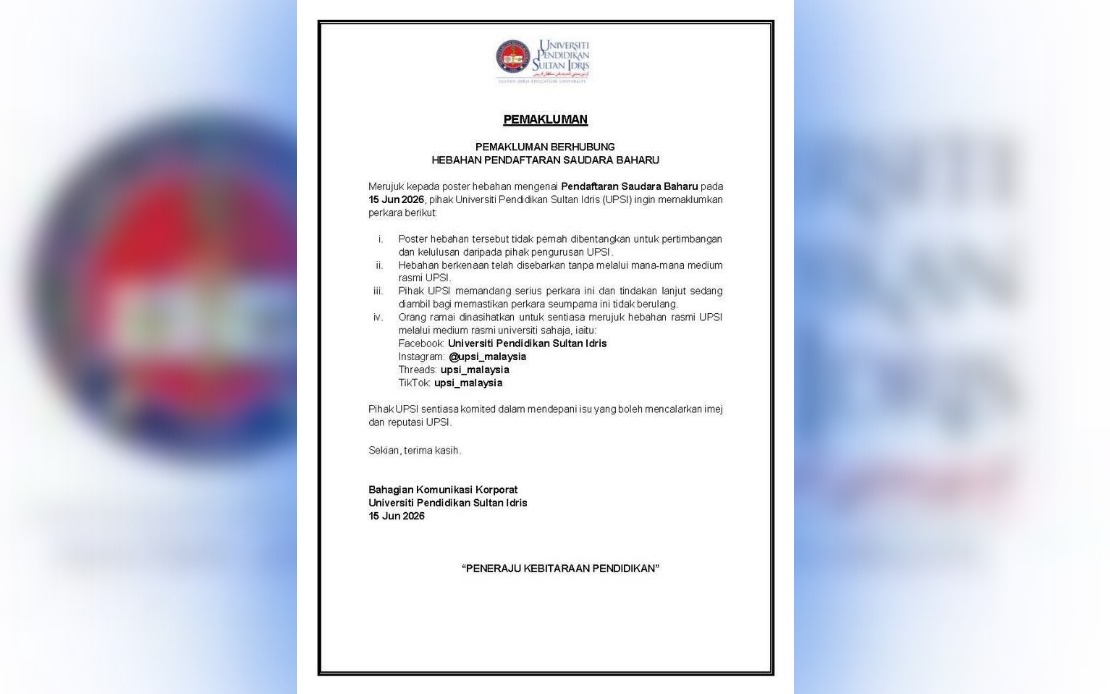
Universiti Pendidikan Sultan Idris (UPSI) has moved to clarify its position regarding a poster about registering 'saudara baharu' (Muslim converts, literally "new brothers and sisters") that gained significant traction across social media platforms in mid-June. The institution firmly denied any involvement in the creation or distribution of the material, emphasizing that the document had bypassed all formal institutional procedures and approval mechanisms.
The poster in question, dated June 15, emerged online without undergoing the standard administrative review that UPSI typically applies to official communications. In a statement issued through its official social media accounts, the university stressed that no proposal related to this matter had been formally presented to institutional leadership or subjected to the customary vetting process. This distinction between unauthorized circulation and official university communication is significant in Malaysia's higher education landscape, where institutional credibility depends heavily on the careful management and verification of information released under a university's name.
The rapid spread of the poster across digital platforms highlights the contemporary challenge universities face in controlling their institutional narrative. Social media's viral nature means that unvetted content bearing an organization's name or insignia can quickly reach thousands of people before the institution becomes aware of the circulation. UPSI's public response demonstrates a proactive approach to damage control, a necessary tactic in an environment where misinformation or misleading communications can erode public trust and institutional reputation within hours.
UPSI emphasized its commitment to maintaining the integrity of its communications and warned the public to rely exclusively on announcements distributed through verified official channels. This guidance reflects broader concerns across Malaysian institutions about the proliferation of counterfeit or misattributed materials on social platforms. Universities increasingly find themselves compelled to educate their stakeholders about distinguishing authentic institutional messages from content that merely appears to come from official sources, a task that requires sustained effort and clear communication protocols.
The institution indicated that it views the unauthorized circulation seriously and pledged to implement measures preventing similar incidents in the future. While UPSI did not specify the exact nature of these corrective actions, university administrators typically respond to such breaches by reviewing their digital security protocols, enhancing staff training on information governance, and potentially implementing stricter access controls over materials bearing institutional branding. These procedural adjustments aim to close gaps that allow unauthorized use of university imagery or names.
Beyond the immediate institutional concern, this incident reflects broader tensions within Malaysian society regarding religious conversion and the role of educational institutions in facilitating or promoting religious activities. UPSI's swift denial suggests awareness of how such associations, even when entirely unauthorized, could trigger public debate about the appropriate boundaries between educational institutions and religious advocacy. Universities in Malaysia maintain secular academic missions while operating within a Muslim-majority nation, a balance that requires careful navigation of sensitive religious and cultural issues.
The poster's viral circulation also underscores the vulnerability of institutional identity in the digital age. Materials can be fabricated or misappropriated with increasing sophistication, making institutional verification systems essential rather than optional. UPSI's public statement serves partly as an educational message to stakeholders about identifying legitimate communications, a responsibility that extends beyond the university to media literacy within the broader public.
From a Malaysian media perspective, this incident exemplifies how institutional crises in the social media era demand rapid, transparent responses. UPSI's acknowledgment of the issue and clear disavowal of involvement represents a best-practice response to unauthorized content circulation. The university's emphasis on directing the public toward official channels also reinforces the importance of maintaining trusted institutional communication pathways even as informal digital channels proliferate.
The broader implications for Malaysia's higher education sector include the need for enhanced cybersecurity measures protecting institutional identity and stricter information governance frameworks. As universities compete for reputation and influence in a crowded digital landscape, protecting their official communications becomes as strategically important as protecting their physical infrastructure or financial assets. Institutions that fail to respond decisively to unauthorized use of their identity risk allowing false narratives to become embedded in public perception.
For Malaysian readers and stakeholders in higher education, UPSI's response illustrates an important principle: institutional communications should always be verified through official channels before being accepted as authentic. The incident also highlights how quickly misinformation can spread and how damaging unauthorized associations can be, particularly when sensitive topics like religious conversion are involved. As digital literacy remains an ongoing challenge across Southeast Asia, instances like this reinforce the need for both institutional vigilance and public skepticism toward unverified sources.