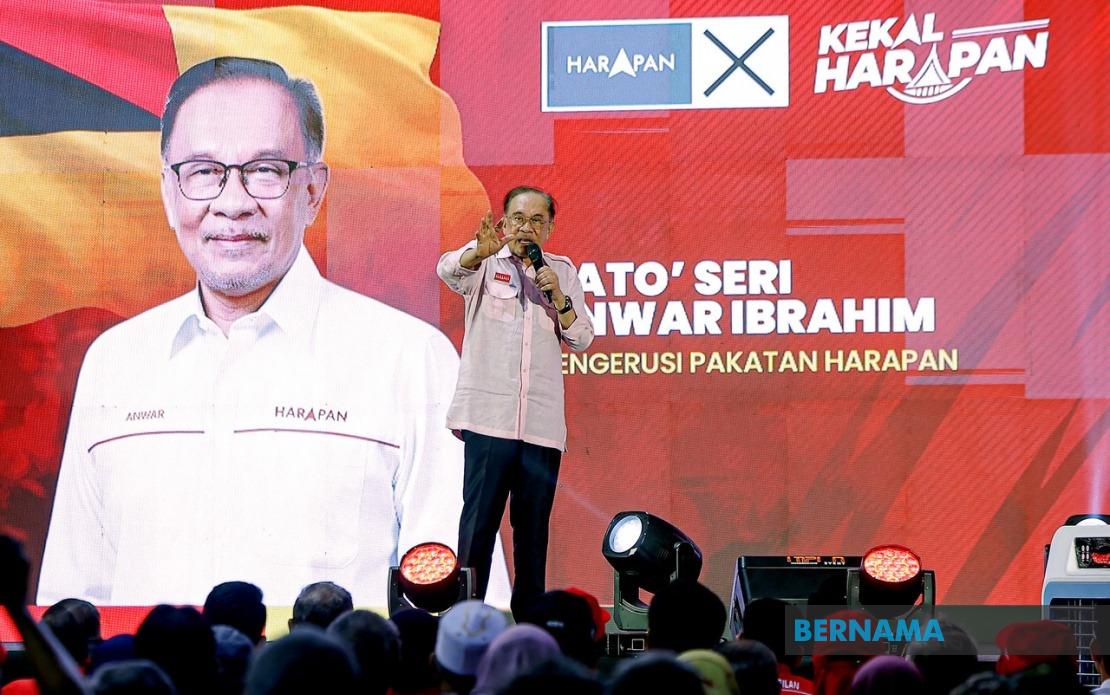
Prime Minister Datuk Seri Anwar Ibrahim has moved to reassure the nation that the Unity Government maintains both stability and strength at the federal tier, insisting that the coalition's cohesion will not be compromised despite electoral contests playing out across Malaysian states. Speaking in Seremban on July 22, Anwar emphasized that the administration's foundational integrity remains sound, a critical reassurance given mounting speculation about potential fractures within the multi-party arrangement that has governed Malaysia since late 2022.
The Prime Minister's statement carries particular weight as it directly addresses concerns that rivalry between coalition members competing for state-level dominance might spill over into federal governance, potentially destabilizing key decision-making processes. Such apprehension is not unfounded in Malaysian politics, where state elections have historically served as early warning signs of broader political realignments. Anwar's careful framing—acknowledging that "there might be issues" at the state level while insisting federal stability remains "not threatened"—suggests the government recognizes the inherent tensions within its structure whilst attempting to compartmentalize them.
Central to the Prime Minister's defense of the coalition's health is his emphasis on the cabinet's operational effectiveness. He highlighted the consistency and fluidity with which high-level ministerial meetings have proceeded, pointing to recent sessions chaired by himself alongside key figures including Minister of Agriculture and Food Security Datuk Seri Mohamad Sabu, Transport Minister Anthony Loke, and Deputy Prime Minister Datuk Seri Dr Ahmad Zahid Hamidi. This invocation of specific ministerial names and their collaborative participation appears designed to signal that no significant ruptures have emerged among the government's heavyweights, and that the formal apparatus of state continues functioning as intended.
The coalition's diversity—spanning parties with sometimes competing ideologies and constituencies—has been both a source of stability and persistent vulnerability. Anwar's comment that the parties cooperate "despite competing against each other at the state level" frankly acknowledges this inherent duality. In Malaysian electoral politics, it is not unusual for parties to contest fiercely in state races whilst maintaining federal arrangements, yet the strain of such parallel competition can accumulate, particularly when electoral losses mount or when state-level outcomes suggest shifting voter sentiment. The Prime Minister's willingness to address this dynamic directly suggests awareness that the arrangement remains fragile, even if currently holding.
Economic considerations underpin Anwar's messaging, reflecting a deliberate strategy to frame the Unity Government's cohesion as essential infrastructure for national prosperity. By tying federal stability directly to investor confidence and economic growth, the Prime Minister positions any collapse of the coalition not as a mere political matter but as a potential economic catastrophe. International and domestic investors, particularly those considering long-term commitments to Malaysian ventures, would naturally be concerned by political turbulence. Anwar's reassurances, therefore, are directed as much at financial markets and foreign capitals as at domestic audiences.
The invocation of the religious phrase "Insha'Allah" (God willing) when expressing hope that stability will be maintained post-elections carries symbolic weight for predominantly Muslim Malaysia, subtly enlisting divine will in support of political continuity. It also suggests a degree of humility about the forces at play—an acknowledgment that outcomes remain uncertain and contingent on factors beyond the government's complete control. Post-election dynamics will largely determine whether the coalition remains intact; results that heavily favor certain coalition members over others could alter internal power calculations and potentially trigger defections or withdrawals.
The upcoming elections referenced by Anwar appear to be state-level contests, though the Prime Minister did not specify which states were scheduled for polls. State elections in Malaysia serve as critical barometers of federal political health, and poor performances by coalition members in their respective strongholds could create pressure for internal recalibration. Historically, party leaders have been quick to distance themselves from unpopular federal policies when facing state electorates, occasionally creating discord that reverberates upward to the national level. The fact that Anwar preemptively signaled his commitment to maintaining federal stability suggests awareness of these dynamics.
The Unity Government's track record over its roughly two-year tenure has seen it navigate significant challenges, including economic headwinds, social policy disagreements, and occasional public tensions between coalition partners. That the Prime Minister felt compelled to issue this reassurance, even as the government continued normal operations, suggests he perceived either rising skepticism about its durability or specific developments—whether state-level setbacks, internal disagreements, or external commentary—that warranted public reinforcement of commitment to the coalition.
For Malaysian observers and the broader Southeast Asian region, the stability of the federal government carries implications beyond domestic politics. Malaysia's economic role as a regional hub and its strategic geopolitical position depend partly on consistent, predictable governance. Prolonged political instability or frequent changes in the ruling coalition could complicate long-term policy implementation, infrastructure development, and bilateral relationships. The Prime Minister's emphasis on continuity and cohesion, therefore, resonates with stakeholders beyond the traditional political sphere.
Looking ahead, the test of Anwar's assertions will come in how the coalition navigates the post-election period. If state-level results produce significant losses for any coalition member, internal pressures will intensify. Conversely, if elections deliver results perceived as validating the federal arrangement, the government's stability could be reinforced. The Prime Minister's current messaging appears designed to establish a narrative of functional cooperation and shared commitment to governance, a narrative he will need to maintain through whatever electoral turbulence may come. Whether this optimism proves warranted will depend not only on political will within the coalition but also on external economic and social factors that shape voter sentiment across Malaysia's diverse states.

