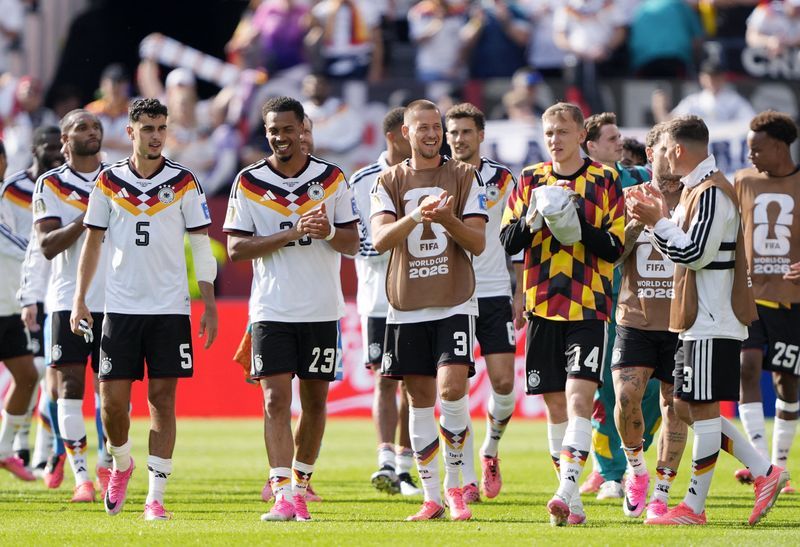
Deniz Undav proved to be Germany's saviour on Saturday, emerging from the bench to score a dramatic two-goal turnaround that carried the Germans past Ivory Coast 2-1 in a pulsating World Cup Group E showdown in Toronto. The versatile striker's clinical finishing secured Germany's passage to the knockout rounds, marking their first advancement past the group stage since clinching the tournament title in 2014. The result leaves Julian Nagelsmann's squad atop Group E with six points and already assured of progression with one match remaining, while the West Africans remain on three points from their opening two fixtures.
The match unfolded as a study in contrasts between the two sides' approaches and fortune. Ivory Coast struck first through Franck Kessie's opportunistic finish in the first half, capitalizing on a rebound after Amad Diallo's shot following a driving run down the flank by Yan Diomande. The West Africans' early breakthrough appeared to vindicate their attacking intentions and extended their remarkable tournament streak to seven consecutive matches with a goal—the longest such sequence in Ivory Coast's World Cup history. Yet Germany's response would prove decisive, demonstrating the resilience and technical proficiency that characterizes Nagelsmann's tactical philosophy.
The Germans arrived at the BMO Stadium buoyed by substantial local support, with more than 100,000 people of German heritage residing in Toronto providing a partisan atmosphere. Despite their numerical advantage in backing, Germany found themselves frustrated at the interval, having created eight attempts on goal without securing a breakthrough. Their struggles were compounded by two disallowed goals in the opening 45 minutes—first when midfielder Aleksandar Pavlovic's short-corner header was ruled a foul against goalkeeper Yahia Fofana, leaving the Borussia Dortmund player visibly bewildered, and later when Jamal Musiala's finish was chalked off for a challenge deemed to have impeded Odilon Kossounou's positioning. The refereeing decisions drew audible disapproval from the German contingent in the crowd but galvanized rather than deflated the European champions' resolve.
Undav's introduction from the bench proved transformative once the second half commenced. The 26-year-old struck with precision in the 68th minute, executing a controlled volley to equalize the contest after latching onto a precisely weighted delivery. Five minutes later, the striker demonstrated composure beyond his years, collecting the ball on the turn before swivelling and dispatching a low drive past a helpless Fofana. The clinical double encapsulated Undav's remarkable recent form—he has now accumulated nine goals across his last eight international outings, a ratio that underscores his growing importance to Germany's tactical setup.
Ivory Coast mounted a late challenge to salvage their group stage hopes, with Simon Adingra fashioning a chance in the closing stages but failing to convert when the opportunity presented itself. Germany's defensive resolve, combined with their transition prowess, ultimately proved sufficient to repel the West African assault, with substitute Nathaniel Brown nearly adding a third after orchestrating a counter-attack that Fofana managed to smother. The encounter typified Group E's competitive nature and unpredictability, emphasizing the tournament's capacity to deliver absorbing contests that pivot on technical execution and mental fortitude.
The result carries significant implications for Group E's final configuration. Germany will conclude their group engagement against Ecuador on Thursday in New Jersey, a fixture that appears largely academic given their assured progression. Ivory Coast faces a must-win scenario against Curacao in Philadelphia on the same evening, with their World Cup aspirations hanging in the balance. Ecuador and Curacao were scheduled to meet later on Saturday in Kansas City, meaning the group's final standings remain subject to the remaining matches' outcomes. Yet Germany's advancement has already been confirmed, underscoring their status as legitimate contenders in a tournament that has produced numerous surprises across multiple groups.
For Southeast Asian observers, Germany's progression represents the continued dominance of established footballing powers in major tournaments, a pattern that has defined recent World Cup competitions. The Germans' ability to overcome adversity and capitalize on substitute performances demonstrates the squad depth and tactical flexibility that separates elite teams from aspirational ones. Meanwhile, Ivory Coast's struggle to build on their early advantage illustrates how momentum can shift rapidly in high-stakes encounters, a cautionary tale for developing football nations seeking to challenge established hierarchies on the world stage.
Undav's emergence as a clutch performer adds another dimension to Germany's attacking options heading into the knockout phase. Rather than relying solely on established figures like Musiala and Serge Gnabry, Nagelsmann has demonstrated strategic flexibility in deploying fresh personnel when circumstances demand. This tactical adaptability, combined with the underlying technical quality evident in Germany's possession-based approach and intricate passing sequences, suggests the Europeans possess the requisite attributes for a sustained tournament run. For Ivory Coast, the challenge now becomes rectifying the inconsistency that has plagued their campaign thus far, requiring either a comprehensive victory against Curacao or a favorable outcome from Ecuador's clash with Germany to harbor any remaining knockout stage aspirations.

