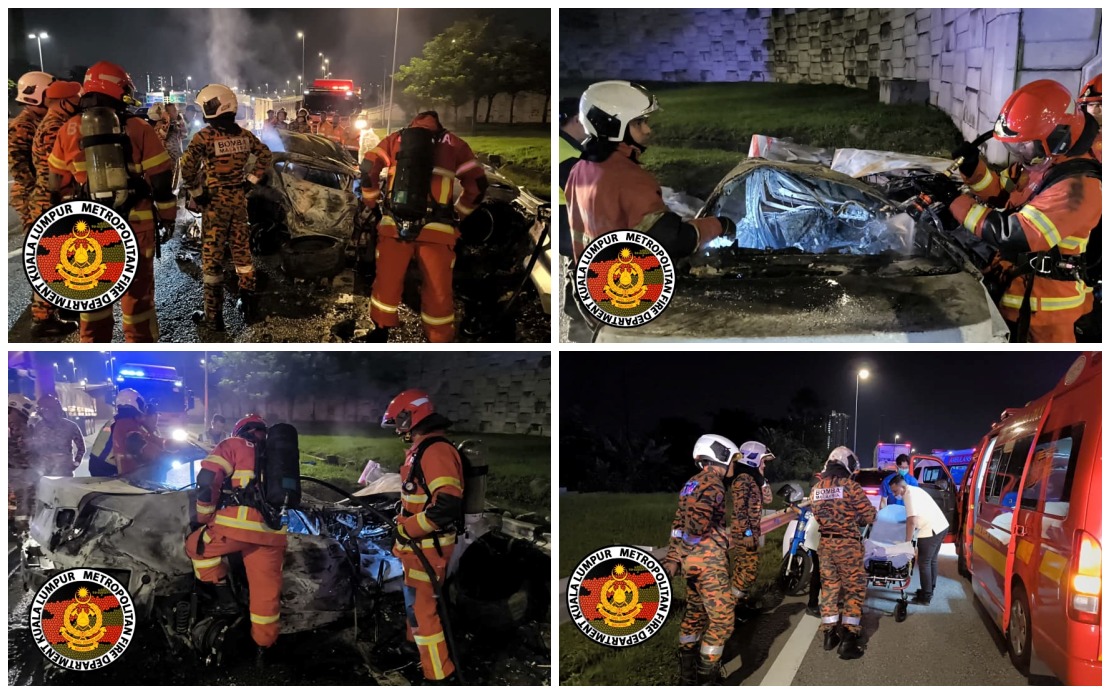
A tragic vehicle collision claimed two lives on the Duta-Ulu Kelang Expressway (DUKE) near Kuala Lumpur in the early hours of Thursday, leaving authorities investigating what led to the devastating incident. The crash, which occurred at the Jalan Kuching exit ramp, resulted in a fierce fire that claimed the lives of the vehicle's occupants whilst a third passenger managed to escape with only minor injuries.
According to ACP Mohd Zamzuri Mohd Isa, the chief of the Kuala Lumpur Traffic Investigation and Enforcement Department, preliminary evidence points to excessive speed as a contributing factor. The BMW 328i Sport, travelling from Jalan Duta in the direction of Selayang, appears to have been driven beyond safe limits for the conditions when the operator lost command of the vehicle. The loss of control resulted in the car skidding across the roadway before striking the left-side barrier with considerable force, a collision violent enough to ignite the vehicle's fuel system.
The two fatalities were identified as Malaysian nationals pursuing tertiary education abroad and domestically. The driver, aged 22, was enrolled as a student at Queensland University of Technology in Australia, whilst the front passenger, 21 years old, was attending Sunway University. Both young men were discovered trapped within the burning vehicle when emergency responders arrived, making rescue impossible. The intensity of the fire left their remains severely charred, necessitating advanced forensic methods for definitive identification.
The survivor, a 20-year-old male student from Singapore, managed to exit the vehicle before the flames became uncontrollable. He sustained only minor injuries consistent with the collision itself rather than thermal exposure, a fortunate outcome that contrasted sharply with the tragic fate of his companions. Emergency medical personnel transported him to Kuala Lumpur Hospital where he received treatment for his injuries.
Authorities have initiated a comprehensive investigative process to establish the precise circumstances surrounding the crash. Identification of the deceased will be conducted using DNA analysis, a standard procedure when conventional methods prove insufficient due to the condition of remains. Investigators are also examining closed-circuit television recordings from cameras positioned along the expressway corridor, potentially capturing moments leading up to and during the collision. The surviving passenger has provided crucial eyewitness testimony regarding the events immediately preceding the crash.
The investigation operates under the framework of Section 41(1) of the Road Transport Act 1987, which addresses serious motor vehicle incidents resulting in fatalities. This legal provision allows traffic authorities to examine various contributing elements including vehicle condition, driver behaviour, road surface characteristics, and environmental factors such as weather conditions and visibility at the time of the incident. The formal classification signals the severity with which authorities regard the collision and reflects their commitment to determining accountability if negligence is established.
This tragedy underscores the persistent dangers associated with excessive velocity on major expressway networks serving the Klang Valley region. The DUKE expressway, a critical infrastructure linking Kuala Lumpur's northern and eastern suburbs, experiences substantial traffic volumes particularly during peak periods. However, incidents occurring during off-peak hours often involve higher speeds as drivers take advantage of reduced congestion, a paradoxical safety risk that has been documented across multiple jurisdictions.
For Malaysian families with students studying internationally or enrolled in domestic universities, the incident represents a sobering reminder of road safety vulnerabilities. The victims' profiles—pursuing higher education in Australia and locally—reflect the common pattern of young Malaysians accessing quality tertiary programmes across the region and globally. Their deaths highlight how tragedy can strike during routine journeys that students undertake regularly, often during informal gatherings and social activities.
Police have issued a public appeal for additional evidence that may assist their investigation. Motorists who were traversing the DUKE expressway during the early morning hours when the collision occurred are encouraged to provide dashcam footage if available, as such recordings frequently capture crucial details invisible to stationary cameras. Information should be directed to the Traffic Police Station at Jalan Tun H.S. Lee or any nearby police facility, with investigators emphasizing that even seemingly minor details may prove significant.
The incident also raises broader questions about vehicle safety features in high-speed collision scenarios, particularly regarding fuel tank integrity and passenger protection systems. Modern automotive engineering incorporates multiple safeguards designed to prevent or mitigate fire risks following crashes, yet catastrophic fires still occur under certain circumstances. Engineers and safety specialists continue examining such incidents to identify opportunities for enhanced protective measures in future vehicle designs.
Beyond the immediate investigation, this tragedy will likely prompt renewed discussions among road safety advocates, transportation authorities, and university leadership regarding passenger safety education and awareness programmes targeting young drivers. Many universities now incorporate defensive driving courses and road safety messaging into student orientation programmes, recognising that young adults represent a demographic group experiencing disproportionately higher rates of serious road incidents throughout Southeast Asia.

