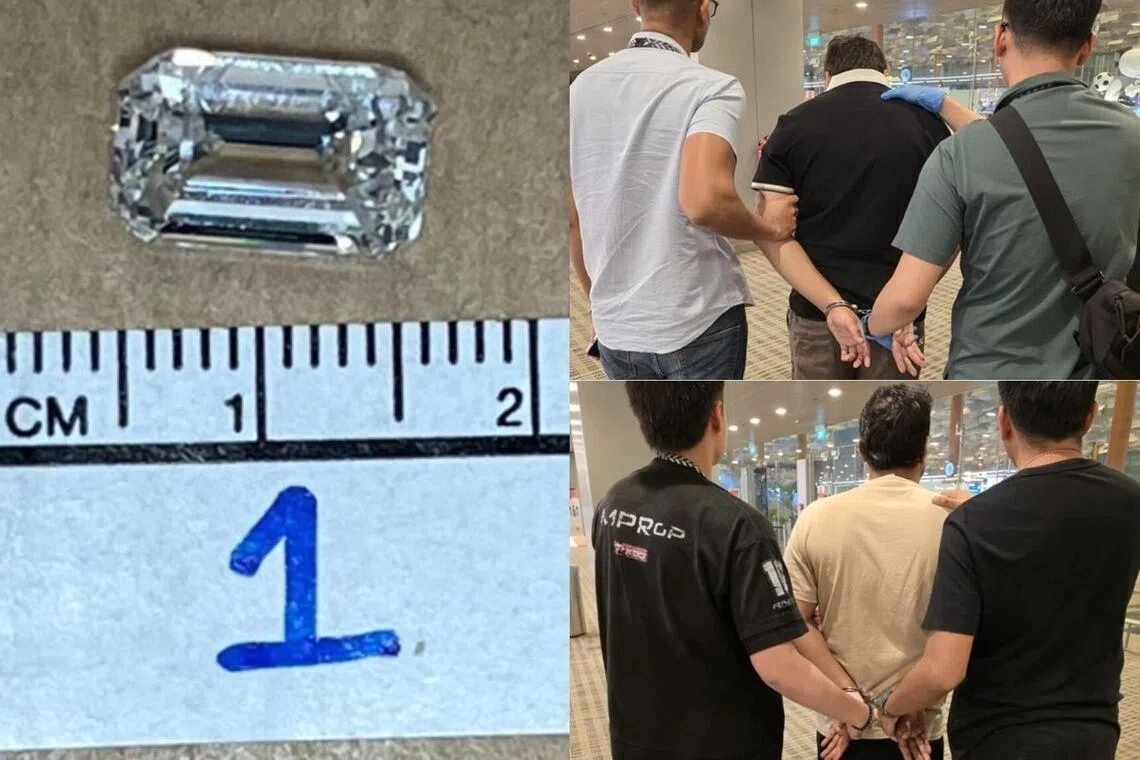
Singapore authorities have arrested two men in connection with the theft of a high-value diamond from a jewellery establishment in Chinatown, marking another incident of organised retail crime targeting the city-state's luxury goods sector. The suspects, aged 30 and 42, were apprehended at Changi Airport Terminal 3 on Friday, June 19, following swift police action after a report was lodged earlier that afternoon. The stolen gem, valued at more than S$235,000, was recovered during the arrest and secured as evidence for the ongoing investigation.
Police received the initial distress call at 3.40 pm on June 19 from Kreta Ayer Road in Chinatown's business district, where the jewellery store alerted authorities to the disappearance of the high-carat diamond. The rapid deployment and subsequent apprehension of the suspects within hours demonstrates the effectiveness of Singapore's law enforcement response to luxury retail theft, a crime category that has attracted increasing attention from regional crime syndicates in recent years.
The modus operandi employed in this case reveals a sophisticated understanding of retail vulnerabilities and customer-seller dynamics. According to preliminary investigations, the two men gained entry to the store by expressing genuine interest in purchasing the diamond, a tactic that lowered the guard of shop staff and allowed them unrestricted access to examine the valuable item. This seemingly innocent inquiry proved to be the opening gambit in a calculated theft operation.
While handling the diamond under the pretence of evaluating its quality and authenticity, the perpetrators executed a switch-and-replace manoeuvre, substituting the genuine stone with a counterfeit replica. This technique, sometimes referred to as the "stone swap" or "sleight-of-hand" theft, requires considerable manual dexterity and nerves, as it must be executed smoothly without arousing immediate suspicion. The thieves then departed the premises without completing any transaction, a behaviour that proved instrumental in unravelling the scheme.
The shop assistant's vigilance and decision to conduct a verification check shortly after the men left became the decisive factor in detecting the fraud. Upon discovering that the diamond on display was not authentic, staff immediately notified police, triggering an investigation that would culminate in the arrests at the airport. This swift detection prevented the stolen diamond from being moved out of Singapore or transferred into illicit channels, a critical outcome that underscores the importance of trained retail personnel in combating organised theft.
Central Police Division officers, supported by the Police Operations Command Centre, employed a multi-layered investigative approach encompassing ground enquiries, analysis of closed-circuit television footage from the store and surrounding areas, and police camera surveillance data. This methodical investigation permitted law enforcement to identify and locate the suspects before they could flee the jurisdiction, a feat that highlights Singapore's extensive security infrastructure and coordination capabilities across its transport hubs.
The arrest at Changi Airport Terminal 3 suggests the suspects may have been attempting to board an outbound flight, possibly to facilitate the sale of the stolen diamond in a foreign market or to evade capture. Singapore's major airports serve as critical chokepoints where police maintain elevated vigilance for suspected criminals, particularly those involved in high-value theft or trafficking. The timing of the airport apprehension prevented a potential transnational dimension to the crime that could have complicated recovery efforts and investigation scope.
The two men are scheduled to face charges under Singapore's penal code for theft in dwelling with common intention, a charge that reflects the coordinated nature of the operation. Under Singapore law, conviction on this charge carries a maximum prison sentence of seven years and monetary fines, penalties that reflect the serious nature of organised retail theft targeting precious commodities. The charge specifically recognises that two or more individuals acted in concert to commit the crime, establishing the essential legal element of common intention.
Police have issued a formal statement emphasising their "zero tolerance" stance toward such criminal activities and reiterating their commitment to apprehending and prosecuting offenders according to applicable law. This messaging serves both as a deterrent to potential criminals and as reassurance to the public that law enforcement takes luxury retail crime seriously. The statement's tone reflects Singapore's broader approach to crime prevention, which combines swift apprehension with proportionate legal consequences.
Beyond the immediate case, Singapore police have extended an alert to jewellery merchants and other retailers of high-value items throughout the island, advising them to heighten awareness regarding the specific modus operandi demonstrated in this incident. The switch-and-replace technique, while not novel, remains effective when perpetrators possess expertise and confidence in execution. Retailers have been counselled to implement preventive measures including closer scrutiny of customer behaviour, restricted handling protocols for valuable items, and rapid verification procedures following customer interactions with premium goods.
For the broader Southeast Asian retail sector and Malaysia in particular, this incident serves as a reminder of vulnerabilities within luxury goods distribution and sales infrastructure. International organised crime networks targeting high-value diamonds and precious stones operate across regional borders, and retail establishments in major commercial centres—whether in Singapore, Kuala Lumpur, or other urban hubs—face comparable risks. The case demonstrates how swift police response, trained retail staff, and integrated surveillance systems constitute essential components of effective loss prevention.
The recovery of the stolen diamond represents a positive outcome for both the retailer and Singapore's law enforcement reputation, yet the incident underscores persistent challenges within the luxury retail sector globally. As organised retail crime becomes increasingly sophisticated, retailers must balance customer service accessibility with robust security protocols. The case will likely inform future training programmes for jewellery store personnel across the region, emphasising the importance of transaction verification and alert reporting procedures.

