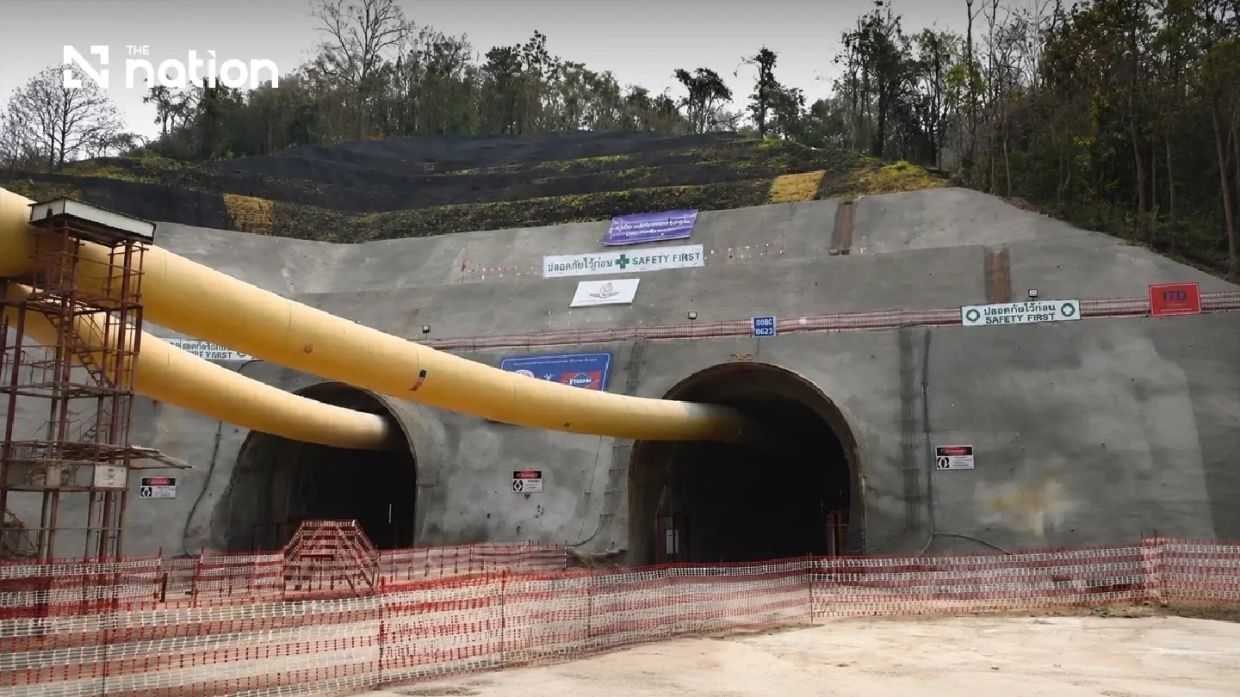
A construction accident at a major railway tunnel in northern Thailand has left two workers dead and seven others injured, raising fresh concerns about site safety standards across regional infrastructure projects. The incident occurred inside the Doi Luang railway tunnel in Chiang Rai's Chiang Saen district on Saturday evening, June 20, during ongoing construction for the State Railway of Thailand's Den Chai-Chiang Rai-Chiang Khong railway line. Authorities received initial reports of the collapse at 8.35pm, triggering emergency response protocols and hospitalisation of all affected personnel.
Deputy Transport Minister Siripong Angkasakulkiat provided preliminary findings suggesting that falling rocks from the tunnel wall triggered the collapse while workers were applying waterproofing systems to the interior surfaces. Earlier assessments had pointed to failures within the shotcrete construction phase, though officials cautioned that investigations remained ongoing to establish the precise sequence of events. The conflicting initial reports underscore the complexity of determining root causes in underground construction environments, where multiple systems and hazards operate simultaneously.
The casualty toll comprised two fatalities, three workers with serious injuries requiring intensive hospital care, and four sustaining minor injuries. All victims were evacuated to medical facilities for treatment, with authorities securing the accident zone to prevent further incidents. Siripong stated that the situation had been stabilised and the affected area cordoned off, with the project's safety division assuming direct control of operations and implementing close monitoring of conditions until comprehensive investigations concluded.
The Doi Luang tunnel itself represents a significant engineering undertaking, stretching 3.4 kilometres through the mountainous terrain of northern Chiang Rai. The tunnel had already been bored through to completion, meaning workers were engaged in finishing and systems installation when the accident occurred—phases often presenting distinct hazard profiles to the initial excavation phase. This particular structure forms part of Contract 3 of the broader Chiang Rai-Chiang Khong railway segment, a substantial portion of the larger regional connectivity initiative.
Contract 3, valued at THB19.385 billion, encompasses approximately 87 kilometres of both at-grade and elevated railway tracks, three railway stations, three halts, the Doi Luang tunnel, plus comprehensive signalling and telecommunications infrastructure. Such scope and complexity demand rigorous coordination among multiple contractors and specialised work teams, each operating according to prescribed safety protocols. The scale indicates the significance of this railway corridor for Thailand's transportation networks and regional trade linkages within Southeast Asia.
Responsibility for executing Contract 3 falls to the CKST-DC3 Joint Venture, a consortium combining three major Thai and Sino-Thai construction firms: CH. Karnchang Public Company Limited, Sino-Thai Engineering & Construction Public Company Limited, and Chiangmai Construction Co., Ltd. Joint venture arrangements, while spreading risk and bringing diverse expertise to complex projects, can sometimes complicate accountability structures when safety incidents occur, requiring careful delineation of responsibilities among partners. The consortium's reputation and future project eligibility may depend significantly on how thoroughly and transparently it conducts its internal investigations.
The State Railway of Thailand's Special Projects and Construction Department mobilised immediately following notification, dispatching inspection teams to the accident site to assess structural integrity and operational continuity. Such rapid response protocols, while demonstrating institutional preparedness, also reflect the critical nature of maintaining infrastructure project schedules—a tension that occasionally creates pressure to resume work before comprehensive safety assessments conclude. The ministry's commitment to reporting further updates when available signals an intent toward transparency, though such communications require careful calibration to avoid either minimising legitimate safety concerns or unduly alarming stakeholders.
This accident arrives amid broader conversations about construction safety standards across Southeast Asian infrastructure megaprojects. The Den Chai-Chiang Rai-Chiang Khong railway represents part of China's Belt and Road Initiative connectivity drive through the region, making safety performance visible to international observers and partner governments. Incidents in tunnel construction, particularly involving waterproofing and finishing phases, demand heightened vigilance given the inherent risks of working in confined underground spaces where ventilation, communication, and evacuation present distinct challenges compared to surface construction.
The investigation underway will likely examine multiple factors including equipment maintenance, worker training and supervision, adherence to engineering specifications, and environmental conditions within the tunnel. Material quality control for waterproofing systems and structural supports, worker fatigue and shift patterns, and the adequacy of emergency protocols will feature prominently in technical and regulatory reviews. Such investigations often reveal systemic rather than isolated failures, potentially influencing safety practices across the broader construction industry if findings are widely disseminated and acted upon.
For Malaysian readers and construction sector professionals, this incident serves as a cautionary reminder of the risks inherent in complex underground infrastructure works. Southeast Asian countries pursuing ambitious rail expansion programmes—including Malaysia's own Rail Line 3 and other mass transit initiatives—can extract valuable lessons regarding scaffolding systems, ground stability assessment, and worker protection in tunnel environments. Knowledge transfer between nations regarding incident investigations and remedial measures strengthens regional capacity to prevent similar tragedies.
The railway corridor itself, once operational, promises to enhance connectivity between Thailand's northern provinces and eventually extend into Laos, facilitating trade flows and passenger movement across borders. Such projects justify rigorous safety investments, as operational success depends fundamentally on construction integrity. The human cost of this accident—two lives lost and seven families affected—underscores that infrastructure development must never compromise worker welfare for schedule adherence or cost control.

