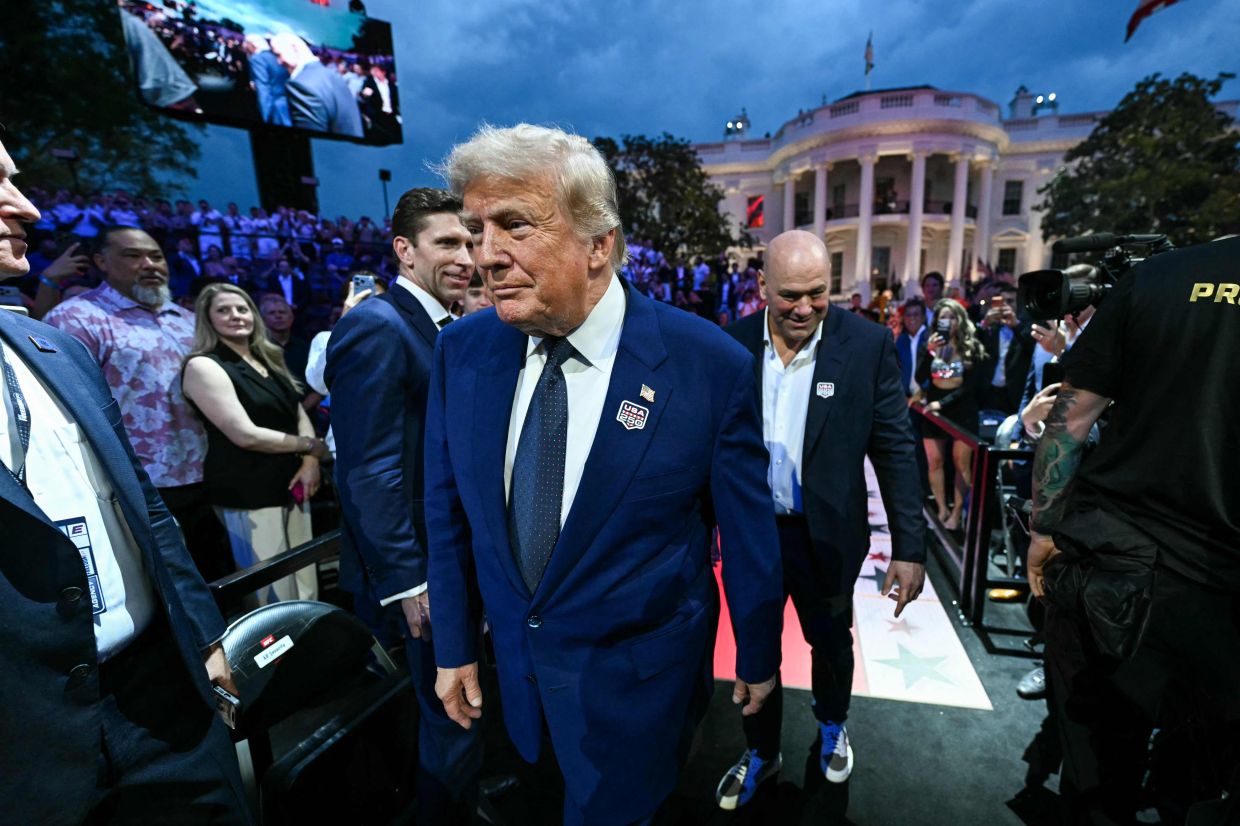
Donald Trump turned 80 this past weekend in characteristic style, inviting the Ultimate Fighting Championship to stage a spectacle on the South Lawn of the White House before embarking on what is expected to be a contentious diplomatic trip to France. The Sunday evening event, kicking off just before 8:30pm, represented a departure from the ceremonial gatherings that have traditionally graced the presidential residence, replacing genteel affairs with the visceral intensity of professional mixed martial arts.
The nearly 100-foot-tall "Claw" arena, designed to accommodate seven cage matches, dominated the landscape of the South Lawn, towering above the historic mansion itself. The structure held 4,300 spectators within its confines, while as many as 120,000 additional viewers occupied the nearby Ellipse, where free tickets had been distributed through a lottery system. This scale of construction and attendance underscores the magnitude of the undertaking—a temporary sports installation dwarfing the more modest ice rinks and gardens that have previously occupied the presidential grounds.
The guest list reflected Trump's political and business networks. Meta Platforms Chief Executive Mark Zuckerberg, Paramount Skydance Chief Executive David Ellison, Treasury Secretary Scott Bessent, and members of Trump's extended family were seated among the crowd. Military personnel were similarly well-represented, with servicemembers occupying sections of the arena while watch parties were simultaneously organised at bases globally, including Okinawa. Joe Rogan, the podcast host whose audience skews toward young male voters who significantly backed Trump during the 2024 election, provided commentary throughout the matches. Medal of Honor recipients and first responders ceremonially escorted fighters into the arena, lending gravitas to an otherwise unconventional venue for such competition.
The event was framed as part of a broader celebration of the nation's 250th anniversary, with the Trump administration promoting commemorative gold coins bearing the president's likeness, a large fair on the National Mall, and an IndyCar race through Washington DC streets scheduled for August. This bundling of Trump's personal milestone with national commemoration has drawn scrutiny, with the Public Integrity Project filing a lawsuit characterising the White House fight as "a volcano of corruption." Despite such legal challenges, the event proceeded largely as planned, though inclement weather initially delayed proceedings with lightning strikes and thunder reported across the capital.
The Ultimate Fighting Championship invested more than US$60 million to stage the event, with the company covering all costs according to White House statements. Yet the financial model remains ambiguous—while UFC President Dana White, a longtime Trump ally, suggested the event would operate at a loss for the organisation, unnamed company executives have indicated alternative perspectives on profitability. The Trump family venture World Liberty Financial contributed an additional US$250,000 in bonuses for the top two fighters competing, blurring lines between personal and commercial interests.
Sponsorship details reveal corporate participation from cryptocurrency platform Crypto.com and truck manufacturer Dodge's Ram brand, alongside the World Liberty Financial arrangement. These partnerships illustrate how the event became a vehicle for commercial exposure within the context of presidential hospitality. Over seven federal agencies reportedly allocated significant resources and manpower to the event's execution, according to court filings, suggesting substantial government expenditure beyond the UFC's own investment.
Public opinion has proven divided on the spectacle. A YouGov poll released June 5 found 51 percent of Americans surveyed disapproved of the White House fight, with only 27 percent expressing approval—a finding that underscores the polarising nature of transforming the presidential residence into a venue for mixed martial arts competition. The controversy extends beyond mere aesthetics; critics have questioned whether using the presidency's home as a commercial entertainment venue represents an appropriate use of national institutional space.
The pregame festivities themselves generated headlines by appropriating some of Washington's most historically significant locations. The fighter weigh-in and news conference was held at the Lincoln Memorial, where competitors engaged in the theatrical trash-talk and victory predictions characteristic of UFC promotional events. This choice of venue—the site of Martin Luther King Jr.'s "I Have a Dream" speech—struck many observers as incongruous with the monument's historical gravity. Fighters like Michael Chandler reframed the occasion through patriotic language, emphasising the symbolic weight of performing on "the White House lawn for America's 250th birthday," yet this rhetorical elevation could not fully distance the event from its fundamentally commercial nature.
The logistical complexity extended to preparations within the White House itself. Locker rooms were established on the presidential grounds, including within the Indian Treaty Room, a space ordinarily reserved for official government functions and state ceremonies. This repurposing of historically significant interior spaces reflected the comprehensive nature of the transformation, turning the entire complex into a temporary sports venue rather than a governmental seat.
Trump's subsequent comments about permanently retaining the Claw structure—comparing it favourably to the Eiffel Tower in Paris—sparked additional controversy before he clarified he was joking. Court filings confirmed the structure would be dismantled beginning at 10am Monday, the morning Trump departed for France and meetings with Group of Seven leaders. The UFC championship belt apparently travelled with the president to Europe, serving as a physical memento of the weekend's festivities.
For Southeast Asian readers, the event's significance extends beyond mere spectacle. The tight relationship between Trump's administration and the UFC, alongside partnership agreements involving the State Department and Federal Bureau of Investigation, suggests how professional sports organisations are being integrated into diplomatic and national security frameworks. The event's appeal to young male demographics—a constituency Trump explicitly cultivated during his 2024 campaign—highlights how entertainment properties can be weaponised for political coalition-building. Additionally, the inclusion of military watch parties at bases such as Okinawa demonstrates how domestic political celebrations increasingly incorporate American servicemembers stationed across the Pacific, blurring boundaries between entertainment, military operations, and political messaging in ways that carry implications for regional security dynamics.

