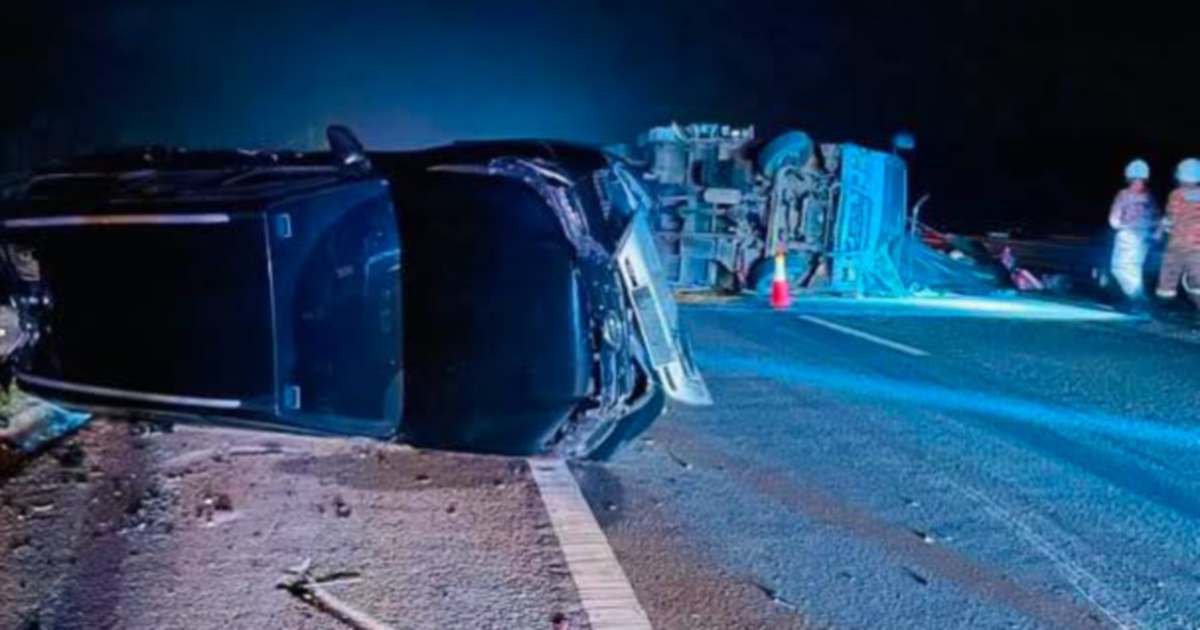
Three media officers assigned to Deputy Prime Minister Datuk Seri Dr Ahmad Zahid Hamidi were among seven individuals hurt when three vehicles collided on the East Coast Expressway at the Km144 mark in Maran during the early morning hours. While the incident resulted in multiple casualties, those injured, including the media personnel, avoided critical injuries.
The accident unfolded at a busy stretch of the major expressway that connects Malaysia's east coast states, a route frequently travelled by government officials and media contingents. The circumstances surrounding the collision—which brought together passenger vehicles in close succession—serve as a reminder of highway safety challenges that persist despite infrastructure improvements along major arterial routes.
Incidents involving official delegations naturally attract heightened public attention, particularly when they involve support staff travelling with high-ranking government figures. The Deputy Prime Minister's media team plays a crucial role in official communications and documentation, making their safety a matter of operational concern for the government's administration. The fact that all involved in this particular incident sustained only minor injuries represents a fortunate outcome given the severity that multi-vehicle collisions on expressways can entail.
The East Coast Expressway has been a transformative infrastructure project for the peninsula's eastern corridor, significantly reducing travel times between major commercial and population centres. However, like all high-speed corridors, it demands heightened vigilance from drivers navigating its multiple lanes and interchanges. Early morning driving conditions, particularly those involving fatigue or reduced visibility, have been consistently identified as contributing factors in expressway accidents across Malaysia.
Several aspects of this incident warrant examination. The involvement of three separate vehicles suggests a possible chain-reaction scenario, where initial impact between two vehicles may have drawn a third party into the collision. Such sequences on expressways can escalate danger exponentially, as vehicles travelling at highway speeds have limited reaction time and braking distance. The specific location at Km144, while not previously identified as an accident hotspot in public reporting, falls within a section of the expressway that handles significant daily traffic volume.
Response protocols for accidents involving official personnel typically involve coordinated efforts between traffic police, emergency medical services, and highway authority personnel. The early hour of the incident—described as occurring during dawn hours—likely meant lighter traffic conditions overall, which may have facilitated faster emergency response. Modern expressway systems in Malaysia are equipped with emergency communication networks and surveillance systems designed to detect incidents rapidly and dispatch assistance.
From a broader perspective, this accident exemplifies ongoing concerns about road safety on Malaysia's expressway network. Despite continuous investments in highway infrastructure and enforcement initiatives, accident rates remain a public health concern. The involvement of seven people across three vehicles underscores how quickly incidents can expand their impact when multiple road users are affected. Media accompanying high-level officials often travel in convoy arrangements, which while offering some protective benefits, also concentrate personnel in proximity to one another.
The recovery and investigation phases following such incidents typically involve detailed documentation by traffic authorities. Factors such as vehicle maintenance, driver alertness, weather conditions, and mechanical failures are all examined systematically. For incidents involving government officials' delegations, additional scrutiny may be applied to ensure thoroughness and public confidence in the investigation process.
The incident serves as a practical reminder for all expressway users, particularly those operating vehicles during early morning or late evening hours, to maintain heightened attention and appropriate speeds. Fatigue-related incidents account for a significant portion of expressway accidents, and drivers transporting passengers—especially those with official duties—bear particular responsibility for vehicle safety and trip planning.
For Malaysia's transport and safety authorities, incidents of this nature generate valuable data contributing to ongoing efforts to reduce expressway casualty rates. Detailed analysis of collision patterns, contributing factors, and outcomes inform policy decisions regarding speed management, road design modifications, and enforcement priorities. The East Coast Expressway, being a critical north-south artery, continues to draw attention from both safety specialists and urban planners seeking to balance efficient transport with accident prevention.
The fact that none of the seven injured sustained serious injuries suggests that vehicle safety features and emergency medical response in this instance functioned effectively. As vehicle technology continues advancing with improved crash protection systems, casualty outcomes from expressway incidents have shown gradual improvement over recent years. Nevertheless, prevention through driver behaviour and attention remains the most effective strategy for reducing accidents on high-speed corridors across Malaysia and the region.

