Thailand's government has put its peace negotiations with southern insurgent fighters on indefinite hold, cancelling a scheduled meeting that was set to take place in Malaysia next month. The decision follows last week's violent assault in Narathiwat province, where assailants killed five rangers and wounded six civilians, including a young child. The attack represents a significant setback for peace efforts that had been gaining momentum in recent months, raising questions about the fragility of the reconciliation process in one of Southeast Asia's most intractable conflicts.
Thanat Suwannanont, who directs both the National Intelligence Agency and chairs Thailand's Southern Border Provinces Peace Dialogue Panel, announced the suspension during a press briefing on Tuesday. His remarks underscored the government's view that the timing of the assault—occurring while diplomatic channels were actively engaged—demonstrated either a breakdown in control over militant factions or a deliberate challenge to the peace process itself. The cancellation marks a reversal of what officials had characterised as encouraging progress in earlier rounds of talks, suggesting that even modest gains remain vulnerable to reversal when violence resurfaces.
According to Suwannanont, the government had sent formal correspondence to the insurgent group demanding explanations for the attack and clarification regarding which elements were responsible. This communication underscores a complication inherent in negotiating with decentralised armed movements—the challenge of verifying whether leadership has genuine authority over all operational units or whether splinter factions act independently. The very structure of insurgent organisations often permits hard-line elements to undertake attacks that complicate diplomatic efforts, a dynamic familiar to observers of conflicts across the region.
The official emphasised that while the fighters may have acted according to their own impulses or operational calculations, the government could not simply accept violence as a natural occurrence during peace discussions. Once hostilities resume, authorities argued, the entire foundation for dialogue must be rebuilt, requiring new preconditions and confidence-building measures before substantive negotiations can resume. This reflects a broader principle in conflict resolution: that escalating violence fundamentally alters the political context within which talks occur, shifting incentives and raising security concerns for all parties.
The assault took place at approximately 6.45 pm local time on the previous Wednesday when six attackers, their faces concealed and dressed entirely in dark clothing, assailed a security checkpoint in Ban Bukit Sami within Rangae district of Narathiwat. The assailants employed firearms and improvised explosive devices, suggesting a coordinated operation rather than a spontaneous incident. Beyond the five rangers killed, the attack left six civilians wounded, including a three-year-old girl, highlighting the indiscriminate nature of the violence and its impact on ordinary residents caught in the conflict zone.
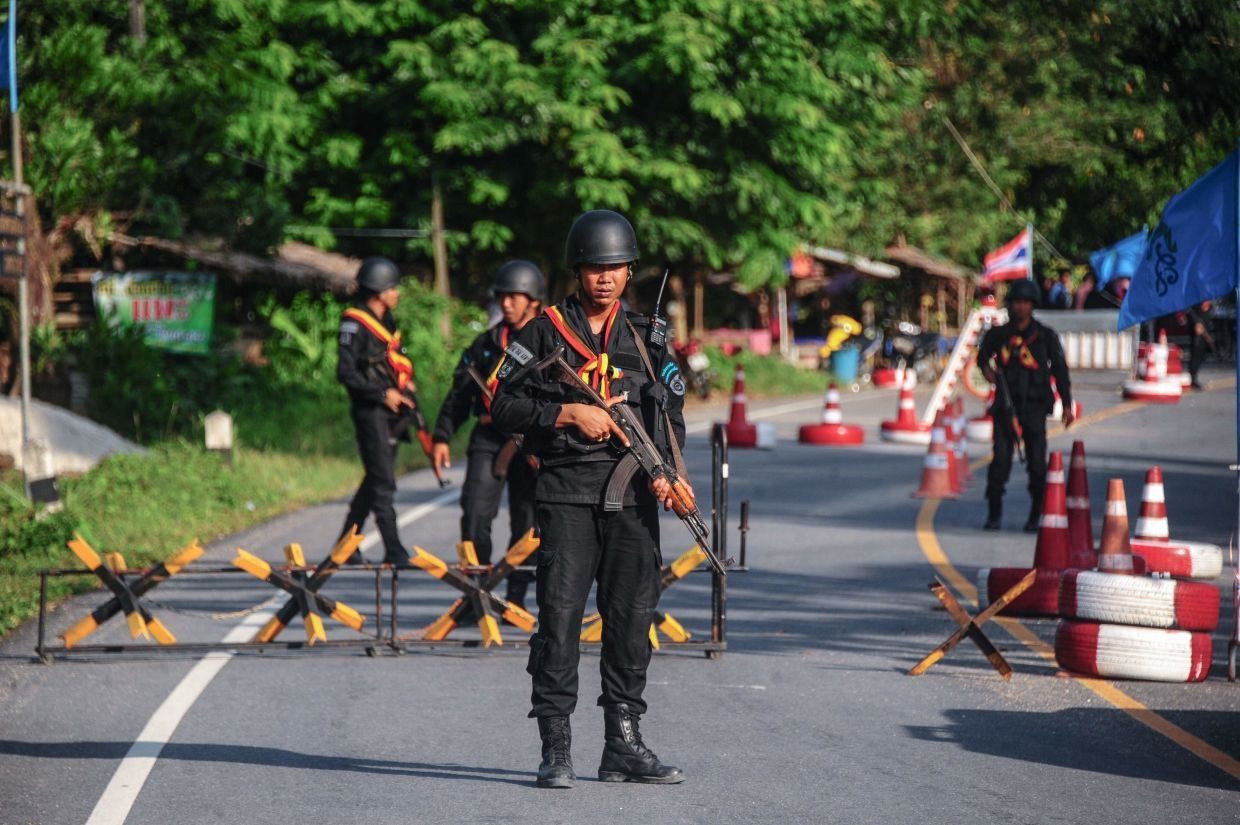
In response to the attack, Thailand's government deployed martial law across thirteen districts within Narathiwat province, granting security forces expanded powers to conduct manhunts and implement heightened protective measures throughout the affected region. This represents an escalation in military-style governance of the area, suggesting that authorities view the assault as sufficiently serious to warrant extraordinary security responses alongside the suspension of diplomatic efforts. The dual approach—intensified law enforcement combined with postponed talks—reflects the tension between short-term security imperatives and longer-term reconciliation goals.
The Internal Security Operations Command, which oversees counterinsurgency operations in the southern border region, announced that the Narathiwat Provincial Court had issued arrest warrants for two individuals aged forty-five and forty-three whom investigators believed participated in the attack. Authorities connected these suspects to an armed assault that occurred on July 22, establishing a pattern of violence spanning several months. The formal charges include terrorism-related offences, premeditated murder of government personnel, armed robbery resulting in death, and weapons and explosives violations—a comprehensive legal framework reflecting the state's determination to prosecute those responsible.
Prime Minister Anutin Charnvirakul has publicly reiterated that dialogue remains fundamental to any sustainable resolution of the southern conflict, rejecting the notion that isolated incidents should derail the broader peace strategy. This positioning attempts to maintain the government's commitment to negotiation while simultaneously demonstrating that violence carries serious consequences and will not accelerate the negotiation timeline. The delicate balance reflects awareness that abandoning peace efforts entirely would signal capitulation to militant pressure, yet persisting with talks immediately after attacks risks appearing weak or unresponsive to public security concerns.
Thailand's southern border provinces have endured more than two decades of insurgent violence rooted in historical grievances, religious identity, and competing visions for autonomy and governance in a Muslim-majority region. The conflict has claimed thousands of lives and displaced communities, making it one of the region's most persistent security challenges. Previous peace initiatives have achieved limited success, faltering repeatedly when violence resurfaces or when parties dispute fundamental issues regarding the scope of negotiations and ultimate political outcomes.
For Malaysian observers, the suspension carries implications beyond Thailand's borders, particularly given Malaysia's historical role as a venue and sometimes mediator for these talks. The cancellation of the September meeting originally planned on Malaysian soil reflects a broader regional reality: that conflicts of this nature resist neat diplomatic solutions and remain vulnerable to recurrence even when negotiating frameworks appear established. The incident also highlights how delegations from one nation must manage the unpredictability of engaging with non-state actors whose command structures and internal cohesion remain disputed.
The suspension period provides space for several potential developments. Either the government and insurgent representatives may quietly conduct back-channel discussions to restore a negotiating framework, or the violence may prompt a renewed military offensive that displaces dialogue entirely for months or years. The outcome will depend substantially on whether leaders within the insurgent movement can exert sufficient control over their operatives to prevent further attacks, and whether Thai policymakers remain convinced that negotiation offers better prospects than intensified counter-insurgency operations.
This latest episode illustrates an enduring pattern in the southern Thai conflict: windows of diplomatic possibility periodically open, only to be slammed shut by renewed violence before substantive progress crystallises into durable agreements. Until both the Thai state and insurgent leadership develop mechanisms for preventing spoiler attacks and building sufficient mutual trust to weather inevitable incidents, peace agreements will remain elusive. The path forward requires not merely cancelling scheduled meetings but addressing the root causes—territorial, religious, political, and economic—that generate recurring cycles of violence and abandoned negotiations.

