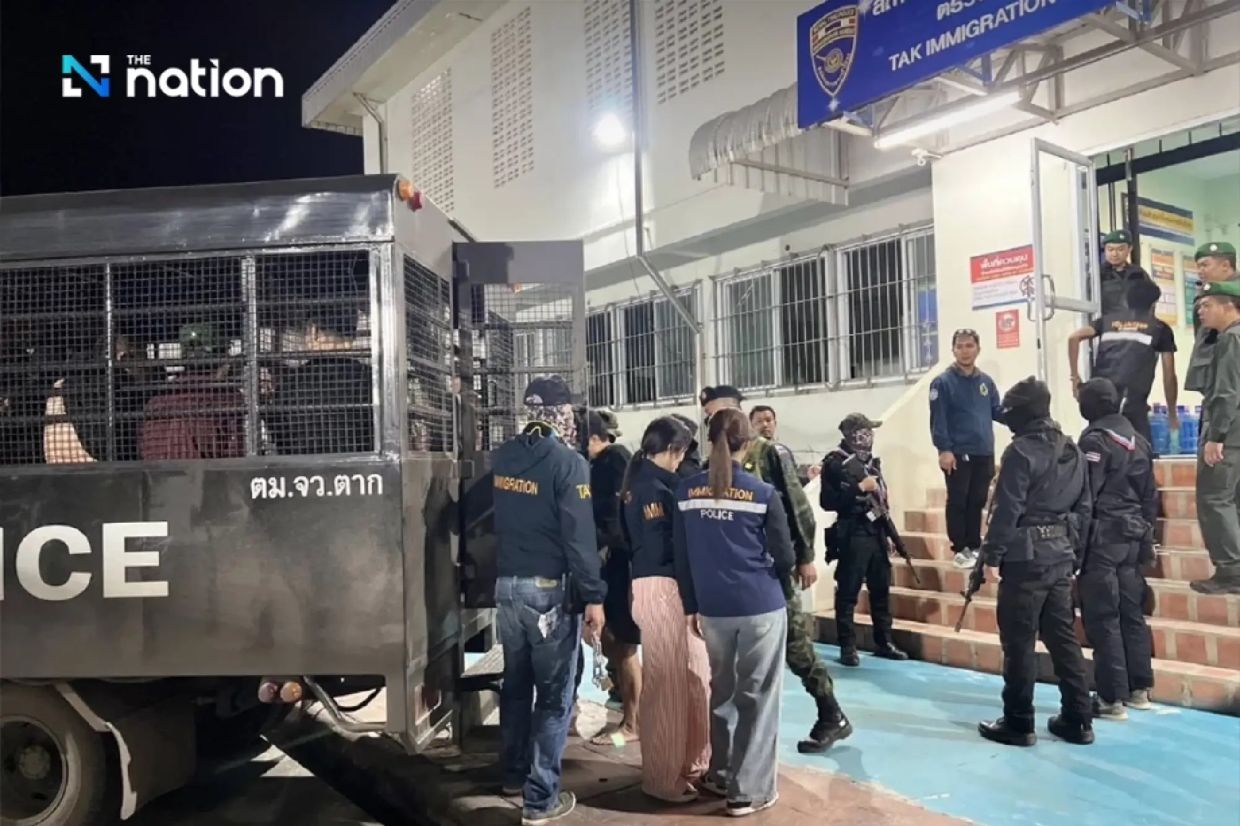
Thailand is undertaking a significant restructuring of its immigration procedures to accelerate the deportation of foreign nationals convicted of crimes, as authorities grapple with an influx of transnational criminal networks exploiting the kingdom as an operational hub. The initiative reflects growing frustration within Bangkok's security establishment that existing legal mechanisms have become unwieldy obstacles to removing foreign offenders, many of whom languish in state custody for extended periods while their cases navigate labyrinthine appeals processes, court hearings and protracted embassy negotiations.
The root of this challenge traces directly to a permissive visa policy introduced in July 2024 under the previous Srettha Thavisin administration. That 60-day visa exemption scheme permitted travellers from 93 countries and territories to enter Thailand without advance visa applications, a measure intended to stimulate tourism but which inadvertently created substantial security gaps. By circumventing the traditional visa application process, Thai diplomatic missions lost the opportunity to conduct pre-arrival screening of criminal histories, financial backgrounds or other risk factors. Some visitors subsequently exploited this loophole by executing repeated border runs—leaving and re-entering Thailand frequently—to reset their legal stay rather than departing permanently, effectively circumventing immigration controls.
This regulatory vacuum has facilitated the settlement of foreign criminals across Thailand's landscape. Authorities report that undocumented and illegal foreign workers now compete with Thai nationals in labour-intensive sectors including hospitality, restaurant operations, resort management and entertainment. Beyond employment violations, intelligence agencies have documented more serious criminal activity: illicit property acquisition through nominee arrangements, sophisticated call-centre fraud operations, money laundering schemes and the circulation of what officials term "grey capital" through informal financial networks. These problems have crystallized in prominent tourist destinations including Pai in Mae Hong Son province, Pattaya in Chonburi, Koh Phangan in Surat Thani and Bangkok itself.
Recognising the security implications, the current Anutin government elevated transnational crime suppression to a priority concern within Thailand's national security framework. Immigration Bureau officials, Royal Thai Police commanders and agency heads across the bureaucracy received directives to strengthen border screening and enforcement operations. The government introduced four complementary proactive measures: systematic flagging of travellers exhibiting unusual entry-exit patterns without evident justification; heightened screening protocols targeting arrivals from high-risk jurisdictions; deeper integration of international criminal databases maintained by Interpol with Thai security agencies; and structural reforms designed to eliminate overlapping or redundant visa classifications. More dramatically, on May 19, 2026, the Thai Cabinet formally approved cancellation of the problematic 60-day exemption across all 93 countries and territories. Thailand is transitioning back toward bilateral, country-by-country visa arrangements, with most foreign arrivals now expected to receive maximum permitted stays of 30 days.
Government policy makers have justified this reversal by reframing Thailand's tourism strategy around qualitative rather than quantitative objectives. Officials argue that the 60-day exemption scheme failed to produce measurable increases in tourist numbers or visitor spending while simultaneously exposing Thailand to a substantially wider spectrum of security risks. This recalibration reflects a deliberate pivot toward attracting visitors assessed as lower-risk and higher-value rather than maximising raw arrival figures. Security agencies have simultaneously intensified enforcement operations targeting foreign nationals residing illegally within Thai territory. Coordinated inspections conducted by military personnel, police forces and administrative officials have generated sustained apprehension of foreign offenders now undergoing legal proceedings and facing deportation orders.
Yet this intensified enforcement campaign has revealed systemic bottlenecks within Thailand's immigration removal framework. Many foreign detainees remain administratively stranded within Thai custody facilities, unable to exit the system expeditiously. Some lack financial resources to cover repatriation costs and must await coordination between Thai authorities and their respective embassies regarding financial assistance arrangements. Others facing deportation following criminal convictions retain procedural mechanisms permitting them to contest or appeal deportation orders under the 1979 Immigration Act. Current statutory provisions permit foreign nationals 48 hours following receipt of a deportation notice to file appeals with the Immigration Bureau, accompanied by supporting documentation. While such appeals remain pending—the typical circumstance—deportation orders are routinely suspended, excepting only the most serious cases. Furthermore, detainees may petition the Immigration Commission to defer removal or extend provisional stay on humanitarian or legal grounds, further elongating timelines.
Responding to these systemic constraints, Prime Minister Anutin Charnvirakul has directed Deputy Prime Minister Pakorn Nilprapunt, who oversees legal and regulatory affairs, to lead interagency coordination with the Royal Thai Police, Immigration Bureau and Interior Ministry toward comprehensive revision of immigration legislation and subordinate regulations. The objective is to engineer faster, more adaptable and ultimately more effective deportation procedures while maintaining compliance with Thailand's international legal obligations and domestic human rights commitments. The government has targeted Sections 54 and 55 of the 1979 Immigration Act—the statutory provisions governing removal of foreign nationals—as requiring amendment. Premier Anutin publicly acknowledged that while his administration has achieved measurable progress in arresting and prosecuting foreign nationals engaged in transnational crime, call-centre fraud syndicates, nominee business schemes and other violations, detention and conviction alone prove insufficient when deportation procedures themselves remain chronically protracted. Some offenders, he observed, effectively resume ordinary life while formal removal procedures inch forward through bureaucratic channels, elevating risks of recidivism and continued criminality.
The deputy police commissioner, Pol Lt Gen Trairong Phiwpan, provided detailed explanation of the procedural complexities underlying current deportation delays. When Thailand maintains an extradition treaty with a foreign jurisdiction, the attorney-general must evaluate the specific case before forwarding materials to the appropriate court for an extradition order. Conversely, when no treaty exists, the Foreign Ministry must petition the attorney-general, who subsequently requests the court to issue an extradition order. Throughout this layered process, human rights considerations remain embedded within each procedural stage. Detainees retain enforceable rights to petition the courts, contest their removal or request temporary release on human rights grounds. Thailand's participation in the United Nations Human Rights Council and ratification of eight major international human rights conventions—encompassing children's rights, women's rights, civil and political rights, economic and social rights, racial discrimination, torture prevention, disability protections and prevention of enforced disappearance—creates substantive legal obligations that courts must respect during removal proceedings.
Police officials acknowledged that revisiting the deportation framework could yield beneficial improvements, particularly given that multiple overlapping statutes currently govern various aspects of the removal process. They noted that Thailand, as a sovereign state bound by international human rights law, possesses legitimate authority to reassess and recalibrate how extradition and deportation procedures operate. However, Trairong cautioned that no universally applicable timeline can be imposed across all deportation cases, as individual detainees may legitimately exercise distinct rights derived from bilateral extradition treaties and human rights protection mechanisms. When detainees refrain from invoking human rights remedies, repatriation proceeds considerably faster. But when legal challenges and counterclaims reach the courts, the timeline necessarily extends pending judicial consideration.
Reform efforts, according to the police assessment, should concentrate on compressing procedural timeframes, eliminating redundant steps and reducing arbitrary delays while preserving judicial capacity to evaluate the gravity of individual circumstances. Cases warrant differentiated treatment based on whether they involve simple immigration violations such as unauthorised entry or visa overstay, or more serious conduct including transnational criminal activity or participation in organised fraud networks. Deputy Prime Minister Pakorn is expected to initiate comprehensive discussions across the Interior Ministry, Royal Thai Police and other relevant agencies to assemble granular information and evaluate potential consequences across all institutional and legal dimensions. This multi-stakeholder consultative process will inform the specific legislative amendments required to achieve the government's objective of maintaining security and lawfulness while accelerating removal of foreign offenders from Thai jurisdiction.

