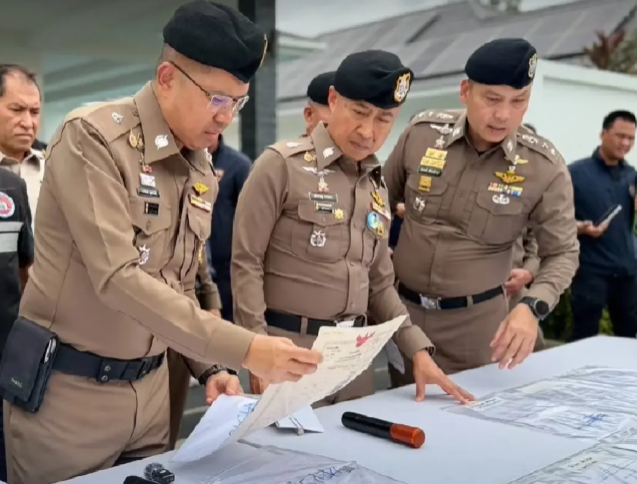
Thai police have intensified efforts to combat a long-standing loophole in property law by arresting 13 foreign nationals during coordinated raids across 15 locations in Hua Hin. The operation, which unfolded in Prachuap Khiri Khan on August 10, represents the sixth phase of a nationwide campaign targeting nominee share structures designed to circumvent restrictions on foreign real estate ownership. The arrested individuals—three British, four Chinese, and one each from Italy, France, the Netherlands, Austria, the Philippines, and the United States—were among dozens targeted as authorities seek to dismantle networks believed to have concealed foreign beneficial ownership of approximately 300 million baht in combined property value across 33 companies.
The enforcement action involved more than 200 police officers and government officials, reflecting the scale of concern among Thai authorities about the systematic circumvention of foreign ownership rules. Court-issued arrest warrants were executed against 45 foreign nationals altogether, while 39 Thai citizens were summoned for questioning. The operation was coordinated at the highest levels, with Deputy National Police Chief Pol Gen Samran Nuanma ordering the crackdown and oversight provided by Pol Lt Gen Nopasil Poolsawat and Pol Lt Gen Phisit Tanprasert. The involvement of the Prachuap Khiri Khan governor and officials from the Department of Business Development and Department of Lands underscores the multi-agency approach to addressing property-related foreign investment concerns.
Focus during the Hua Hin phase centered on a development of modern pool villas in Thap Tai subdistrict, where individual properties were valued between 10 and 20 million baht each. Investigators identified six companies allegedly operating through Thai nominee shareholders within this single development, with four entities linked to earlier phases of the investigation and two representing newer iterations of the scheme. The sophistication of these arrangements suggests coordination and possibly institutional knowledge among facilitators assisting foreign investors seeking to acquire Thai property despite legal prohibitions on direct ownership by non-citizens.
Interrogations of the arrested foreigners revealed a consistent narrative regarding their motivations and understanding of the legal framework. Foreign nationals claimed they sought to legally hold property in Thailand and had been counseled by law firms and accounting practices to establish corporate entities as a mechanism to achieve this objective. Many believed the nominee arrangements represented a legitimate pathway to property ownership compliant with Thai law. However, police investigations found that the companies in question were not conducting genuine business operations, indicating the structures existed primarily to mask beneficial ownership. The identity of the legal and accounting firms providing such counsel remains undisclosed, though their role in facilitating these arrangements raises questions about professional liability and regulatory oversight.
Thai nationals named as shareholders presented a markedly different account when questioned. These individuals asserted they had agreed to hold shares nominally on behalf of foreign parties but had never actually paid for shareholdings or participated in company management. Most significantly, they claimed to have never reviewed financial documentation or investment records, suggesting their role was purely perfunctory. This division of knowledge and responsibility—where Thai shareholders maintained formal ownership while remaining disconnected from actual decision-making and financial management—lies at the heart of nominee schemes. Police assessment concluded that such corporate structures were deliberately engineered to obscure foreign control and beneficial ownership of underlying properties, thereby creating an appearance of Thai ownership for regulatory purposes.
The investigation extends beyond the arrested individuals and nominal shareholders to examine potential corruption within government ranks. Thai authorities indicated that officials suspected of facilitating these arrangements or improperly assisting participants would also face scrutiny. This dimension reflects broader concerns about institutional capture and the degree to which regulatory systems protecting Thai property rights may have been compromised at various administrative levels. The willingness to investigate potential official complicity suggests recognition that individual criminal conduct alone cannot explain the prevalence and sophistication of nominee networks across multiple provinces and business sectors.
The Hua Hin operation should be understood within the context of an escalating multi-phase campaign spanning several years and multiple jurisdictions. The initial investigations commenced on Koh Phangan in Surat Thani, where authorities examined nominee companies alongside law firms and accounting networks allegedly facilitating property and tourism business control. Subsequent phases expanded geographic scope to Phuket, Phang Nga, and Krabi—all major foreign investment destinations—before shifting to Chonburi and subsequently Chiang Mai. Through the first five phases, authorities examined 233 plots and land parcels totaling more than 160 rai, with an estimated combined value exceeding 2.539 billion baht. The magnitude of these figures illustrates the scale of property value potentially affected by nominee arrangements and suggests the problem extends well beyond isolated cases to constitute a systematic pattern affecting Thailand's real estate market.
Prosecutorial outcomes from earlier phases demonstrate varying degrees of success in converting investigations into legal accountability. Courts approved 133 arrest warrants across the first five phases, yet only 20 cases resulted in convictions. This gap between warrants and convictions may reflect legal complexities in establishing criminal liability, difficulties in gathering evidence suitable for prosecution, or challenges inherent to cases involving international parties and cross-border financial transactions. The relatively modest conviction rate should temper expectations regarding the ultimate impact of the current crackdown, though the campaign's continuation suggests authorities remain committed despite prosecutorial challenges.
For Malaysian investors and property market observers, the Thai enforcement campaign offers pertinent lessons regarding the legal risks associated with nominee structures in Southeast Asian property markets. While Malaysia maintains its own foreign ownership restrictions and nominee regulations, the Thai case demonstrates both the prevalence of circumvention attempts and the eventual escalation of enforcement responses. The involvement of professional service providers—law firms and accountants—in facilitating illegal structures suggests that complexity alone does not inoculate arrangements from regulatory action. Malaysian investors seeking to acquire Thai property or those considering similar strategies in other jurisdictions should recognize that authorities are actively investigating and prosecuting such arrangements, with consequences including criminal liability, asset seizure, and potential civil penalties.
The campaign also reflects evolving sophistication in detecting nominee arrangements. Traditional approaches relying primarily on reviewing company registration documents have evidently proven insufficient, prompting authorities to examine financial transactions, digital records, and witness testimony to establish beneficial ownership. The seizure of computers, mobile phones, and electronic data alongside physical documents indicates investigators are pursuing comprehensive digital forensics to trace financial flows and communications among alleged network participants. This methodological evolution suggests that future nominee schemes will face progressively more difficult enforcement environments as investigative capacity and cross-agency coordination improve across the region.
Thailand's stated commitment to continue investigating suspected nominee networks and foreign-funded groups operating unlawfully across tourist destinations nationwide suggests the campaign will persist beyond the current phase. The establishment of public reporting mechanisms—including local police stations and a dedicated hotline numbered 1599—reflects an attempt to encourage community participation in enforcement. However, the success of such mechanisms depends on public awareness and understanding of what constitutes illegal nominee activity, which may vary significantly among foreign investor communities operating in different provinces. The campaign's geographic concentration in tourist and expat-heavy areas like Hua Hin, Phuket, and Chiang Mai suggests that authorities have strategically targeted regions with the highest concentrations of foreign property investment activity.
Looking forward, the persistence and expansion of Thailand's nominee crackdown will likely influence foreign investor behavior across Southeast Asia and affect the property markets of competing destinations. Malaysian authorities monitoring these developments may face pressure to strengthen enforcement of their own foreign ownership and nominee provisions, particularly if Thai actions generate headlines regarding foreign investor vulnerability to prosecution. Conversely, some foreign investors deterred by Thai enforcement may redirect capital toward alternative destinations perceived as offering greater legal certainty. The broader implication extends to regional regulatory harmonization and cooperation; as countries increasingly coordinate efforts to address cross-border property and investment schemes, the vulnerabilities of informal structures become progressively more pronounced, potentially driving legitimate foreign investment toward transparent, compliant channels.

