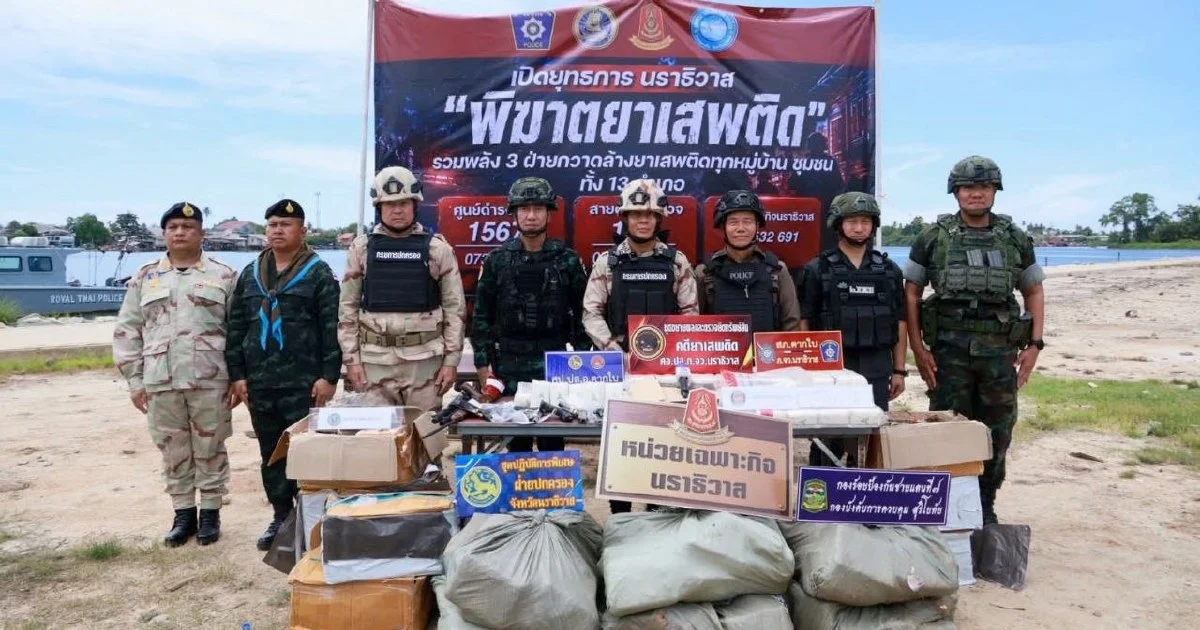
Thai law enforcement has intensified its grip on cross-border drug trafficking networks, making 233 arrests during an extended anti-narcotics campaign in Narathiwat province. The month-long operation represents a significant escalation in Thailand's efforts to combat organised drug syndicates that have increasingly integrated Malaysian operatives into their supply chains, highlighting the porous nature of illicit trade routes spanning the northern Malaysian border.
The crackdown, concentrated in the southern Thai province bordering Malaysia, yielded crucial intelligence about trafficking operations that were attempting to move contraband into Malaysian territory. Among those detained, authorities identified several individuals with established connections to Malaysian-based criminal networks, suggesting a deliberate effort by transnational syndicates to utilise Malaysia as a transit point or distribution hub for narcotics destined for regional markets. This discovery underscores how drug trafficking organisations have evolved from operating strictly within national boundaries to establishing sophisticated cross-border partnerships that exploit regulatory gaps and territorial boundaries.
Particularly significant was the interception of a smuggling attempt involving approximately RM1.2 million worth of illicit drugs. The size of this seizure indicates that the networks operating in the region deal in substantial volumes, suggesting they supply not just local markets but also distribute to neighbouring countries. Malaysian authorities have long grappled with the challenge of narcotics transiting through the country, and this Thai operation provides valuable confirmation that organised criminal enterprises actively target Malaysian territory as a corridor for moving contraband northward to Thailand or southward toward Singapore and beyond.
The geography of Narathiwat province makes it particularly strategic for trafficking operations. Situated directly opposite Malaysia's Kelantan state across the Golok River, the region offers multiple informal crossing points that criminal networks have historically exploited. Thai authorities' decision to concentrate enforcement efforts in this specific area suggests they have mapped out particular routes or networks of concern, likely developed through intelligence sharing with Malaysian counterparts or independent surveillance operations.
The involvement of Malaysian nationals or Malaysia-based operatives in these Thai networks is not surprising given the historical pattern of organised crime in Southeast Asia. Malaysian traffickers possess certain advantages in regional networks—familiarity with Malaysian port facilities, established distribution channels, and connections with local buyers and dealers. Thai criminal organisations have increasingly recruited Malaysian partners either through coercion, financial incentives, or pre-existing family and ethnic ties that span the border. This collaboration represents a concerning evolution in how regional drug trafficking operates.
Thailand's month-long campaign demonstrates a more sustained approach to combating narcotics compared to shorter-term operations. Extended crackdowns allow authorities to map networks more comprehensively, identify key players and supply routes, and disrupt operations before they can reorganise. The fact that Thai police sustained enforcement pressure for an entire month suggests either substantial resources dedicated to the initiative or particular concern about trafficking volumes in the region during that period. For Malaysia, which continues to struggle with drug addiction rates and the role of narcotics in fueling petty crime, such regional enforcement efforts provide crucial support in addressing the supply side of the equation.
The arrest figures—233 individuals—point to relatively large-scale operations. Trafficking syndicates rarely function with single individuals; they require couriers, dealers, financial managers, and logistics coordinators. A three-figure arrest total likely represents only the visible portion of these networks, with many more operatives remaining undetected. Malaysian authorities should view this as a signal that significant trafficking infrastructure remains active along the Thai border, requiring enhanced vigilance and intelligence cooperation.
Intelligence sharing between Thai and Malaysian law enforcement has historically been inconsistent, complicated by differing operational priorities, jurisdictional limitations, and occasional diplomatic sensitivities. However, the practical reality of shared drug trafficking problems increasingly forces cooperation. Thai authorities alerting Malaysia to networks with Malaysian connections serves mutual interests, as disrupting operations on either side of the border ultimately reduces the overall supply reaching consuming markets in both countries. The interception of the RM1.2 million shipment suggests at least some communication is occurring between agencies.
The seizure value—RM1.2 million—reflects current street-level narcotics prices, indicating that the intercepted drugs likely consisted of substances like methamphetamine, heroin, or fentanyl rather than larger-volume but lower-value cannabis. These synthetic drugs and opiates represent the most dangerous commodities circulating through Southeast Asian markets, driving addiction, overdose deaths, and associated violent crime. Thailand's successful interdiction therefore has potential public health implications extending throughout the region.
Looking forward, Malaysian authorities will need to absorb lessons from this Thai operation. The revelation that Malaysian-based traffickers are actively involved in cross-border networks targeting their own country suggests that enforcement attention should focus not merely on interdicting drugs at the border, but on dismantling the Malaysian nodes of these syndicates. Intelligence from Thai arrests could provide names, aliases, and operational patterns that Malaysian police can pursue domestically. Effective counter-narcotics work requires understanding how criminal networks operate across multiple jurisdictions and targeting the entire chain rather than individual links.
This crackdown also highlights broader challenges facing Southeast Asia's narcotics control efforts. The region's economic dynamism, transportation infrastructure, and multiple porous borders create an environment where drug trafficking remains highly profitable. Addressing the supply side requires not merely law enforcement but also tackling demand reduction, addressing corruption that enables trafficking, and reducing the appeal of narcotics distribution to impoverished communities where traffickers recruit. Thailand and Malaysia, along with other regional governments, must recognise that sustainable progress demands coordinated approaches spanning enforcement, treatment, prevention, and development.

