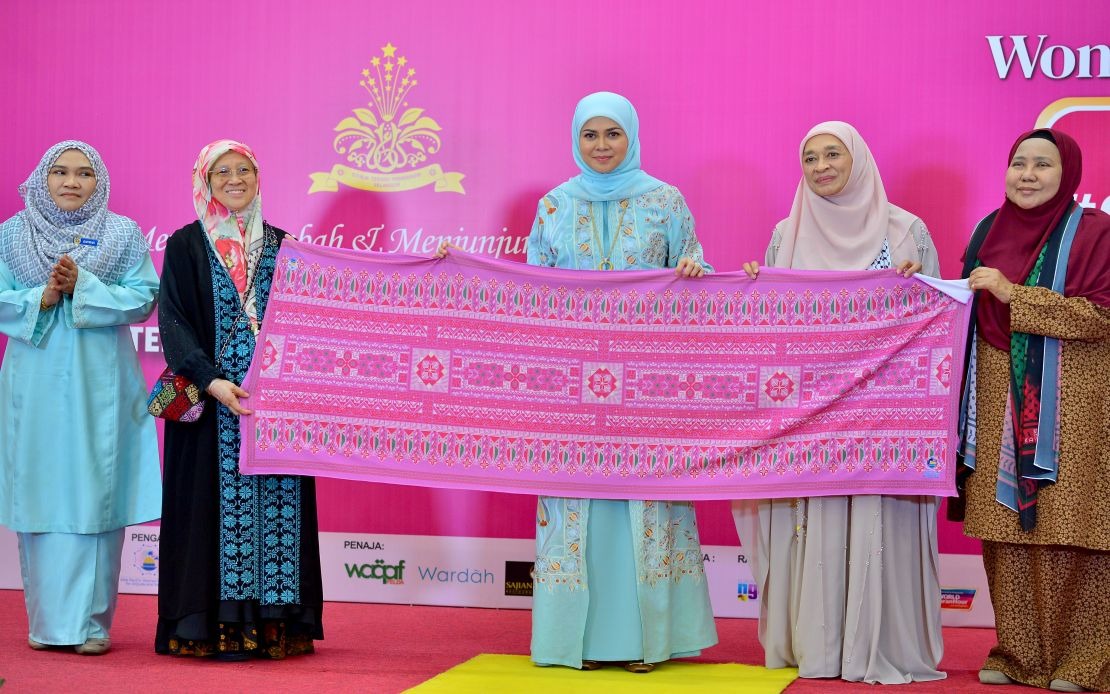
Tengku Permaisuri Norashikin opened the Women Summit & Women #QuranHour 2026 programme at the Dahlia Auditorium within Sultan Salahuddin Abdul Aziz Shah Mosque in Shah Alam, signalling institutional support for grassroots women's spiritual empowerment initiatives across the region. The royal patronage underscores the growing recognition among Malaysia's leadership that women's religious education and psychological resilience merit sustained attention, particularly in contexts marked by displacement, conflict, and social fragmentation that resonate across Southeast Asia.
The event, jointly orchestrated by Yayasan Warisan Ummah Ikhlas and the Asia Pacific Women's Coalition for Al-Quds and Palestine, assembled approximately 400 female participants hailing from Selangor, Singapore, Indonesia, and beyond. This cross-border attendance demonstrates the appetite within Muslim communities across the region for structured programmes that integrate Quranic study with mental health and character formation, moving beyond conventional religious instruction toward holistic personal development frameworks.
Underscoring the programme's thematic direction, organisers selected "Women of Grit" as the guiding concept, deliberately drawing inspiration from the perseverance demonstrated by Palestinian women navigating the devastating realities of conflict in Gaza. The curators explicitly positioned these women's endurance—their capacity to maintain family structures, sustain children's education, preserve faith commitments, and process trauma amid comprehensive loss—as a model for wider female audiences grappling with contemporary adversity. This framing transforms a geopolitical crisis into a pedagogical resource, extracting spiritual and psychological lessons applicable to diverse hardship scenarios women encounter.
Director Gharizah Hashim articulated the programme's core objective as extending beyond surface-level strength building to encompass the cultivation of inner peace, discernment in decision-making, and purposeful forward movement anchored in divine guidance. She characterised the initiative as addressing a specific gap in available resources: women require frameworks that simultaneously acknowledge life's escalating complexity whilst offering grounded, scriptural foundations for navigating uncertainty. By positioning Quranic revelation as a practical toolkit for psychological resilience rather than solely theological instruction, the programme appeals to women managing intersecting demands of family, employment, community participation, and personal wellbeing.
The assembly of distinguished speakers and facilitators reflected the programme's interdisciplinary ambitions. Tirmizi Ali, the 2014 International Quran Recitation Champion, contributed technical expertise in Quranic recitation and memorisation, whilst Associate Professor Dr Nora Mat Zin from the International Islamic University Malaysia's Department of Psychiatry bridged religious practice with clinical understanding of mental health. This combination acknowledges that effective women's empowerment requires simultaneous investment in spiritual cultivation and psychological literacy, particularly when addressing trauma, anxiety, and identity questions prevalent among contemporary female cohorts.
CEO Marhaini Yusoff highlighted the strategic importance of scaling the programme beyond the single summit event through the Rumah Ngaji network, a nationwide system of freely-accessible Quranic learning circles sustained by local philanthropic support. The positioning of this expansion as the "beginning of a more structured movement" indicates organisational ambitions extending well beyond Shah Alam, with state-level replication serving as the immediate growth vector. For Malaysian policymakers and civil society observers, this model demonstrates how grassroots religious education can leverage community sponsorship to reach populations otherwise lacking consistent access to quality Quranic study and character development programming.
The presence of Rumah Ngaji representatives from multiple Malaysian states at the summit itself functioned as both symbolism and practical planning session, establishing networks and sharing best practices among coordinators responsible for local implementation. This deliberate architecture—bringing together practitioners from existing learning circles to participate in and subsequently disseminate a flagship programme—represents sophisticated social mobilisation strategy, transforming individual participants into multipliers within their home communities. The approach acknowledges that sustainable women's empowerment requires embedding initiatives within existing social infrastructure rather than imposing parallel structures.
Within the broader Southeast Asian context, the Women Summit's thematic emphasis on Quranic resilience addresses a substantive need across the region's Muslim-majority and Muslim-minority societies alike. Women throughout the region navigate compounded pressures arising from rapid urbanisation, economic volatility, evolving family structures, and digital-age identity formation, alongside the particular challenges of minority status in non-Muslim-majority nations. Programming that explicitly integrates spiritual resources with psychological frameworks offers Malaysian and regional women accessible vocabulary and practical strategies for maintaining wellbeing and purpose amid such complexity.
The decision to foreground Palestinian women's experiences and resilience as the inspirational touchstone carries both unifying and potentially controversial dimensions. For many regional Muslim women, the invocation of Palestinian steadfastness creates affective connection and establishes solidarity across geographical and socioeconomic distance. Simultaneously, international activists and NGOs increasingly employ similar frameworks, using global solidarity narratives to mobilise domestic constituencies around religious practice and community strengthening. The Women Summit's organisers appear to have deliberately leveraged this affective terrain to energise participation and substantive engagement with the Quranic curriculum, recognising that abstract spiritual instruction often fails to mobilise sustained commitment among contemporary audiences.
Looking forward, the programme's expansion through state-level Rumah Ngaji networks will constitute a significant test of whether summit-level enthusiasm translates into sustained local engagement. Success will depend on coordinators' capacity to adapt the "Women of Grit" framework to local contexts, secure consistent sponsorship funding, and maintain facilitator quality across diverse communities. For Malaysian women's civil society and religious institutions, the programme offers a potential template for women's empowerment initiatives that prioritise scriptural grounding, community participation, and psychological coherence rather than donor-driven externally-designed interventions.

