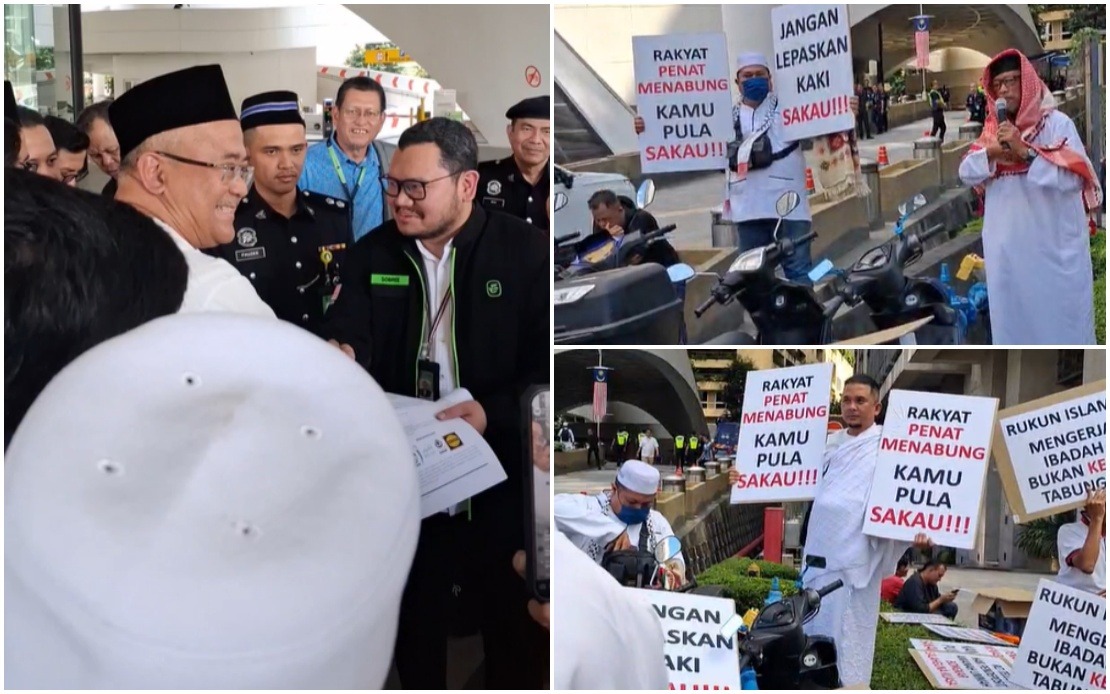
The Royal Commission of Inquiry into Lembaga Tabung Haji's management has become a defining moment for how Malaysia handles institutional accountability, with the MADANI coalition's leadership now insisting that any subsequent investigations must remain insulated from political pressure or manipulation. Speaking at a solidarity gathering at Menara TH in Kuala Lumpur, MADANI chairman Amir Zuhair Abdull Khalid stressed that the RCI's findings covering the 2014 to 2020 period deserve rigorous examination through established legal channels, not through the distorting lens of partisan politics or external pressure.
The distinction Amir Zuhair drew between political grandstanding and genuine accountability reform reflects a deeper concern within Malaysia's civil society about how high-profile investigations are conducted. Rather than allow the RCI report to become fodder for competing political narratives, he urged all stakeholders to respect the independence of investigative bodies, particularly the Malaysian Anti-Corruption Commission (MACC), which will likely play a central role in pursuing cases arising from the inquiry's conclusions. This appeal carries particular weight given Malaysia's history of investigative processes becoming entangled with political cycles, sometimes resulting in selective prosecutions or uneven application of the law.
What makes this situation especially sensitive is the scale of public funds and depositor trust at stake. Tabung Haji manages the financial assets and religious savings of millions of Muslim Malaysians, making any mismanagement or governance failure a matter that extends far beyond administrative irregularities. The RCI's examination of the institution's operations during a six-year period has already uncovered troubling patterns, and the legitimacy of any corrective action depends entirely on whether investigations appear and function as genuinely independent inquiries rather than tools of political advantage. Amir Zuhair's repeated injunction against interference thus serves as a guardrail against the politicization of what should be a straightforward pursuit of accountability.
The RCI report itself appears to have identified not merely financial mismanagement but also structural governance failures, including allegations that political considerations influenced board appointments and decision-making processes. These findings suggest that the institution's problems were not incidental to its mission but embedded in how leadership positions were allocated and how priorities were determined. Addressing such systemic issues requires investigations that follow evidence wherever it leads, without regard to which political figures or interests might be implicated. This is why the call for transparent, interference-free proceedings has become essential framing for the MADANI coalition.
Amir Zuhair emphasized that determinations of guilt or innocence cannot be made in the court of public opinion or through political rhetoric but must instead emerge from formal legal proceedings with proper prosecutorial oversight. This procedural insistence reflects a mature understanding that while the RCI has documented findings and made determinations, those conclusions must now be translated into actionable evidence for the courts. The gap between a commission's report and a criminal conviction requires meticulous investigation, charging decisions, and trial proceedings, all of which can be compromised if external pressures are brought to bear on investigating or prosecuting authorities.
The coalition of Islamic non-governmental organizations that accompanied this call for transparent investigations has submitted a list of ten demands to the government, signaling that civil society expects concrete action rather than mere rhetoric about accountability. These demands encompass immediate legal proceedings against those found responsible, systematic recovery of losses and misappropriated assets, full implementation of the RCI's recommendations for governance reform, and sustained attention to institutional restructuring under the MADANI government's framework. This multi-pronged approach acknowledges that the investigation phase is only the beginning; genuine institutional reform requires follow-through on multiple fronts simultaneously.
The broader Southeast Asian context makes Malaysia's handling of this case significant. Across the region, large state-linked financial institutions managing religious or community funds have sometimes become entangled in governance scandals, and how Malaysia navigates the Tabung Haji inquiry may establish a template for how the nation approaches similar challenges. The region watches how ASEAN members reconcile the tension between swift, visible accountability and the procedural safeguards necessary to prevent justice systems from becoming instruments of political factional conflict. Malaysia's approach to this particular case could influence expectations and standards across neighboring jurisdictions.
For ordinary Malaysian depositors whose life savings rest with Tabung Haji, the stakes are deeply personal. Many have made contributions over decades with the expectation that their funds would be managed prudently and grow steadily toward retirement or hajj aspirations. If governance failures have resulted in losses, affected depositors deserve not merely symbolic gestures of accountability but tangible asset recovery and structural reforms that prevent recurrence. This reality underscores why the MADANI coalition's insistence on transparent, uncompromised investigations resonates beyond elite political circles.
The invitation for all stakeholders to refrain from exerting pressure on investigating authorities also implicitly addresses the risk that public political noise could inadvertently obstruct investigators by creating incentives for premature conclusions or selective prosecution. While public attention can sometimes encourage thoroughness by keeping investigative agencies accountable to the public eye, unmanaged political pressure can also introduce distortions. The careful balance Amir Zuhair sought to strike recognizes this tension, calling for vigilance without interference, transparency without grandstanding.
Moving forward, the success of this accountability process will be measured not merely by whether charges are filed and convictions obtained, but whether the broader institutional ecosystem at Tabung Haji is genuinely reformed. The RCI's recommendations will require implementation across governance structures, board composition, financial controls, and oversight mechanisms. Only by simultaneously pursuing legal accountability for individuals while advancing systemic reform can Malaysia address both the symptoms and underlying causes of the institution's failures. This requires sustained political commitment beyond the current news cycle, precisely the kind of principled follow-through the MADANI coalition has called for.

