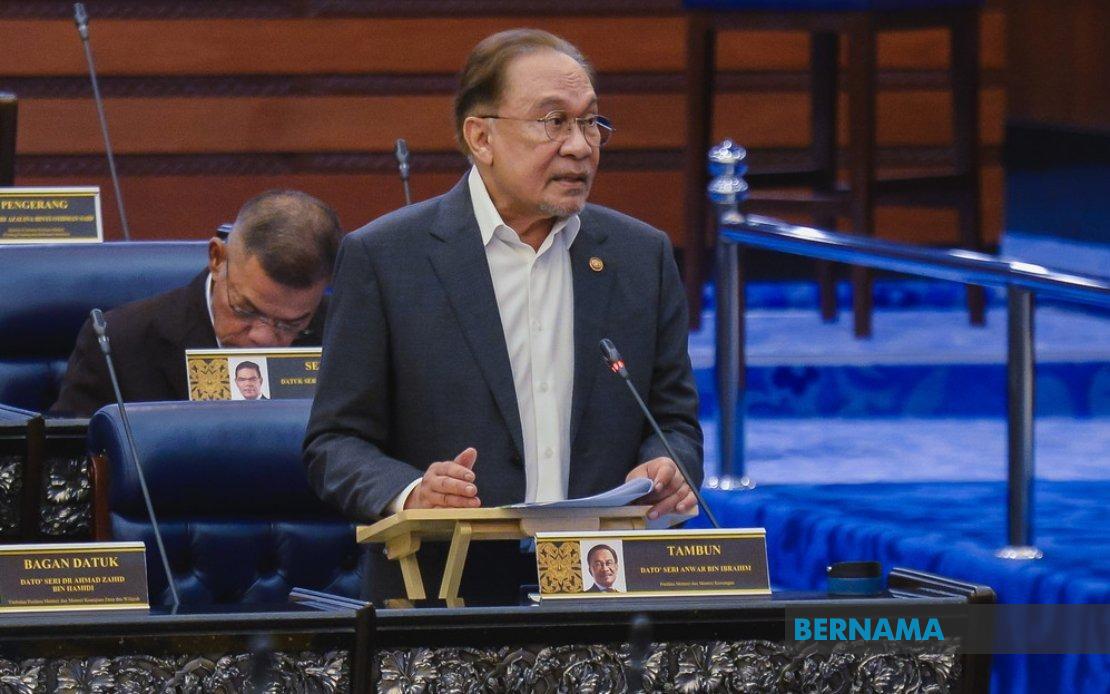
Prime Minister Datuk Seri Anwar Ibrahim has set a clear boundary on how the Federal Government will handle requests from state administrations for supplementary project funding, declaring that any application involving a Notice of Change must undergo formal renegotiation before approval. Speaking in the Dewan Rakyat, Anwar underscored the significance of this protocol, explaining that such financial requests carry substantial implications that cannot be resolved through simple bureaucratic rubber-stamping.
The Prime Minister's intervention addresses a structural tension that has long plagued Malaysia's federal-state funding arrangements. When states issue a Notice of Change—a formal modification to project specifications or scope—the financial consequences ripple upward to federal authorities. Anwar's position essentially establishes that the Federal Government will not automatically accommodate cost overruns simply because a state has contractually committed to them. This reflects growing fiscal discipline in Putrajaya after years of sprawling development expenditures across different administrations.
Anwar identified multiple critical factors that must be examined during any renegotiation process. First among these is determining the contractor's culpability in driving up costs. This distinction matters enormously: if construction companies have failed in proper estimation or underpriced tenders to secure contracts, the Federal Government should not absorb losses arising from their miscalculation. Conversely, if external factors such as material price volatility or supply chain disruptions caused increases, the analysis might lean differently. Only through rigorous investigation can accountability be properly assigned.
The second dimension Anwar emphasized concerns federal fiscal sovereignty. The Prime Minister explicitly stated that the Federal Government cannot be bound by decisions originating from state-level administrations and cannot allow itself to be automatically triggered into providing loans or allocations whenever project costs escalate. This principle, though straightforward in concept, has frequently been breached in Malaysian governance, creating moral hazard wherein states perceive the federal coffers as unlimited backstop for their financial mismanagement or poor planning.
The Kedah water project that prompted these remarks illustrates the practical stakes involved. The Pulau Bunting Water Treatment Plant requires federal approval for its Notice of Change, meaning that Kedah cannot simply proceed with cost additions and expect reimbursement. Instead, state officials must enter substantive negotiations with federal counterparts, presenting justifications for the increases and proposing revised funding mechanisms. This approach forces states to demonstrate genuine need rather than making casual requests.
For Malaysian readers and regional observers, Anwar's statement signals a recalibration of how the Federal Government intends to manage intergovernmental finances during the remainder of his administration. Previous governments have varied considerably in their willingness to discipline state spending, sometimes treating supplementary allocations as political favours doled out to friendly state administrations. By establishing transparent renegotiation protocols, Anwar appears intent on depoliticizing such decisions and placing them on a more rational, evidence-based footing.
The implications extend beyond individual projects. State administrations across Malaysia now understand they must budget more carefully and cannot treat federal resources as infinitely flexible. This should incentivize better project planning, more realistic tendering processes, and more realistic initial cost estimates. States that submit applications riddled with gaps or dependent on optimistic assumptions will face tougher scrutiny during renegotiation.
Deputy Prime Minister and Energy Transition and Water Transformation Minister Datuk Seri Fadillah Yusof was tasked with providing further technical details on the framework governing these renegotiations. This delegation to a specific minister with portfolio responsibility suggests the Federal Government is developing formal guidelines rather than handling cases ad hoc. The existence of systematic procedures, properly documented and applicable across different sectors and states, represents institutional progress in federal-state relations.
The water sector context is particularly relevant, given Malaysia's ongoing challenges with urban water supply reliability and infrastructure aging. Kedah's Pulau Bunting project exists within this broader landscape of necessary investment. However, necessity does not exempt projects from financial discipline. States must still justify why initial estimates were inadequate and what new information or conditions prompted the changes. This scrutiny protects public funds while supporting genuinely essential infrastructure.
For Southeast Asia more broadly, Malaysia's approach carries instructive value. Federal systems across the region frequently struggle with cost escalation in development projects and the resulting pressure on central governments to subsidize state-level decisions. Anwar's insistence on renegotiation as a mandatory step introduces a circuit-breaker into this dynamic, preventing automatic approvals and forcing dialogue.
The policy also reflects Malaysia's fiscal pressures in the post-pandemic era. The government's debt-to-GDP ratio remains a concern, and indiscriminate spending approvals exacerbate that problem. By tightening controls over supplementary allocations, the Federal Government protects medium-term debt sustainability while still allowing genuinely justified projects to proceed after proper evaluation. This balance is essential for long-term economic stability.
Moving forward, state governments submitting Notice of Change applications should prepare comprehensive documentation explaining cost increases, demonstrating they explored cost-reduction alternatives, and proposing how additional funding will be sourced or reprogrammed. The days of expecting automatic federal approval appear to be ending under Anwar's administration, marking a significant shift in Malaysia's federal-state fiscal relations and establishing expectations that state leaders must operate within tighter financial constraints.

