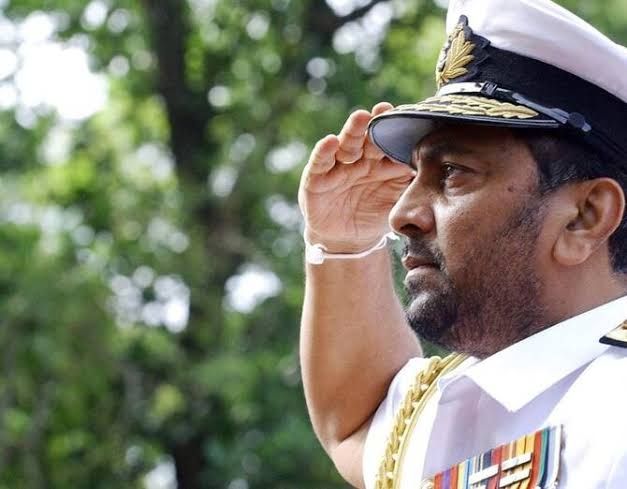
Sri Lanka's anti-corruption authorities have arrested a retired senior naval officer in connection with a scheme to unlawfully recruit the son of former president Mahinda Rajapaksa into the armed forces. Admiral of the Fleet Wasantha Karannagoda, 73, was taken into custody by the Bribery Commission on Friday over his alleged role in the 2006 enlistment of Yoshitha Rajapaksa, who reportedly lacked the necessary qualifications for the position.
Karannagoda held the position of navy commander during the final years of Sri Lanka's protracted civil war against Tamil separatists, serving in that capacity when the conflict concluded in 2009. The military establishment elevated him to the rank of admiral of the fleet a decade later in 2019, a ceremonial distinction that has left him without operational responsibilities in recent years. The Bribery Commission's formal statement characterized his actions as constituting corruption in the recruitment and training processes involving the former president's son, drawing a direct connection between his conduct and the admission of an unqualified candidate.
Yoshitha Rajapaksa, now 38 years old, currently remains free on bail pending trial after his arrest last month for related charges. Investigators allege that he misappropriated state resources to finance his attendance at the Royal Navy's prestigious Dartmouth Naval College in Britain, raising serious questions about how public funds were deployed for his personal advancement. The younger Rajapaksa's rapid ascent through military ranks despite lacking standard entry credentials has become emblematic of the broader pattern of nepotism and privilege that characterised his father's presidency.
The arrest of Karannagoda represents a significant escalation in Sri Lanka's pursuit of accountability for historical grievances and systemic corruption. Beyond the current recruitment allegations, the former admiral faces grave charges related to his command during the final phase of the civil war. International sanctions imposed by Britain in March 2025 reflect the seriousness of accusations against him, including allegations of serious human rights violations and extrajudicial killings that occurred under his watch. These formal designations represent a rare instance of international pressure applied to Sri Lankan military figures, underscoring the gravity of the alleged conduct.
Additionally, Karannagoda faces charges of conspiracy to murder concerning the deaths of eleven young men between 2008 and 2009, crimes that had previously been dismissed when political circumstances favoured their suppression. Those charges were initially abandoned in October 2021 during the presidency of Gotabaya Rajapaksa, Mahinda's younger brother, when the family wielded substantial political influence over the judicial system. However, the landscape shifted dramatically with the election of President Anura Kumara Dissanayake in September 2024, who campaigned explicitly on a platform of rooting out systemic corruption and investigating long-dormant high-profile criminal matters that implicated powerful figures.
Dissanayake's administration has prioritised prosecuting unresolved cases against members of the Rajapaksa dynasty and their close circle, demonstrating a marked departure from the impunity that previously sheltered the family. This policy reversal reflects broader public frustration with decades of corruption and arbitrary state violence that went unpunished under successive administrations. Multiple family members and associates now face diverse criminal charges spanning embezzlement, misappropriation of public resources, and crimes against humanity, though these cases remain in various stages of judicial proceedings across the courts.
The focus on Yoshitha Rajapaksa's financial improprieties extends beyond the military recruitment matter. Prosecutors are investigating how he accumulated sufficient wealth to purchase residential property during his father's tenure as president, a period spanning 2005 to 2015 when the family accumulated considerable material assets. In responding to investigators' queries, the younger Rajapaksa claimed that he had funded the property purchase through proceeds from selling gemstones gifted by his paternal grandaunt, a narrative that unravelled under scrutiny when the elderly relative could not account for how she had originally obtained such valuable stones. This explanation exemplifies the murky financial dealings that characterised the family's decade in power.
The legal jeopardy facing the Rajapaksa family has widened considerably under the new administration. Gotabaya Rajapaksa, the former president who briefly served after his brother's administration concluded, has been subjected to international travel restrictions pending investigation into alleged connections to the 2019 Easter Sunday bombings, a coordinated series of attacks targeting hotels and churches that killed 279 people and injured hundreds more. His attempted detention overseas underscores the extent to which the family's political fortunes have reversed and how their previous allies in state institutions have withdrawn protection.
For Malaysian observers, the Rajapaksa case offers instructive parallels regarding institutional accountability and the dangers of prolonged impunity for powerful figures. Sri Lanka's experience demonstrates how a change in political leadership can enable prosecutions that were previously deemed untouchable, provided there exists sufficient political will and public demand for justice. The revival of dormant cases against Karannagoda and other military figures illustrates the vulnerability of historical compromises that sacrifice justice for temporary political stability. Additionally, the focus on financial crimes and nepotistic practices reflects growing regional concern about how elite networks exploit state resources for personal enrichment, a phenomenon that extends across South and Southeast Asia.
The broader trajectory of these investigations suggests that Sri Lanka's judicial system, despite years of political manipulation, retains capacity to function when shielded from executive interference. The Dissanayake government's commitment to prosecuting corruption contrasts sharply with the obstruction that characterised earlier periods, indicating that institutional reform remains possible even in contexts marked by historical politicization. However, the pendency of numerous cases, sometimes stretching across years, underscores the glacial pace of justice and the practical difficulties of mounting complex prosecutions involving powerful defendants with extensive resources for defence.

