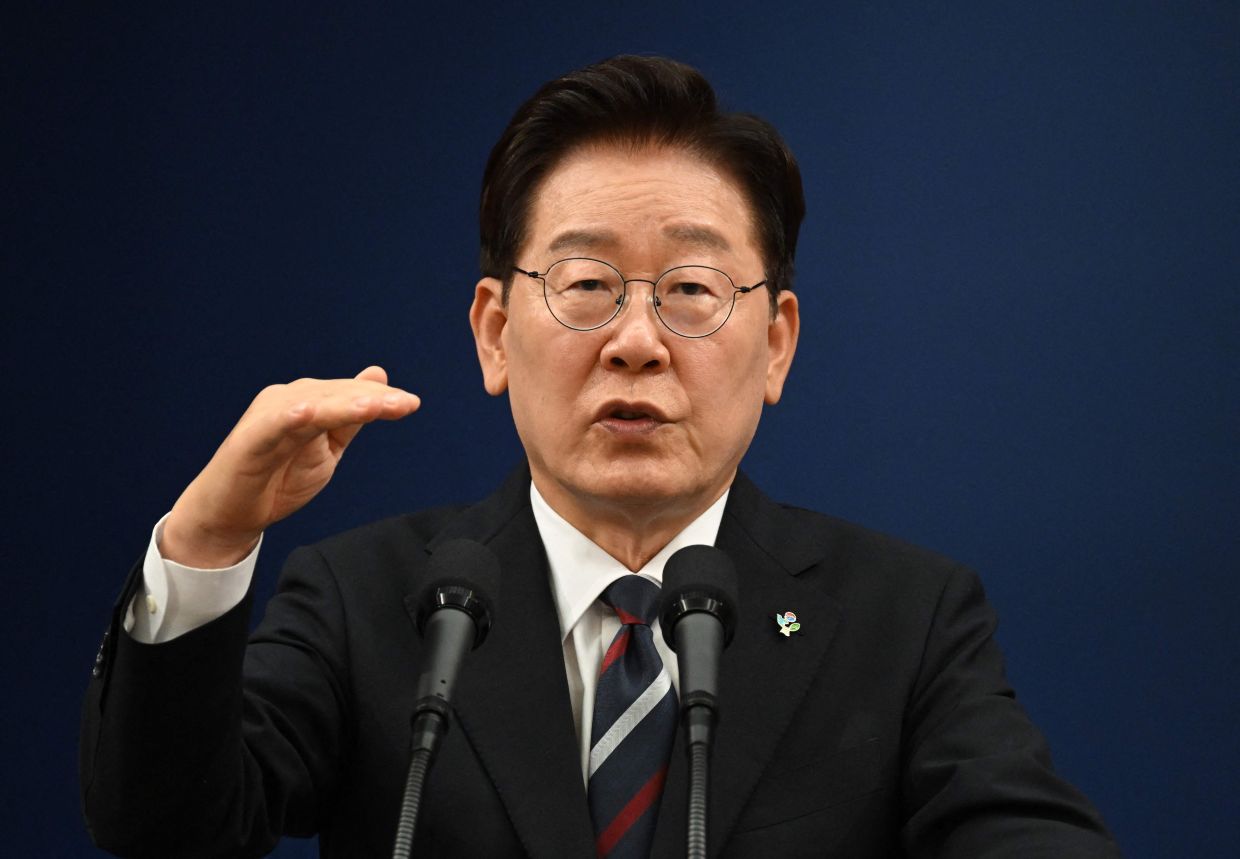
South Korean President Lee Jae Myung has experienced a significant political setback as his approval rating slipped below the 50 per cent threshold for the first time since assuming office on June 4, 2025. According to a Realmeter survey conducted from June 15 to June 19, his approval rating fell to 46.7 per cent, representing a decline of 4.8 percentage points from the previous week and marking the fifth consecutive week of erosion in public support. This crossing of a symbolic political divide carries substantial implications for his government's ability to advance its legislative agenda and maintain coalition stability heading into the second half of his term.
The deterioration in presidential approval becomes more striking when mapped against the trajectory of Lee's first weeks in office. His rating started at approximately 60.5 per cent in mid-May and has experienced an almost uninterrupted decline, with marginal recovery during brief windows before resuming its downward march. The movement from 59.3 per cent to 59.1 per cent to 55.2 per cent in successive weeks before reaching 51.5 per cent in mid-June illustrates a steady erosion of confidence. The latest dip to 46.7 per cent represents not merely a statistical adjustment but reflects genuine public disappointment accumulating across multiple policy fronts and governance challenges.
Crucially, negative assessments now constitute 49.7 per cent of all responses, surpassing positive views and establishing what pollsters characterise as a structural unfavourable environment for the administration. Though this margin remains within the survey's margin of error of plus or minus 2 percentage points, the symbolic importance of disapproval exceeding approval cannot be overstated in South Korean politics, where the 50 per cent threshold carries psychological weight among both the general public and political analysts. The remaining 3.6 per cent of respondents expressed uncertainty, suggesting relatively high polarisation within the electorate.
Two principal factors have driven this decline, according to Realmeter's analysis. The first concerns ballot shortages that occurred during the June 3 local elections, which sparked immediate political controversy and demands for accountability from various constituencies. The second stems from intensifying factional disputes within Lee's ruling Democratic Party of Korea as various factions position themselves ahead of the August 17 convention to select a new party chair. This confluence of external electoral mismanagement and internal party turbulence has created a negative political environment that the pollster suggests has overshadowed otherwise positive developments such as Lee's recent European trip and stock market recovery above the 9,000-point mark on the Kospi.
Geographical analysis reveals significant regional variation in Lee's support collapse, with particular vulnerability in traditionally conservative areas that have historically formed his political base. In Daegu and North Gyeongsang Province, conservative strongholds, his approval plummeted 9.9 percentage points to just 34.6 per cent, suggesting substantial defection among core supporters. The Greater Seoul metropolitan region, encompassing Incheon and Gyeonggi Province alongside the capital itself, demonstrated similarly steep declines of 7.6 percentage points each, with Seoul's rating reaching just 39.8 per cent. These metropolitan declines carry particular political weight, as Greater Seoul accounts for nearly half of South Korea's population and represents a swing region critical to electoral outcomes.
Ideological fracturing within Lee's coalition presents an additional governance challenge revealed by the survey's demographic breakdowns. Support among moderate voters fell 4.9 percentage points to 47.5 per cent, suggesting that centrist voters—often the most volatile segment—are particularly susceptible to current political messaging regarding government performance and economic management. Liberal voters, theoretically outside Lee's natural constituency, nevertheless represent a significant approval base at 80.4 per cent, though this declined 3.2 percentage points, indicating some softening even within the ruling party's core demographic. Conservative voters showed more resilience, with approval declining only 0.7 percentage points to 19.8 per cent, yet this low absolute figure underscores the limited enthusiasm among ideological conservatives.
The presidential office responded to the polling data with a statement emphasising humility and responsiveness, acknowledging that public assessments reflect evaluations of both economic conditions and broader governance performance. Cheong Wa Dae indicated that the administration would intensify attention to public concerns and expectations, suggesting an implicit recognition that current policies or communications strategies require recalibration. This defensive posture contrasts with the relatively strong political mandate Lee possessed upon taking office and indicates the rapidity with which presidential coalitions can fracture when early governance challenges accumulate without offsetting positive developments.
Contextual comparison with Lee's predecessors illuminates whether his current difficulties represent normal early-term volatility or signal more profound political problems. Former President Yoon Suk Yeol experienced disapproval exceeding approval within six weeks of his June 2022 inauguration, substantially faster than Lee's trajectory. Former President Park Geun-hye took approximately 16 months to reach this threshold in June 2014, while Moon Jae-in required 19 months to experience this crossover in December 2018. Lee's timeline of roughly six weeks to reach negative territory places him squarely between these precedents, suggesting that while his decline has been steep, it falls within historical parameters for troubled South Korean presidencies.
Parallel party-level polling conducted by Realmeter reveals a more nuanced political landscape where the conservative People Power Party maintains a narrow advantage over the opposition Democratic Party despite internal turbulence. The People Power Party held 42.3 per cent support compared to the Democratic Party's 40.1 per cent, though this gap narrowed from the previous week's more comfortable margin. The Democratic Party's recovery of 2.1 percentage points reflects the temporary rallying effect of a bipartisan agreement to investigate election administration failures, demonstrating that cross-party cooperation on accountability issues can yield modest political dividends for opposition parties.
The People Power Party's support, however, exhibits troubling weakness among younger demographics that portends longer-term political challenges. Support among voters in their twenties collapsed 10.5 percentage points to 48.6 per cent, while the thirty-something cohort saw declines of 5.1 percentage points to 47.4 per cent. These generational defections suggest that the party's response to election management controversies and internal leadership disputes has failed to resonate with voters who increasingly prioritise government competence and political stability. For Malaysia and other Southeast Asian democracies monitoring South Korean political developments, Lee's situation underscores how election administration failures and party-internal conflict can rapidly undermine executive authority even absent fundamental policy disagreements.
The implications of Lee's declining approval extend beyond domestic Korean politics to regional considerations. South Korea's international relationships, defence posture regarding North Korea, and economic policy coordination with regional partners—including Malaysia through ASEAN frameworks—typically reflect presidential authority and domestic political stability. Extended periods of low presidential approval can constrain executive decision-making capacity and complicate international negotiations. For Malaysian policymakers and regional observers, Lee's political trajectory serves as a reminder that Asian democracies remain vulnerable to rapid legitimacy crises when governments fail to manage technical governance challenges effectively, regardless of ideological orientation or policy intentions.
Moving forward, Lee faces a compressed window to stabilise his approval rating before the August 17 Democratic Party leadership convention further disrupts the political environment. The convergence of persistent election fallout, internal party factionalism, and emerging economic concerns regarding asset market disparities—which pollsters identified as particularly damaging among moderate voters—suggests that tactical communications adjustments alone may prove insufficient. Whether Lee can reverse the downward trend depends substantially on whether his government demonstrates tangible progress on election administration reform and party unification, or whether the current negative trajectory persists into the second half of 2025.

