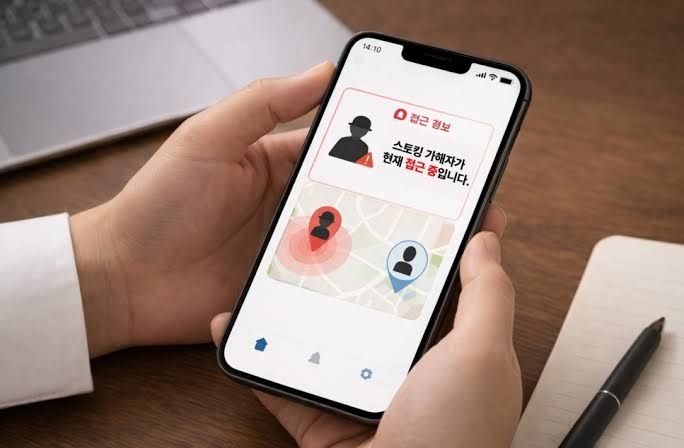
South Korea has introduced a groundbreaking mobile application that fundamentally reshapes how authorities protect stalking victims by granting them direct access to real-time location data of suspected perpetrators. Unveiled on June 24 through the Ministry of Justice, this system represents a significant technological advancement in victim protection, allowing individuals to monitor a stalker's current whereabouts and track their directional movements through a dedicated smartphone interface. The initiative signals recognition by Seoul that existing safeguards had proved inadequate, prompting officials to deploy more sophisticated digital tools to address what has become an increasingly urgent public safety concern across the nation.
The urgency behind this new system stems from a disturbing pattern of failures within South Korea's existing protective infrastructure. Between 2021 and August 2025, data compiled by Representative Lee Gwang-hee of the ruling Democratic Party of Korea revealed that 23 victims were either murdered or subjected to attempted murder despite having been equipped with emergency alert devices. This stark statistic underscores a critical vulnerability: reactive alert systems that notify victims of danger after the fact proved insufficient to prevent the most severe outcomes. By contrast, the location-tracking capability embedded in the new application offers a preventative dimension, enabling victims to anticipate threats and adjust their movements accordingly before dangerous situations develop.
Electronic monitoring of suspected stalkers has only recently been formally integrated into South Korea's criminal justice framework. Beginning in 2024, courts began ordering the installation of ankle monitors in certain high-risk stalking cases, complementing the smartwatch-type emergency alert devices that authorities had been distributing to victims for several years prior. This layered approach reflects an acknowledgment that no single protective mechanism suffices to counter the sophistication and persistence of determined stalkers. The new app essentially bridges the gap between these two technologies, transforming ankle monitors from tools that merely track criminals for law enforcement purposes into instruments that directly serve the safety interests of the people they endanger.
Implementing a system that broadcasts real-time location data of individuals under court order inevitably raises complex privacy considerations. To navigate these concerns responsibly, the Justice Ministry undertook a comprehensive revision of regulations governing electronic monitoring in December 2025. These regulatory amendments establish boundaries around how location information may be accessed, retained, and shared, ensuring that the expansion of victim access does not inadvertently create new vulnerabilities or authorise unnecessary surveillance. This regulatory framework reflects international best practice in balancing victim protection with the fundamental privacy rights of suspects, even those accused of serious offences.
The implications of South Korea's approach extend beyond that nation's borders, particularly for Southeast Asian jurisdictions grappling with similar gaps in stalking victim protections. Many countries throughout the region, including Malaysia, rely primarily on conventional restraining orders and periodic police patrols to deter would-be perpetrators—mechanisms that operate on assumption rather than real-time intelligence. South Korea's technological solution offers a template for how developing economies might leverage smartphone penetration and monitoring infrastructure to create victim-centric safety systems without requiring massive investments in traditional law enforcement capacity. As digital stalking and harassment increasingly transcend borders, regional policymakers may find value in studying how Seoul has structured both the technical architecture and privacy safeguards underpinning this innovation.
The government's roadmap extends beyond the current application rollout. The Ministry of Justice has announced plans to introduce an additional procedural reform scheduled for April 2027 that would permit stalking victims to petition courts directly for restraining orders, circumventing the requirement to work through law enforcement agencies. This structural change represents a philosophical shift toward victim empowerment, acknowledging that survivors often possess superior knowledge of their circumstances and should retain greater agency in determining the legal protections they seek. Currently, victims must convince police to file court requests on their behalf—a process that can introduce delays and, potentially, institutional resistance to protective orders.
This multi-layered reform strategy reveals sophisticated policy thinking about the various phases through which stalking cases typically progress. Early intervention through direct petition mechanisms may prevent cases from escalating to the point where electronic monitoring becomes necessary. Where monitoring is eventually ordered, real-time location access empowers victims to maintain situational awareness and modify behaviour to minimise risk exposure. Together, these systems create a comprehensive protective ecosystem that addresses both the structural and technological dimensions of victim safety. The fact that South Korean officials have sequenced reforms across multiple years suggests confidence that these interventions will work synergistically rather than in isolation.
For Malaysian readers, the South Korean experience offers instructive lessons as policymakers contemplate technological solutions to persistent crime challenges. The country's willingness to invest in smartphone-based systems that serve protective purposes reflects broader recognition that digital infrastructure, when properly governed, can enhance rather than merely threaten public safety. Malaysia's own digital ecosystem has expanded dramatically, creating potential opportunities to implement comparable protective technologies. However, success would require not only technical capability but also institutional confidence in victim-centred justice approaches and genuine commitment to privacy safeguards—prerequisites that demand careful institutional and regulatory preparation.
The broader context shaping South Korea's initiative involves changing patterns of interpersonal violence and technological sophistication among perpetrators. Traditional stalking has evolved to incorporate digital harassment, location tracking via smartphones, and coordinated online campaigns designed to intimidate and isolate victims. Conversely, protective technologies have become more sophisticated, enabling authorities and victims to respond with equivalent technical capability. South Korea's app system represents a calculus that granting victims technological power to monitor their stalkers may prove more effective than relying solely on law enforcement reactivity or the passive reassurance provided by emergency alert buttons.
As this system begins operations, questions remain about implementation challenges and long-term effectiveness. Victim engagement with the application will depend partly on user interface design and the reliability of underlying monitoring systems. Equally important will be how law enforcement agencies integrate the victim-facing app with their own investigative processes, ensuring that alerts generated through the system lead to timely intervention rather than merely documenting patterns of concerning behaviour. The coming months and years will generate empirical evidence about whether real-time location access genuinely deters further stalking or merely shifts perpetrator tactics toward new channels of harassment. South Korea's willingness to measure and refine these systems iteratively will likely determine whether this technological innovation becomes a replicable model for victim protection throughout the region.

