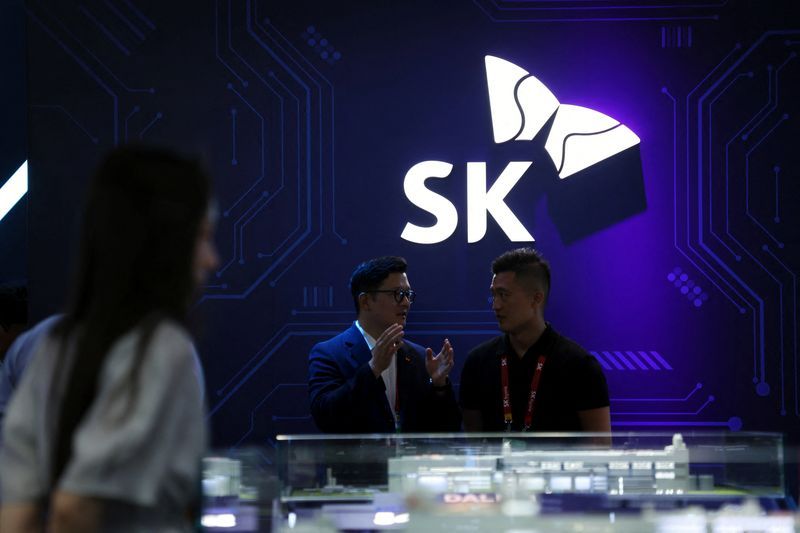
South Korea's SK Hynix revealed on Wednesday its intention to mobilise up to 45.45 trillion won, equivalent to $29.43 billion, through a listing of American Depositary Receipts as the technology company moves to broaden its shareholder base and accelerate capacity expansion for memory semiconductors powering artificial intelligence systems globally. The company submitted a regulatory filing confirming the offering details, though it cautioned that the final amount raised could shift following the bookbuilding phase, which determines actual investor demand and pricing.
The Nasdaq-listed ADRs will be backed by 17.79 million newly issued shares, with each ten ADRs representing a single common share in the company. Settlement is scheduled for July 10, marking a significant milestone in global semiconductor financing. Four major investment banks—BofA Securities, Citigroup Global Markets, Goldman Sachs, and JP Morgan Securities—are jointly managing the offering, reflecting the transaction's scale and strategic importance to global capital markets.
Should the offering price reach the top end of its indicated range, SK Hynix would eclipse Alibaba's 2014 New York debut that raised $21.8 billion, becoming the largest American Depositary Receipts offering in history. This record-breaking potential underscores investor appetite for exposure to semiconductor manufacturers capitalising on the artificial intelligence revolution sweeping through technology infrastructure globally.
Capital raised through this offering will finance multiple strategic investments essential to SK Hynix's growth trajectory. The company plans to construct a new chip fabrication facility in Yongin, establish an advanced packaging manufacturing centre in Cheongju, and acquire cutting-edge chipmaking equipment including an Extreme Ultraviolet Scanner—critical technology for producing the most advanced semiconductor nodes. These investments position SK Hynix to capture growing demand from data centres and computing systems requiring high-performance memory solutions.
SK Hynix has emerged as one of the primary beneficiaries of the global artificial intelligence boom, securing its position as a dominant supplier of high-bandwidth memory chips that form essential components in AI systems operated by major technology companies. Major customers including Nvidia and Alphabet's Google depend heavily on SK Hynix's memory products to power their machine learning infrastructure and computational platforms. This customer concentration among global technology leaders provides stable, long-term revenue visibility.
The company's strategic importance to the AI ecosystem was underscored when SK Hynix surpassed Samsung Electronics to become South Korea's most valuable corporation on Monday, a landmark moment reflecting shifting dynamics within the Korean technology sector. While Samsung has long dominated Korean market capitalisation, SK Hynix's explosive growth in high-margin AI-related semiconductor production has fundamentally altered competitive rankings. This shift highlights how emerging technology cycles can rapidly redistribute corporate value across established industrial players.
For Southeast Asian investors and policymakers, SK Hynix's expansion trajectory carries significant implications. The company's aggressive capacity expansion signals confidence in sustained demand for memory semiconductors across the region's developing AI infrastructure. Malaysia, Vietnam, and Thailand—nations actively building semiconductor supply chain capabilities—observe SK Hynix's investment patterns closely as indicators of where memory chip production will concentrate over the coming decade.
The ADR listing also reflects broader trends in how global capital flows toward semiconductor manufacturers positioned at the intersection of artificial intelligence and data centre development. By accessing American equity capital markets directly, SK Hynix gains institutional investor exposure while maintaining South Korean governance structures, a dual-listing strategy increasingly adopted by Asian technology champions seeking global growth capital.
Geopolitical considerations surrounding semiconductor supply chains remain relevant context for this capital raise. As Western economies seek to reduce dependency on concentrated memory chip suppliers, SK Hynix's expansion signals investment in capacity that could supply not only Asian markets but increasingly Western manufacturers relocating production closer to home markets. The company's growth investments therefore carry implications for global semiconductor geopolitics and supply chain resilience discussions.
Investor reception to the offering will provide critical signals about global appetite for semiconductor exposure amid artificial intelligence's rapid mainstream adoption. Strong demand for SK Hynix's ADRs would validate market confidence in memory chip demand extending well beyond current projections, potentially spurring competitive capacity investments by other manufacturers including Samsung, Micron Technology, and international foundries. Conversely, tepid interest would suggest concerns about oversupply or artificial intelligence deployment slower than promotional forecasts.

