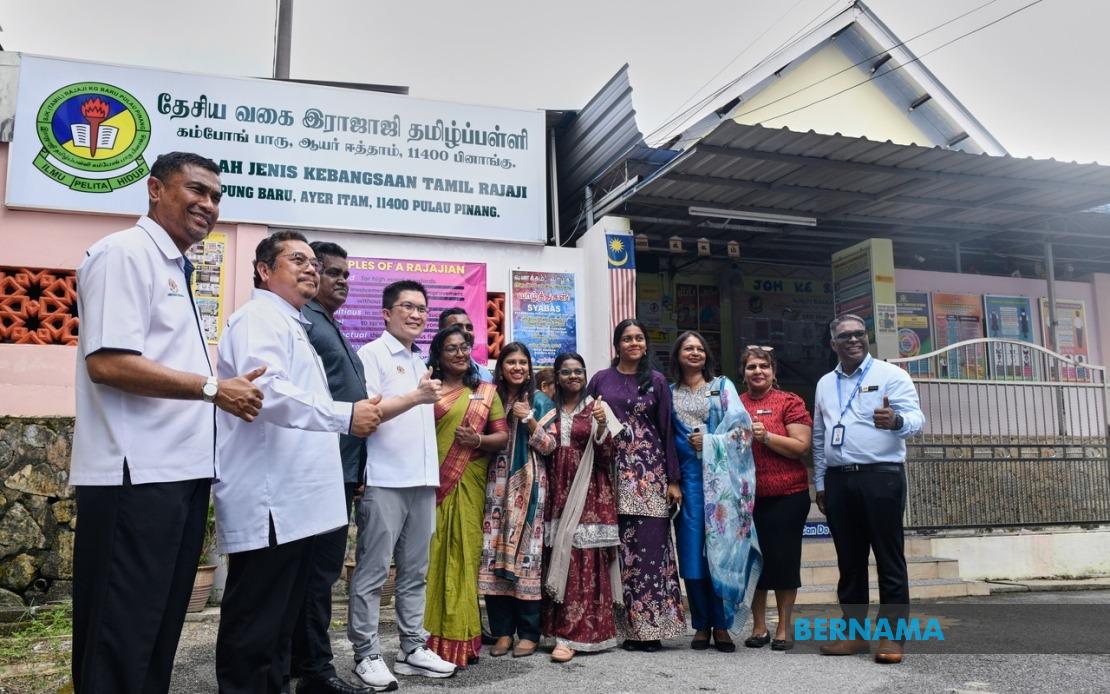
Sekolah Jenis Kebangsaan Tamil (SJKT) Rajaji in George Town has secured approval from the Education Ministry to construct a new RM8 million school building at a relocated site in Farlim, Bandar Baru Ayer Itam, marking a significant infrastructure upgrade for one of Penang's long-established Tamil-medium educational institutions. Deputy Education Minister Wong Kah Woh announced the development after presenting the formal approval letter, signalling the ministry's commitment to modernising Tamil school facilities across the northern region.
The existing institution, which has operated for 76 years, currently faces substantial operational constraints stemming from severe space limitations at its present location. With approximately 100 pupils enrolled, the school has struggled to provide adequate facilities and conducive learning environments within its cramped premises. This constraint has prompted both the school management and state authorities to pursue relocation as the most viable solution to improve educational quality and student welfare without compromising operational standards.
The relocation site spans 2.3 acres in Farlim, positioned roughly 500 metres from the school's current location. The Penang state government approved this land allocation in 2022, recognising the strategic value of maintaining the institution's presence within the same neighbourhood while providing substantially enhanced facilities. This proximity ensures minimal disruption to the existing student community and allows for continuity in the school's role within the local Tamil-speaking population.
Wong outlined the implementation timeline during his announcement, noting that construction activities are expected to require approximately 18 months to complete. The Education Ministry has projected that SJKT Rajaji will commence operations at the new site by the 2029 academic session at the latest, allowing sufficient buffer time for any unforeseen delays whilst maintaining momentum toward the relocation goal. This phased approach reflects careful planning to ensure students experience minimal educational interruption during the transition period.
The approval process itself involved coordinated efforts between multiple stakeholders. The school's board of governors submitted a formal application to the Education Ministry in 2023, which was subsequently approved after all outstanding issues with local authorities were satisfactorily resolved. This sequential resolution of administrative and regulatory matters demonstrates the collaborative governance approach required for such significant educational infrastructure projects in Malaysia's federal-state framework.
A particularly noteworthy aspect of the project is its funding mechanism. The entire RM8 million construction cost will be underwritten by a private sector developer as part of its corporate social responsibility initiatives. This arrangement exemplifies the growing partnership between government educational bodies and commercial enterprises in addressing infrastructure deficits within the school system. By leveraging CSR funding, the project avoids placing additional financial strain on the state government's education budget whilst still delivering essential modernisation.
State Housing and Environment Committee chairman and Penang Tamil Schools Special Committee chairman Datuk Seri S. Sundarajoo emphasised the broader significance of this development within Penang's Tamil school landscape. The state currently operates 28 Tamil national-type schools, many of which are undergoing concurrent development initiatives. These include efforts to secure permanent sites for schools lacking stable land tenure and the phased implementation of infrastructure improvements across multiple institutions.
Sundarajoo highlighted that groundbreaking ceremonies for at least three separate SJKT projects are scheduled to commence during the current year, indicating a coordinated push to upgrade Tamil school infrastructure across Penang. Additionally, several long-stalled projects, notably involving SJKT Sungai Bakap and SJKT Juru, are being revived and reactivated after periods of inactivity. This revival of dormant initiatives suggests renewed momentum and enhanced resource allocation toward Tamil education development.
The significance of these concurrent developments extends beyond mere facility improvements. Sundarajoo characterised the initiatives as reflecting a deliberate strategy to enhance Tamil school facilities without imposing burdensome costs on the state government. This approach acknowledges both the educational imperative to provide quality learning environments and the fiscal realities facing state budgets. By diversifying funding sources and engaging multiple stakeholders, Penang appears to be constructing a more sustainable model for Tamil school development.
For Malaysian policymakers and education observers, the SJKT Rajaji project offers insights into viable approaches for addressing infrastructure deficits within vernacular school systems. Tamil-medium schools have historically experienced funding constraints and facility limitations relative to their Malay and English-medium counterparts, affecting educational outcomes and student retention. The integration of corporate funding mechanisms with government oversight provides a potential template for scaling improvements across other states and ethnic-medium school systems.
The relocation also carries implications for property development and urban planning in Penang. The identification and allocation of land in Farlim demonstrates how education infrastructure requirements can be integrated into broader spatial planning frameworks, ensuring that growing residential areas maintain adequate institutional support.
For the 100 pupils currently enrolled at SJKT Rajaji and their families, the new facility promises transformative improvements. Modern classrooms, expanded recreational spaces, and purpose-built learning facilities will replace the existing cramped conditions, potentially enhancing educational outcomes and student engagement. The project thus represents not merely an administrative reorganisation but a tangible investment in student welfare and educational quality for a historically marginalised segment of Malaysia's school population.