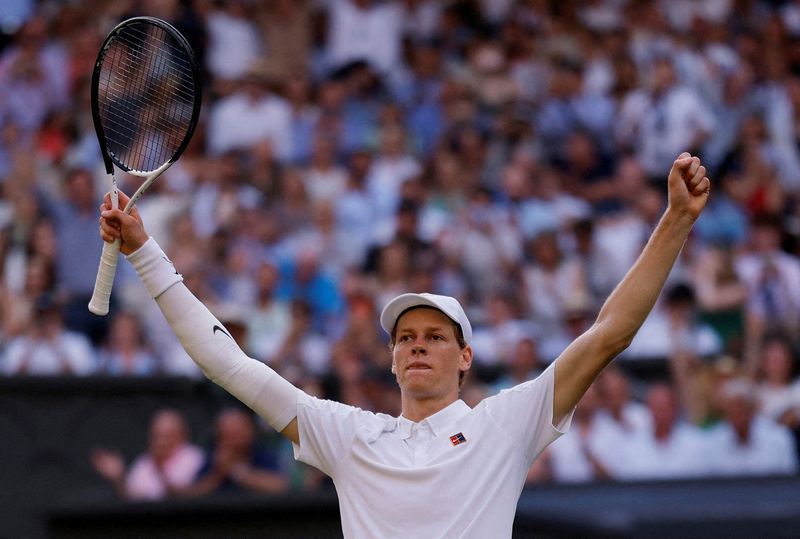
Jannik Sinner returns to the All England Club this week as defending Wimbledon champion, yet the Italian's previously formidable aura has been noticeably punctured. The world number one arrives for the grass-court Grand Slam having endured a jarring setback at Roland Garros last month, where physical difficulties curtailed what had been a remarkable winning streak and raised persistent questions about his durability under the intense pressure of tennis's major tournaments. With Carlos Alcaraz sidelined by injury, the landscape has shifted dramatically, creating a vacuum that several ambitious contenders are now poised to exploit.
Sinner's collapse in Paris marked a striking departure from the dominance he had orchestrated across the clay-court season. The 24-year-old Italian had constructed an impressive 30-match winning run stretching back to February before it evaporated in the second round at Roland Garros, a premature exit that contradicted his standing as the circuit's most commanding force. The physical strain that undermined his performance prompted considerable speculation about whether back-to-back tournament appearances with minimal recovery had depleted his reserves precisely when stamina mattered most. For a player accustomed to imposing his will through superior athleticism and consistency, the sudden vulnerability felt profoundly unsettling.
Mats Wilander, the seven-times Grand Slam champion, offered a measured assessment of Sinner's predicament while maintaining confidence in his eventual return to form. Wilander attributed the Paris disappointment primarily to accumulated fatigue rather than any fundamental weakness, noting that Sinner's compressed schedule across the two months preceding Roland Garros had afforded insufficient opportunity for meaningful training sessions and proper recuperation. The Swedish legend suggested that the respite Sinner has now taken should restore him to competitive readiness, though he cautioned that grass-court tennis presents its own distinct variables that cannot be overlooked. Wilander's perspective carries particular weight given his intimate knowledge of performing under pressure at the sport's highest level, and his assessment essentially positions Sinner as temporarily diminished rather than permanently damaged.
Yet Sinner's decision to bypass traditional grass-court tune-up tournaments before Wimbledon's Monday commencement has drawn scrutiny from rival camps. That unconventional preparation strategy, whether born from caution or calculated risk, provides limited concrete evidence of his readiness for the demands that lie ahead. Competitors and analysts alike will scrutinise every movement during his opening matches, searching for telltale signs of lingering physical hesitation or diminished explosiveness. In the absence of recent tournament data, such observations become especially significant for interpreting whether the rest has genuinely restored him or whether deeper concerns remain unresolved.
Novak Djokovic emerges as perhaps the most imposing figure in Sinner's defensive perimeter. The 39-year-old Serbian champion, whose exceptional movement and return capabilities render him perpetually dangerous on grass, carries particular motivation into this fortnight. Djokovic continues pursuing an historic 25th Grand Slam title—a standalone record that would surpass his current tie with Margaret Court—and time considerations render this window increasingly critical. At an age where elite performance becomes chronologically more precarious, Djokovic recognises that genuine championship opportunities may be narrowing. His own early exit from Roland Garros paradoxically strengthens rather than weakens his candidacy, as Andy Roddick astutely observed, since the setback provides psychological recalibration and renewed hunger.
Roddick, the three-times Wimbledon finalist whose podcast commentary carries credibility forged through personal experience, articulated a compelling case for Djokovic's genuine contention status. The American suggested that a seasoned competitor of Djokovic's calibre, surveying the altered landscape with Alcaraz absent and Sinner visibly shaken, would inevitably harbour realistic ambitions of capturing his eighth Wimbledon crown—a total that would match Roger Federer's unmatched record. Roddick's argument essentially proposes that Djokovic retains sufficient grasscourt mastery and competitive drive to exploit the momentary vulnerability created by contemporary circumstances.
Alexander Zverev, meanwhile, arrives as an entirely different proposition following his maiden Grand Slam triumph at Roland Garros. The 29-year-old German's breakthrough victory carries profound psychological implications beyond the trophy itself, particularly his demonstrated ability to sustain pressure through multiple rounds against elite opposition. Boris Becker, the six-times major winner and fellow German, has positioned Zverev as a genuine Wimbledon favourite, emphasising that the German's formidable serve—arguably the sport's most reliable weapon on grass—provides substantial structural advantages. Becker's analysis hinges on the argument that aggressive serving itself approximates a fast-track to the tournament's latter rounds, with successful grass-court specialists nearly automatically reaching the semi-final stage by virtue of that single weaponry.
Becker's endorsement carries particular resonance because it comes from someone intimately acquainted with Wimbledon's specific demands, having claimed the title twice during his illustrious career. The six-times champion's willingness to position Zverev above Sinner in the favourites conversation represents a notable departure from recent convention and reflects genuine assessment rather than mere patriotic bias. That Zverev must adapt his clay-court game to grass's different pace and bounce mechanics remains true, but Becker suggests that adaptation falls well within the German's technical repertoire and competitive experience.
Alcaraz's absence fundamentally restructures the contenders' configuration. The Spanish champion's dominance during his previous Wimbledon victories in 2023 and 2024 demonstrated rare grass-court mastery that few players can match, and his injury accordingly removes a player genuinely capable of controlling matches across multiple surfaces. That gap creates expanded opportunities for the secondary tier of contenders who might otherwise struggle against a fully healthy field. American contingent members Ben Shelton, Taylor Fritz, and Frances Tiafoe all possess the technical capabilities and physical attributes to trouble top-seeded opponents, particularly in early-round matchups before likely confronting the tournament's elite players.
Flavio Cobolli, the Italian who unexpectedly reached the Roland Garros final, represents another force within that emerging wave of younger challengers poised to capitalise on the transitional moment. Cobolli's recent elevation through the rankings and his demonstrated capacity to sustain performance across successive rounds suggests a player arriving at career inflection point. The convergence of these factors—Sinner's diminished certainty, Djokovic's renewed ambition, Zverev's breakthrough confidence, and Alcaraz's forced withdrawal—has genuinely democratised the draw in ways that favour multiple pathways to the trophy.
For Malaysian and Southeast Asian followers of professional tennis, this fortnight carries particular relevance in demonstrating how quickly established hierarchies can shift. The notion that a dominant player can be temporarily destabilised through physical circumstances offers perspective on the knife-edge margins separating success from disappointment at sport's highest echelon. Similarly, the opportunity for multiple contenders to stake legitimate championship claims reflects broader tennis evolution, where extended depth means traditional certainties no longer automatically prevail. Sinner's defence remains probable, but it has become substantially less predetermined than seemed imaginable mere weeks ago.

