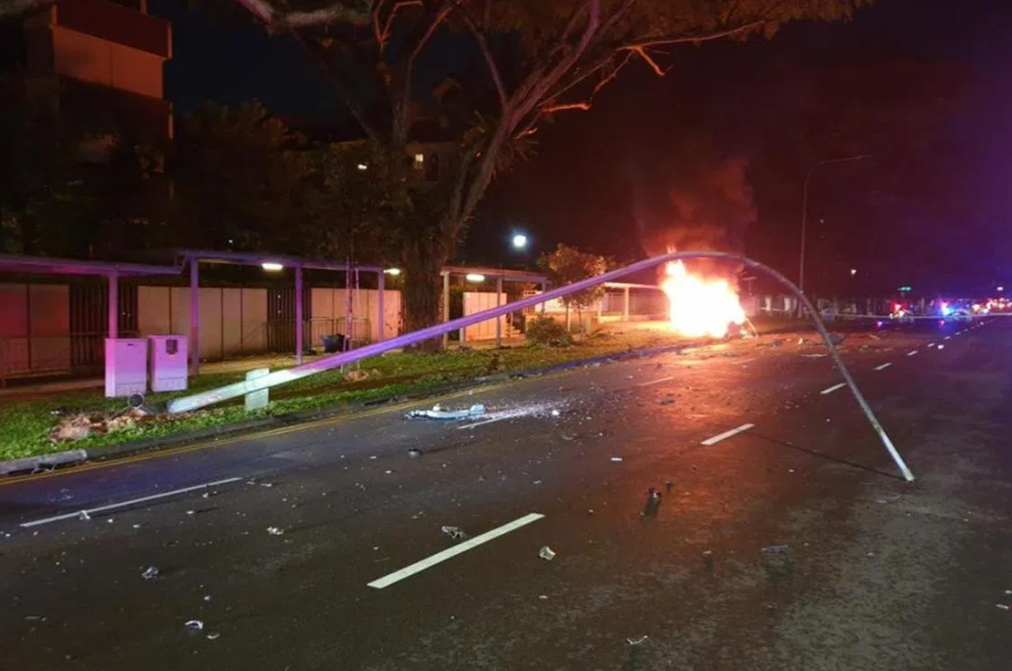
A 29-year-old Singaporean man has been charged with a constellation of serious traffic and drink-driving offences following a chaotic predawn incident on March 6, 2024, that culminated in a high-speed collision with a school bus and left his vehicle engulfed in flames. The charges—announced in court on Thursday June 18—underscore the escalating dangers posed by alcohol-impaired drivers on busy urban thoroughfares, particularly when innocent bystanders, including vulnerable young passengers, are endangered.
Aaron Tan Yao Cong initially triggered alarm bells when he ignored traffic controls along Cavenagh Road near Bukit Timah. Instead of proceeding straight as the signage dictated, he veered into a left-hand bend and proceeded deliberately into the oncoming traffic lane, bringing his vehicle to a halt on the left side of the two-lane carriageway. This manoeuvre, captured in police documentation, represented the opening moves of what would prove to be a particularly reckless episode spanning multiple kilometres across Singapore's established traffic network.
The situation deteriorated sharply when Tan, apparently panicked or defiant, accelerated away as police officers approached his burning vehicle at around 6am. His subsequent flight along Bukit Timah Road and Upper Bukit Timah Road saw his vehicle reach average speeds of 114 kilometres per hour, a particularly dangerous velocity for urban streets where pedestrians and other road users might reasonably expect safer conditions. Compounding this risk, Tan's driving pattern involved continuous weaving between other vehicles, a behaviour that multiplied the likelihood of catastrophic collision.
The climactic impact occurred at the junction of Sixth Avenue when Tan allegedly disregarded a red traffic light signal and smashed into a private bus executing a lawful U-turn. The collision's force proved sufficient to propel Tan's vehicle into a lamp post, an impact severe enough to ignite the car. Both Tan and three passengers managed to escape the burning wreckage, but the bus occupants—its driver and two young passengers aged nine and ten—required hospital treatment, with the two schoolchildren receiving particular medical attention for their injuries sustained in the crash.
What elevates this incident beyond a typical motor accident is the presence of alcohol impairment. When arrested, Tan refused to submit to a breathalyser examination at the roadside, a refusal that itself constitutes a separate criminal offence in Singapore. Subsequent blood analysis revealed 148 milligrams of alcohol per 100 millilitres of blood, a reading substantially exceeding Singapore's prescribed limit of 80 milligrams per 100 millilitres. For Southeast Asian readers, this context matters considerably: Singapore maintains some of the region's strictest drink-driving enforcement protocols, and exceeding the limit by nearly 85 percent represents a severe level of intoxication.
Tan's criminal history amplifies the seriousness of the current charges. He carries a prior conviction dating to 2019 for both drink-driving and driving without due care and attention, meaning he was not a first-time offender but rather someone whose previous encounters with the justice system apparently failed to deter subsequent dangerous behaviour. This pattern suggests either inadequate deterrence, insufficient rehabilitation through earlier sanctions, or a deliberate disregard for societal road safety standards.
The five charges formally laid against Tan encompass drink-driving, dangerous driving causing hurt, abandoning a vehicle in a manner likely to endanger others, refusing to cooperate with breathalyser procedures, and driving contrary to traffic flow. Each carries distinct sentencing frameworks. For the drink-driving charge as a repeat offence, Tan faces potential imprisonment of up to two years and fines reaching S$20,000. The dangerous driving causing hurt charge carries up to two years imprisonment and S$10,000 in fines, though repeat offenders can face doubled fines. The remaining charges carry lesser but cumulatively significant penalties including up to six months imprisonment for refusing the breathalyser and three months for contravening traffic directions.
Singapore's judicial approach to repeat drink-drivers typically proves substantially harsher than first-time offenders, reflecting the jurisdiction's zero-tolerance stance toward behaviours that demonstrably elevate road fatality risks. This case exemplifies the legislative intent: not merely punishing dangerous conduct, but specifically aggravating sentences when offenders have previously received warnings through criminal conviction. The involvement of injured children intensifies public concern around licensing standards and whether individuals with problematic driving records should retain unrestricted driving privileges.
For Malaysian road safety advocates, this incident carries instructive lessons. Malaysia's own traffic enforcement statistics reveal recurring challenges with impaired driving, particularly along major metropolitan routes and during early morning hours when monitoring may prove less intensive. The escalation visible in Tan's behaviour—initial traffic violation expanding rapidly into high-speed flight—demonstrates how early intervention points matter critically in preventing cascading dangerous conduct.
Tan's case also highlights the effectiveness of Singapore's technology infrastructure in documenting sequential violations. The precise timestamps, speed measurements, and traffic light status at each junction reflect sophisticated camera and detection systems that establish prosecution-ready evidence. Malaysian authorities and regional traffic safety stakeholders continue developing comparable capabilities, though deployment remains inconsistent across different states.
The two injured children on the school bus represent the most troubling dimension of this incident. Young passengers depend entirely upon other road users' compliance with safety regulations and their own sobriety. When an impaired driver operates a vehicle at dangerously elevated speeds whilst contravening multiple traffic controls, the randomness of who occupies adjacent vehicles becomes horrifyingly consequential. That schoolchildren travelled to hospital with injuries directly attributable to one man's deliberate disregard for traffic laws raises fundamental questions about licence retention policies and whether mandatory ignition interlock devices should be imposed upon repeat offenders.
Tan will return to court on July 16, at which point he must formally respond to the charges. He has not yet indicated whether he intends to plead guilty to any count or contest the allegations. Given the documentary evidence encompassing police observations, vehicle telemetry, traffic system records, and medical examinations, conviction appears substantially probable. The sentencing phase will likely depend upon whether courts view the injury to schoolchildren as an aggravating factor warranting sentences toward the upper end of available ranges, thereby signalling to other drivers that drink-driving resulting in harm to vulnerable passengers carries particularly severe consequences.
Regional road safety organisations monitoring this case will assess whether Singapore's judicial response aligns with neighbouring jurisdictions' approaches to repeat offenders and whether the severity of punishment proves sufficient to deter comparable future conduct. The case ultimately illustrates that effective traffic safety requires layered interventions: reliable enforcement, swift prosecution, meaningful penalties, and crucially, public education about alcohol's impairment effects on reaction time, judgment, and vehicle control.

