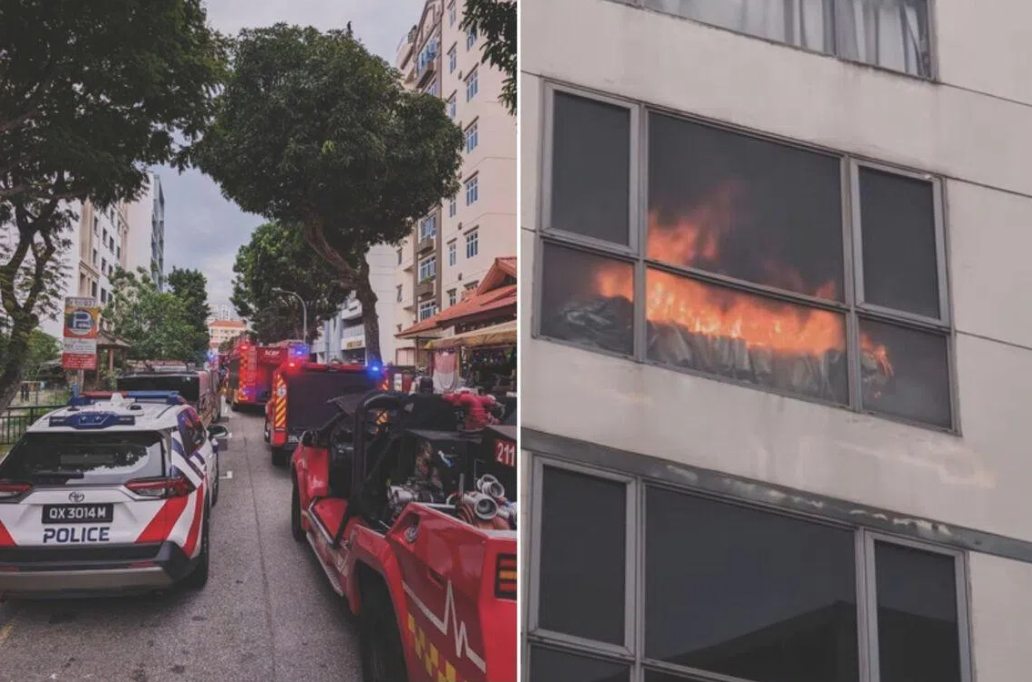
Five residents were forced to leave their homes at Casa Aerata condominium in Geylang on Sunday afternoon after a power-assisted bicycle battery being charged in an unoccupied unit suddenly ignited, prompting a swift emergency response from both police and civil defence personnel. The Singapore Civil Defence Force received the alert at 5.35pm on June 21 regarding the fire in a seventh-floor apartment at 9 Lorong 26 Geylang, where the PAB battery had been left charging without supervision in the living room.
The discovery of the blaze raised immediate safety concerns within the residential building, particularly as fires involving battery-powered mobility devices have become an increasingly common problem across urban residential areas in Singapore and the wider region. Emergency responders quickly evacuated residents from neighbouring units as a precautionary step, though fortunately the incident resulted in no injuries to any occupants. The SCDF successfully contained and extinguished the flames using conventional firefighting equipment, including a hosereel and compressed air foam backpack system.
Initial investigations by the SCDF determined that the fire originated from an electrical fault within the PAB battery itself, a finding that underscores the growing hazards associated with the rising popularity of personal active mobility devices across Singapore's densely populated residential zones. The incident drew the attention of Bishan-Toa Payoh GRC MP Cai Yinzhou, who responded immediately after observing smoke and hearing emergency sirens in the vicinity. He subsequently assisted in clearing the area beneath the affected unit in anticipation of potential structural damage from heat, and indeed, the window of the burning apartment eventually shattered from the intense temperatures.
The authorities have seized on this incident to reinforce critical safety messaging regarding the use and maintenance of active mobility devices. The SCDF explicitly cautioned the public against purchasing or deploying non-original or counterfeit batteries for their PABs, personal mobility devices, and other active mobility aids, as these unregulated components frequently lack proper safety mechanisms and quality control standards. Beyond equipment selection, the civil defence force stressed the importance of never leaving batteries charging for extended periods or overnight, practices that dramatically increase the risk of thermal runaway and combustion.
The incident reflects a troubling trend that has prompted regulatory bodies across Southeast Asia to examine battery safety more closely. Statistical data from the SCDF reveals that of 304 electrical fires recorded in Singapore residential premises during the first part of 2025, 34 were directly attributable to active mobility devices. This represents a significant portion of domestic fire incidents and demonstrates how quickly these consumer technologies have created new fire safety challenges in apartment buildings and condominiums where residents often store devices in shared or individual living spaces.
While the absolute number of active mobility device fires appears to have declined somewhat when comparing the most recent figures to the previous year—dropping from 67 incidents in 2024 to 49 in 2025—the composition of these fires has shifted in concerning ways. Personal mobility device fires specifically increased from 25 cases in 2024 to 31 cases in 2025, suggesting that certain device categories present particular hazards that warrant targeted intervention. This divergence hints at distinct safety profiles among different types of active mobility devices and their respective battery systems.
For Malaysian residents and those across Southeast Asia, the Singapore incident carries important implications as the adoption of power-assisted bicycles, e-scooters, and similar devices accelerates across the region's urban centres. Many of these devices are purchased through informal channels or online marketplaces where battery authenticity cannot be guaranteed, creating widespread exposure to defective or counterfeit power systems. The convenience and affordability of these alternatives to traditional transportation have driven rapid uptake, but insufficient consumer awareness about proper charging protocols and equipment verification remains a critical gap.
The intersection of consumer demand, affordable pricing, and inadequate regulation has created conditions where substandard batteries enter the market widely. Users often remain unaware that their devices contain non-original components until a fire occurs, and many charging practices that seem reasonable—such as overnight charging while residents sleep—actually represent significant fire risks. Building management companies and residential associations across the region would be wise to implement policies and educational campaigns addressing safe storage and charging protocols for active mobility devices.
Regulatory frameworks governing the sale and importation of batteries for active mobility devices remain fragmented across Southeast Asia, creating opportunities for counterfeit products to circulate widely. Singapore's approach, which emphasises public education and civil defence readiness, provides a model that other nations might adapt to their specific contexts. However, the broader challenge requires coordination between consumer protection agencies, electrical safety authorities, and retailers to ensure that only compliant batteries reach end users and that charging infrastructure incorporates appropriate safety features.
The Casa Aerata incident serves as a stark reminder that technological convenience often arrives with hidden risks that only become apparent through accidents and near-misses. Residents in high-density residential environments throughout Malaysia and the broader region should critically examine their own storage and charging practices for any active mobility devices they own. Equally important is the need for manufacturers and distributors to ensure that their supply chains maintain integrity and that consumers have reliable means of verifying product authenticity before purchase, reducing reliance on post-incident emergency response as the primary safety mechanism.

