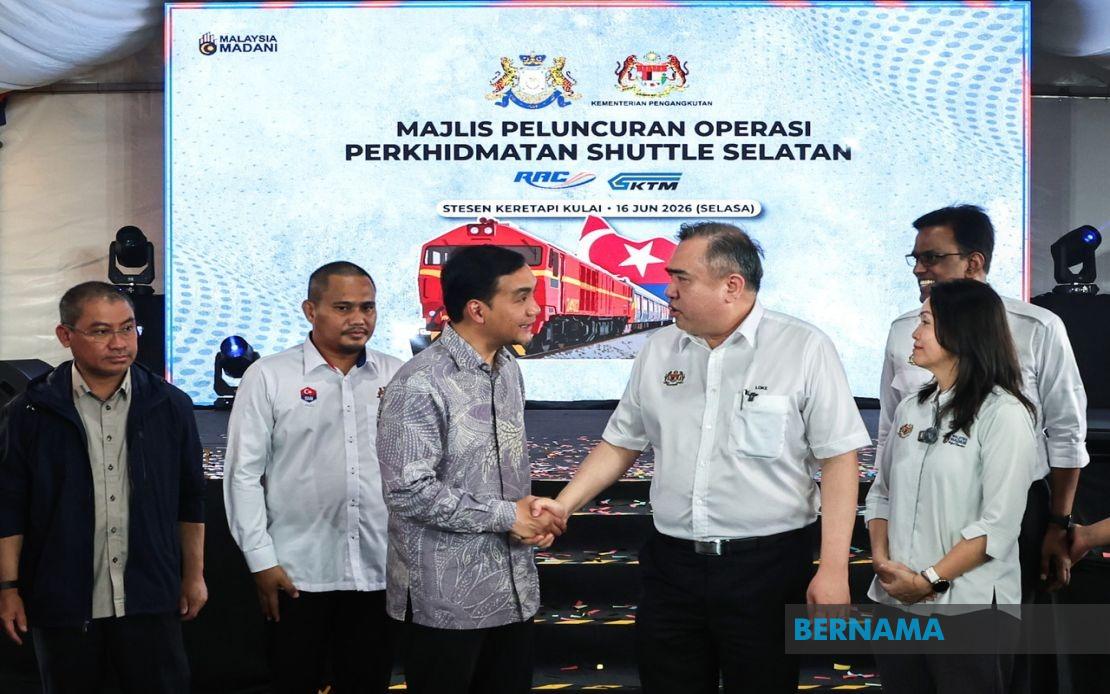
Johor has taken a significant step forward in addressing its public transport needs with the official launch of the Shuttle Selatan service, a rail-based connectivity initiative linking three major population centres in the state. The service, which began operations from Kulai KTM station, is designed to tackle the growing mobility challenges in a region experiencing rapid economic expansion and demographic growth. Transport Minister Anthony Loke, alongside Johor Menteri Besar Datuk Onn Hafiz Ghazi, unveiled the service with the expectation that it will provide meaningful transport solutions to more than two million people across Kulai, JB Sentral and Pasir Gudang.
The initial rollout focuses on two primary routes that reflect current demand patterns in the region. The Kulai-JB Sentral-Kulai route offers commuters a journey time of approximately 40 minutes, making it a competitive alternative to road-based transport options that typically involve congestion and longer travel times. The second route, operating between Kempas Baru and Pasir Gudang, spans a journey of between 40 to 45 minutes, connecting the growing Pasir Gudang industrial and port area with central business districts and residential zones. These routes serve as anchor services that will form the backbone of the system's expansion in coming years.
Among the most ambitious aspects of the Shuttle Selatan initiative is the government's vision for future growth. Plans are underway to extend connectivity further north, with a proposed expansion route that would run from Paloh to Kulai via the stations of Kluang, Renggam and Layang-Layang. This expansion reflects strategic thinking about Johor's internal connectivity, recognising that sustainable transport infrastructure must link not only major urban centres but also secondary towns and emerging growth nodes. The extension would effectively create a north-south transport spine serving communities that currently have limited rail-based alternatives.
Complementing these main routes, three additional stations have been identified for future development. Taman Daya, Bandar Baru Sri Alam and Pasir Putih are slated for inclusion in the network, ensuring that the benefits of rail-based public transport reach a wider geographic spread of the population. This methodical approach to station placement suggests careful analysis of settlement patterns and commuting flows rather than ad-hoc expansion. By targeting residential developments and population centres, the authorities appear intent on maximising the utilisation rate of the system and ensuring that residents in surrounding areas can reasonably access the service.
A critical recognition underpinning the Shuttle Selatan service is that modern public transport requires seamless integration between different modes. The government has therefore implemented a comprehensive suite of support measures designed to address the first-and-last-mile connectivity challenge that often hinders public transport adoption. Feeder bus services have been introduced to carry passengers from residential areas to rail stations, while Bas.My route coordination ensures that different operators work in concert rather than competition. A dedicated shuttle service operates from Kempas Baru, one of the key nodes, and park-and-ride facilities at AEON Bandar Dato' Onn allow commuters to combine personal vehicle use with rail travel, reducing pressure on urban road networks while still accommodating those without direct transit access.
To overcome the behavioural inertia that often accompanies the introduction of new public transport services, particularly in areas where car dependency is established, the government has deployed an incentive strategy centred on the Commuter MADANI Shuttle Selatan Card. Three thousand of these cards have been distributed free to Johor residents, offering unlimited rides for a specified duration at a subsidised rate. Each RM50 card represents an attractive entry point for cost-conscious commuters to trial the service without significant financial commitment. This approach recognises that public transport adoption often requires breaking psychological barriers as much as providing physical infrastructure.
The financial commitment behind this initiative extends beyond the cards themselves. The Railway Assets Corporation has allocated over RM150,000 in incentive funding specifically designed to catalyse a shift in travel behaviour away from private vehicles. This investment signals that the government views mode-switching not as an overnight transformation but as a gradual process requiring sustained encouragement. For Southeast Asian readers, such incentive structures offer insights into how regional governments are attempting to make public transport more attractive in contexts where motorisation rates are rising rapidly.
The strategic rationale for Shuttle Selatan reflects broader trends reshaping Johor's economy and society. As one of Malaysia's fastest-growing states, Johor is experiencing simultaneous expansion across multiple sectors including manufacturing, logistics, port operations, education and international trade. This diversified growth creates complex travel demand patterns that single-mode transport systems struggle to accommodate. By establishing reliable rail connectivity, the state government is attempting to provide infrastructure that can scale with economic activity without requiring proportional expansion of road networks, which become increasingly congested and costly to expand in established urban areas.
The service specifically targets three interconnected objectives: strengthening links between residential areas where the workforce lives, city centres where many businesses and services concentrate, and industrial zones where employment generation occurs. This triangular connectivity model reflects modern urban and regional economic geography, where productivity depends on the smooth movement of workers between home, workplace and service centres. For Johor's port and logistics sectors in particular, efficient workforce movement translates directly into operational reliability and competitiveness in regional supply chains.
The implementation of Shuttle Selatan represents a collaborative achievement involving three key institutions. The Ministry of Transport provided policy direction and coordination, Keretapi Tanah Melayu Berhad operates the service using its existing rail infrastructure and expertise, while the Railway Assets Corporation manages assets and implements development initiatives. This tri-partite arrangement distributes responsibility and expertise appropriately, leveraging the operational knowledge of KTMB while ensuring that broader transport policy goals remain aligned with state development priorities.
For Malaysian observers and regional stakeholders, the Shuttle Selatan launch offers several instructive elements. First, it demonstrates how established rail infrastructure can be repurposed and revitalised to serve contemporary mobility needs rather than being abandoned as uneconomic. Second, it illustrates the importance of comprehensive planning that addresses not merely trunk routes but the supporting ecosystem of feeder services, fare structures and station location. Third, it shows recognition that new public transport services require marketing and incentives to overcome entrenched travel patterns. As Southeast Asia continues to grapple with rising vehicle ownership and urban congestion, the Johor model offers practical lessons in how governments can leverage existing assets to build more sustainable transport systems.