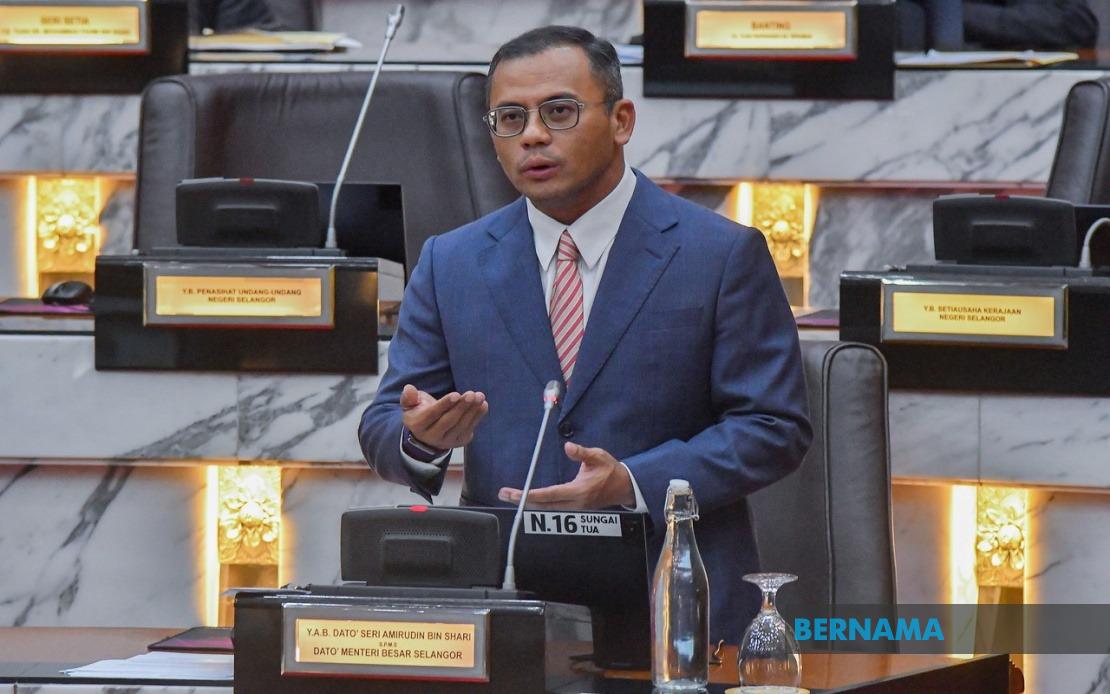
Selangor's Menteri Besar Datuk Seri Amirudin Shari has issued a directive to all local authorities across the state to conduct a comprehensive review of public transportation connectivity, signalling growing concern about gaps in the network that have increasingly drawn public criticism on social media platforms. The instruction comes as commuters, particularly those using the LRT3 system, have voiced frustrations about inadequate pedestrian pathways and poor accessibility between transit hubs and surrounding residential and commercial areas. The matter gained prominence during debate on the Selangor Resilience Strengthening Package in the State Legislative Assembly, when assemblyman Danial Al-Rashid Haron Aminar Rashid from Batu Tiga raised the issue publicly, triggering fresh discussions about infrastructure failures affecting the travelling public.
The Menteri Besar has committed the state government to financing expanded facilities to improve the transit experience, with emphasis on constructing more comfortable and safer pedestrian walkways that link major transport nodes to the communities they serve. Rather than viewing these investments as an expensive luxury, Amirudin positioned infrastructure upgrades as essential to achieving Selangor's broader objective of boosting public vehicle usage and reducing reliance on private motorcars and automobiles. The state administration recognises that without seamless connections between transport modes and local areas, commuters will inevitably revert to personal vehicles despite their added costs and contribution to urban congestion.
A striking aspect of Amirudin's remarks centres on his criticism of local authorities' reactive posture toward infrastructure deficiencies. He charged that PBT officials should not wait for complaints to circulate across social media channels such as X, Threads, and other platforms before taking action. Instead, he insisted that local authorities must engage proactively with council members and key stakeholders to understand ground-level challenges and devise solutions. This shift from reactive to anticipatory governance suggests the state leadership has become acutely aware of how social media amplifies public grievances, particularly when residents feel their concerns have gone unheard through conventional channels.
To translate these directives into concrete improvements, Amirudin announced that Ng Sze Han, the State Investment, Trade and Mobility Committee chairman, will convene meetings with all public transport operators functioning across Selangor. The objective is to develop a comprehensive service mapping exercise that would pinpoint geographic areas currently lacking adequate transit access and identify critical gaps in the network. This data-driven approach represents a deliberate attempt to move beyond anecdotal complaints and instead build a systematic understanding of where infrastructure investment should be prioritised.
The state government is prepared to utilise subsidies as an incentive tool to encourage operators to expand coverage and adjust service schedules in underserved zones. However, Amirudin made clear that subsidies alone cannot solve the problem if operators fail to deploy them strategically. He emphasised that financial support becomes worthless if transport companies do not synchronise operating hours with genuine commuter demand or if they continue ignoring accessibility gaps. The Menteri Besar's message to operators was blunt: subsidies lower your costs, but you must use that advantage to strengthen service quality and coverage, not merely boost profit margins.
The connectivity challenge facing Selangor is particularly acute because the state functions as the economic engine of the Klang Valley, drawing hundreds of thousands of commuters daily into employment, education, and commercial centres. The LRT3 system, which serves the Bandar Utama-Klang corridor, has become a critical artery for north-south transit, yet its effectiveness is severely hampered when passengers cannot easily walk from residential neighbourhoods to stations or from alighting points to their final destinations. This last-mile problem represents a systemic weakness that undermines the entire value proposition of investing in rapid transit infrastructure.
For Malaysian readers and regional observers, Selangor's current predicament offers instructive lessons about transport planning and the imperative of integrated design. Many Southeast Asian cities face similar disconnects between rapid transit systems and the pedestrian realm, often because transit networks were planned in isolation from local land-use patterns and urban development. Selangor's acknowledgment of these gaps, coupled with a willingness to commit fresh resources, suggests a maturing understanding that world-class public transport requires more than modern trains and stations—it demands attention to the human experience of accessing and using those facilities.
The reference to Kinrara assemblyman Ng Sze Han's role underscores how the state government is leveraging political representatives and committee structures to drive implementation. By placing a sitting assemblyman in charge of coordinating operator dialogue and service mapping, the state has created accountability and ensured that findings will be reported directly to the Menteri Besar. This approach also creates opportunities for elected representatives to visibly champion improvements in their constituencies, potentially boosting public confidence that governance is responsive to community needs.
Malaysia's transport sector has long grappled with the tension between centralised planning and fragmented implementation. Selangor's move to standardise and map operator services across the state attempts to address this fragmentation by creating a unified vision of how different providers should complement one another. When bus schedules, LRT operations, and pedestrian infrastructure are planned in isolation, commuters suffer. By contrast, integrated service mapping could enable coordinated timetabling, complementary routes, and infrastructure investments that genuinely function as a system rather than disconnected components.
The financial commitment signalled by Amirudin is notable given Malaysia's broader fiscal pressures. That the state government is prepared to allocate additional funding beyond existing budgets reflects a political judgment that public transport connectivity has become too important to defer. Urban congestion, air quality, and quality of life increasingly turn on whether commuters can reliably access public vehicles, and whether they can do so conveniently from their homes and workplaces. Investing in these connective tissues is therefore not discretionary spending but foundational to sustainable urban development.
Moving forward, the success of Selangor's initiative will hinge on execution discipline and whether local authorities, transport operators, and state-level committees can overcome historical siloes and deliver integrated solutions. The use of subsidies as leverage to incentivise better operator behaviour is promising, but only if the state remains firm in conditioning continued support on demonstrable improvements to accessibility and service coverage. Additionally, ongoing public communication about progress will be essential to sustain confidence that the government is serious about addressing complaints and not merely deflecting criticism.

