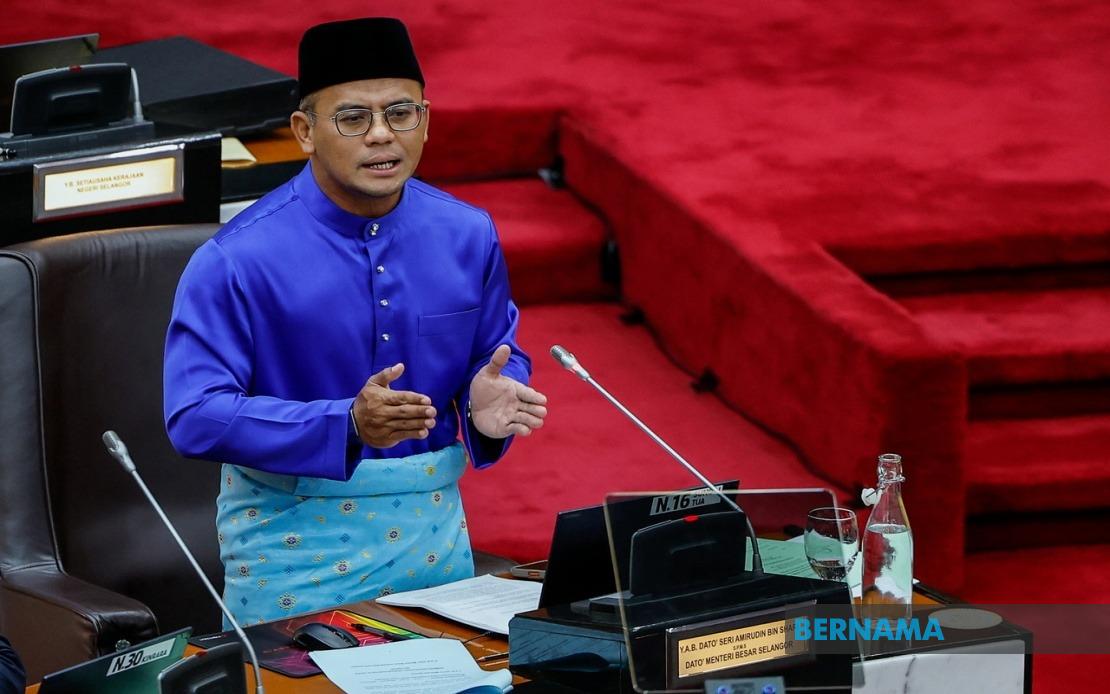
Selangor's government has announced a comprehensive RM209.26 million relief package designed to mitigate the economic fallout from global energy price volatility linked to tensions in West Asia. Unveiled during a special sitting of the State Legislative Assembly in Shah Alam, the second phase of the Selangor Resilience Strengthening Package comprises 15 distinct initiatives that extend well beyond simple cash handouts, instead prioritising structural economic empowerment across vulnerable industries and vulnerable worker cohorts.
Menteri Besar Datuk Seri Amirudin Shari positioned the intervention as a response to deteriorating labour market conditions in Malaysia's most industrialised state. Data from the Social Security Organisation (SOCSO) revealed that 10,869 Selangor residents lost employment during the first five months of the year, with the retail sector accounting for 2,549 of these losses—representing nearly a quarter of total job shedding. The manufacturing sector, another pillar of Selangor's economy, contributed a further 2,316 displaced workers, equivalent to 21.3 per cent of the overall figure. These numbers underscore the vulnerability of specific sectors to global economic headwinds and suggest deepening structural challenges beyond cyclical downturns.
What distinguishes the retrenchment pattern is its impact across the employment hierarchy. Approximately 40 per cent of those who lost positions held management or professional designations, a concentration that points to significant disruption in skilled and decision-making roles rather than merely entry-level work. The remainder comprised technicians, sales personnel and machinery operators—a cross-section reflecting genuine economic contraction rather than seasonal adjustment. This stratification across income and skill levels informed the package's architecture, with particular emphasis on safeguarding retail operations and facilitating transitions toward self-employment for displaced professionals and mid-level workers.
The allocation breakdown reveals deliberate prioritisation across multiple intervention channels. The centrepiece, Selangor Advance (SA500), captures RM100 million and functions as a primary financing mechanism for economic recovery initiatives. Supporting entrepreneurship directly, the Entrepreneur Quick Fund Financing claims RM20 million, while the Selangor Penyayang Project and Teraju IKTISASS each command RM14 million and RM20 million respectively. These larger allocations target business formation and expansion, addressing the supply-side constraint that often prevents displaced workers from transitioning into self-employment despite entrepreneurial inclination. Smaller but strategically important programmes include rental reductions for Local Authority premises at RM4.5 million, designed to lower operational barriers for small retailers and traders recovering from demand contraction.
Support mechanisms extend to agricultural sectors and female-headed households, reflecting Selangor's diverse economic base and demographic vulnerability. The Selangor Farmer Resilience Financing programme secures RM7 million to cushion agricultural producers from input cost inflation and volatile commodity prices. Mama Kerja, a RM5 million initiative presumably targeting female labour force participation and entrepreneurship, acknowledges gender dimensions often overlooked in conventional economic recovery packages. These sectoral and demographic specifics distinguish Phase Two as more granular than typical stimulus responses, attempting to address particular constraints faced by different population segments rather than implementing uniform measures.
Human capital development constitutes another pillar, with skills upgrading and educational support receiving substantial funding allocations. The Selangor Scholarship programme accounts for RM17 million, while the PLATS Career Transition and Selangor Career Programme collectively allocate RM4 million and RM1.5 million toward workforce retraining and labour market transitions. These investments acknowledge that worker displacement during energy price crises often requires skills realignment toward sectors with stronger demand trajectories. By coupling income support with capability enhancement, the package attempts to prevent long-term structural unemployment and skill depreciation that typically follows economic shocks.
Property-related relief measures address household financial stress beyond employment income. The Selangor Smart Rent Moratorium and State Government Housing Loan Moratorium together provide RM2.22 million and RM2.54 million in payment deferrals, offering breathing room for households facing concurrent pressures from job loss and fixed housing obligations. Additionally, a 100 per cent Assessment Tax Rebate worth RM5.5 million reduces fiscal burdens on property-owning households and potentially incentivises business investment in local authority areas. These nested relief measures recognise that economic resilience depends partly on preventing household debt cascades that intensify during downturns.
Selangor's two-phase approach demonstrates accumulative commitment to economic stabilisation. Phase One deployed RM145.8 million, bringing the combined allocation across both phases to RM355.06 million—a substantial provincial investment representing approximately 1.4 per cent of the state's estimated annual development budget. This magnitude reflects serious policy intent, though whether implementation capacity and programme design sufficiently address root causes remains an empirical question requiring monitoring. The sheer number of discrete initiatives, while comprehensive, also introduces coordination complexity and potential overlap that could compromise delivery effectiveness.
The political messaging surrounding the package emphasises inclusive governance and cross-sectoral solidarity, with Amirudin calling for societal cooperation to navigate global uncertainty. This framing positions economic vulnerability as a collective challenge transcending partisan divisions, though its resonance depends on visible programme outcomes rather than rhetorical unity. For Malaysian observers, Selangor's response offers a template for examining how state governments address energy-related economic shocks that increasingly characterise regional circumstances, particularly given global supply chain dependencies and energy market volatility.
The package's effectiveness will ultimately depend on implementation fidelity, disbursement speed and the precise design of eligibility criteria determining which workers and businesses access support. Early programme evaluation focusing on job creation rates, business survival improvements and household financial stability metrics would provide crucial feedback for refining interventions as the global economic outlook continues shifting. For Selangor specifically, managing the transition of 10,000-plus displaced workers through coordinated skilling, entrepreneurship support and temporary income protection represents both urgent challenge and policy opportunity.

