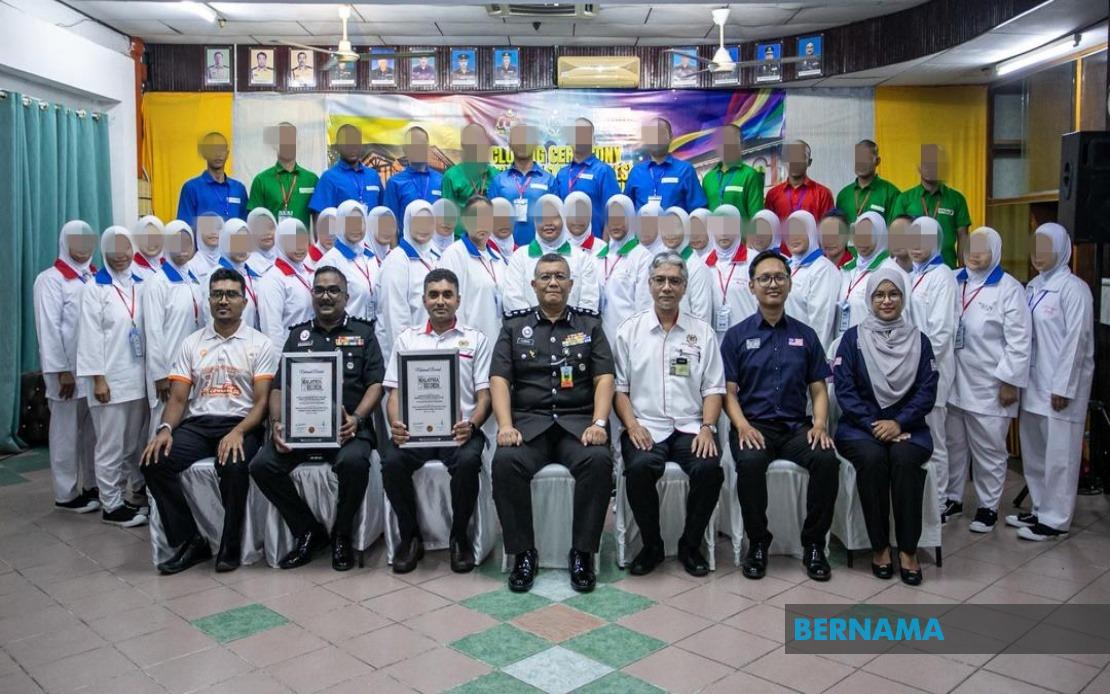
Home Minister Datuk Seri Saifuddin Nasution Ismail has commended the Malaysian Prisons Department for securing recognition from the Malaysia Book of Records following the successful completion of a Basic Life Support and Automated External Defibrillator training course at Batu Gajah Correctional Centre. The achievement involved 42 inmates and represents a notable milestone in the institution's ongoing efforts to develop inmate capabilities beyond custodial containment.
In remarks posted on social media, Saifuddin highlighted the significance of the recognition as evidence that modern correctional facilities serve a broader purpose than punishment alone. The initiative exemplifies how prisons can function as genuine rehabilitation institutions, offering inmates concrete opportunities to acquire marketable skills and personal development that enhance their prospects upon release. This positioning reflects a philosophical shift in Malaysian correctional policy toward restorative rather than purely punitive approaches.
The training programme equipped participants with competency in emergency medical response—specifically in cardiopulmonary resuscitation and defibrillator operation—practical skills with immediate applicability in the job market. Beyond technical proficiency, the initiative was designed to cultivate humanitarian values, instil discipline, and build personal confidence among participants. These intangible outcomes are arguably as important as vocational skills, as they address attitudinal and behavioural factors that influence an individual's successful reintegration into civilian society.
Saifuddin's endorsement underscores the Malaysian Prisons Department's stated philosophy of prioritising rehabilitation and social reintegration over pure incarceration. This philosophical stance carries significant implications for how the correctional system positions itself within broader public discourse. When prison officials and government ministers actively promote such initiatives, they help reshape public perception of inmates as individuals capable of positive transformation rather than irredeemable offenders—a perception shift that can facilitate smoother reentry and reduce recidivism.
The recognition by Malaysia Book of Records serves as external validation of the programme's scale and novelty. In the competitive landscape of institutional achievement and government performance metrics, such recognitions provide tangible evidence of innovation and impact. For the Batu Gajah Correctional Centre, the accolade enhances institutional reputation and may encourage other correctional facilities to develop comparable programmes, creating a demonstration effect across the prison system.
From a practical standpoint, inmates completing life-saving certifications acquire credentials that remain valid upon release, providing concrete advantages in employment applications. Healthcare-adjacent sectors—including security, hospitality, retail, and logistics—increasingly prefer workers with first-aid certification. For formerly incarcerated individuals facing already substantial employment barriers, such credentials can meaningfully improve job prospects and earnings potential, directly supporting economic reintegration objectives.
The scale of the programme—involving 42 inmates—suggests organisational capacity and institutional commitment to expanding such initiatives beyond token gestures. Sustaining and scaling rehabilitation programmes requires ongoing resource allocation, staff training, and administrative coordination. The Batu Gajah facility's success model could inform expansion strategies across Malaysia's broader correctional estate, potentially benefiting thousands of inmates annually if replicated systematically.
For Malaysian policymakers and regional correctional administrators, the initiative offers a case study in pragmatic rehabilitation design. Rather than focusing exclusively on abstract character development, the programme combines practical skill-building with values inculcation—an integrated approach that addresses both employability and social responsibility. This methodology aligns with evidence from criminology research suggesting that meaningful skill acquisition during incarceration significantly reduces recidivism rates compared to purely custodial approaches.
The initiative also holds implications for Malaysia's international standing in correctional governance. As ASEAN nations increasingly scrutinise human rights standards and rehabilitative capacity within criminal justice systems, demonstrable programmes like this contribute to Malaysia's institutional credibility on corrections matters. The Malaysia Book of Records recognition provides documentary evidence of progressive correctional practice that may influence regional and international assessments of Malaysian penal policy.
Saifuddin's statement that "every prospect returning to the community has the skills, values and ability to contribute positively to their family, community and country" articulates an ambitious correctional vision. Achieving this aspiration requires systematic implementation of quality programmes across facilities, adequate resource commitment, and ongoing evaluation of outcomes. The Batu Gajah success signals the system's capacity for excellence, yet scaling such performance presents substantial operational and budgetary challenges.
The Home Minister's call for expanded high-impact programmes suggests receptiveness to further innovation within the correctional system. This openness, if translated into concrete policy support and resource allocation, could accelerate the development and implementation of additional skill-building initiatives across Malaysian prisons. The success at Batu Gajah provides both inspiration and a replicable model for facilities seeking to strengthen their rehabilitation capacity.
Ultimately, the Malaysia Book of Records recognition represents more than institutional accolade—it embodies a practical commitment to transforming incarceration from purely custodial into genuinely rehabilitative. As Malaysia's inmate population grows and post-release recidivism remains a policy concern, demonstrable success in equipping inmates with marketable skills and positive values offers tangible evidence that alternative correctional approaches can deliver measurable impact. The Batu Gajah initiative exemplifies how prison systems can simultaneously serve security objectives while advancing human capital development and social reintegration.

