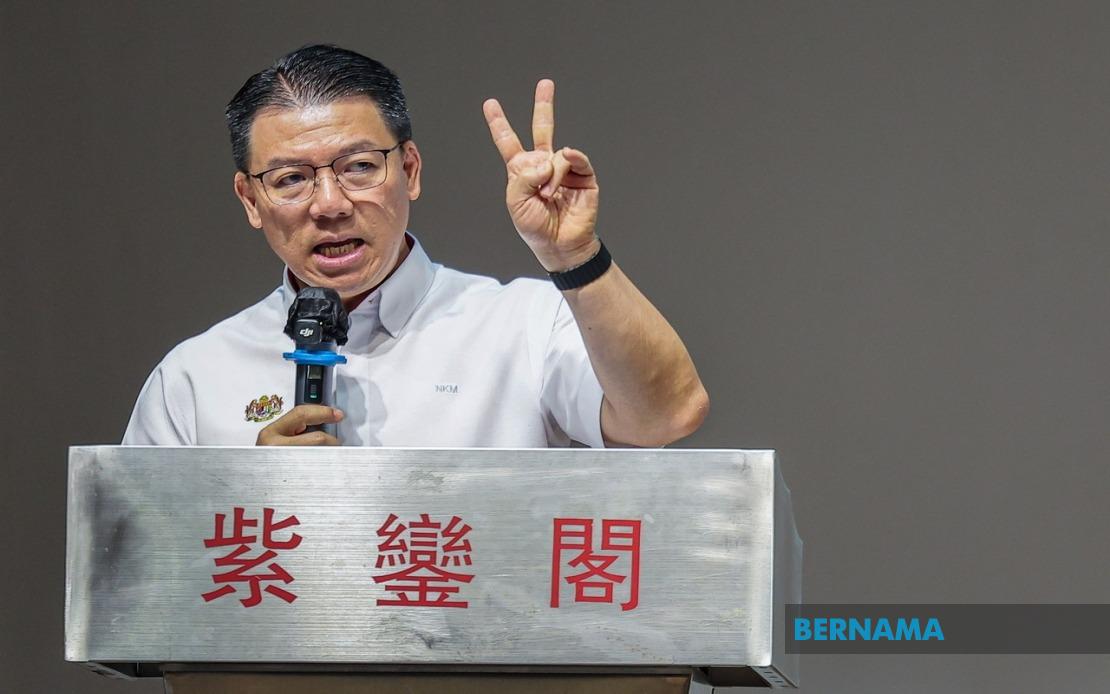
Malaysia's commitment to maintaining religious infrastructure across its diverse faith communities has been reinforced through a substantial RM200 million allocation by the Ministry of Housing and Local Government, with the four-year initiative commencing in 2023. Housing and Local Government Minister Nga Kor Ming announced the figures during an event in Kluang on June 26, where the ministry also distributed RM3.14 million specifically designated for 27 places of worship in Johor this year. The program underscores the MADANI administration's stated approach to development that transcends ethnic and religious boundaries, treating all communities with equal consideration in the allocation of public resources.
The Non-Muslim Houses of Worship (RIBI) Maintenance Initiative has proven responsive to widespread community needs, with authorities receiving 1,478 applications through the dedicated e-RIBI System since its introduction. These submissions represent a combined value exceeding RM279 million, a figure that substantially outpaces the initial allocation and signals the substantial deferred maintenance burden across churches, gurdwaras, Hindu temples, and other religious institutions nationwide. The disparity between applications and available funding illustrates the scale of infrastructure challenges facing minority religious communities and the critical importance of sustained government support in this sector.
Johor's experience exemplifies the initiative's reach and impact. Since 2023 through May 2026, the state has received RM18.75 million distributed among 154 religious institutions, enabling critical repairs, renovations, and safety upgrades that many organisations would struggle to finance independently. These funds support essential maintenance work including structural repairs, electrical system upgrades, sanitation improvements, and emergency remediation. For many smaller congregations and temples operating on modest budgets, such government assistance proves transformative in maintaining their physical infrastructure and ensuring accessibility for worshippers.
Nga framed the initiative within a broader political and economic philosophy emphasising national cohesion as foundational to prosperity. He argued that social stability directly influences investor confidence and economic growth, positioning religious harmony and equitable resource distribution as strategic investments rather than discretionary spending. This framing reflects recognition among governing circles that Malaysia's competitive positioning in regional and global markets depends partly on demonstrating inclusive governance that protects minority rights and ensures all communities participate meaningfully in national development.
The minister's rhetoric emphasised bridge-building and unity as counterweights to divisive messaging in the political landscape. His statement that "when there are those who try to build walls, we build bridges" and "there are those who foster division, we foster unity" appeared directed at political opponents who he suggested pursued sectarian strategies. This positioning attempts to establish the MADANI government as the inclusive alternative, though the statement also signals ongoing political tensions surrounding religious and ethnic issues in Malaysian public discourse.
Transparency and accountability mechanisms have been integrated into the RIBI program design to manage public funds responsibly. The ministry committed to professional monitoring of approved projects, with officials ensuring that allocations reach genuinely deserving organisations. The e-RIBI System itself represents an attempt to systematise the application process, reducing discretionary decision-making and creating documented records of disbursement. Such mechanisms respond partly to historical concerns about patronage in government spending and partly to international standards for development assistance management.
The diversity of institutions eligible under the RIBI framework—encompassing Christian churches, Sikh gurdwaras, Hindu and Buddhist temples, and other religious associations—reflects Malaysia's constitutional guarantees of religious freedom for non-Muslim communities. However, the existence of a dedicated maintenance fund for non-Muslim places of worship, distinct from general infrastructure spending, implicitly acknowledges that these institutions face particular funding constraints. Many operate as community grassroots organisations lacking the scale or resources to mount major capital campaigns, making government support essential for facility preservation.
For Southeast Asian observers, Malaysia's approach offers one model for managing religious diversity in plural societies where state resources must be distributed equitably across communities with different demographic weights and political influence. The program demonstrates that explicit allocation formulas targeting minority religious infrastructure can function without necessarily creating majority backlash, though Malaysian political discourse around religious spending remains sensitive. The willingness to invest in non-Muslim religious spaces also signals a particular vision of national identity that privileges religious coexistence as a governance objective.
The RM3.14 million allocated to Johor for 2026 will support renovation, new construction, maintenance, and emergency repairs across the state's participating institutions. These funds enable work ranging from minor remediation to substantial reconstruction, depending on individual facility conditions. Many congregations have deferred necessary maintenance for years due to financial constraints, making such allocations critical for preventing facility deterioration that could ultimately prove more costly to remedy.
Looking forward, the substantial gap between applications received and funds available suggests the maintenance initiative faces sustained demand beyond its initial four-year timeline. If the pattern continues, policymakers may need to consider permanent baseline funding for religious infrastructure maintenance rather than time-limited programs. The success of the e-RIBI System in generating nearly 1,500 applications also demonstrates that accessible application processes increase program utilisation and can reveal genuine community needs previously undocumented.
For minority religious communities in Malaysia, the RIBI initiative represents tangible acknowledgement of their status as integral components of Malaysian society deserving public investment. The program's continuation and expansion would signal sustained commitment to this principle, while discontinuation or resource reduction would conversely suggest changing governmental priorities. In the competitive Malaysian political environment, where different coalitions and leaders periodically gain power, the institutionalisation of such programs through dedicated funding mechanisms provides some protection against sudden reversals based on political transitions.

