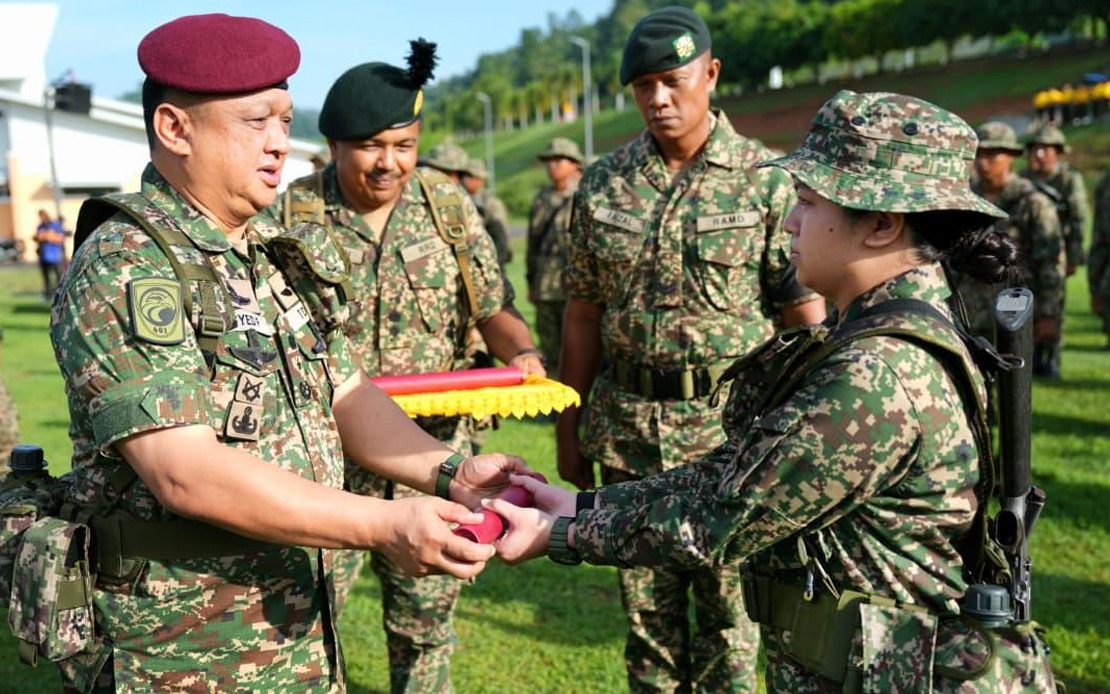
Hajah Sharifah Farah Adriana Jamalullail, the second daughter of the Raja Muda of Perlis and Raja Puan Muda of Perlis, has successfully graduated from the Malaysian Army's Voluntary Young Soldier Basic Course (APMS) following a two-week training programme at Universiti Malaysia Perlis (UniMAP). The course ran from June 7 through June 20, concluding with an official closing parade held at the Boulevard Field of UniMAP's Pauh Putra Campus in Arau. The Raja Muda of Perlis, Tuanku Syed Faizuddin Putra Jamalullail, presided over the graduation ceremony, with the Raja Puan Muda of Perlis, Tuanku Dr Hajah Lailatul Shahreen Akashah Khalil, also present to witness the achievement.
The royal institution's decision to enrol the 25-year-old in the military training programme carries symbolic weight beyond the individual accomplishment. Through an official statement, Istana Arau framed the participation as a deliberate message about fostering patriotism and national love at every tier of Malaysian society. The palace emphasised that the completion of the course by Hajah Sharifah Farah Adriana exemplifies how strengthening the nation's defence constitutes a collective duty shared across all segments of the population, regardless of social standing. This messaging reflects a broader initiative within Perlis's royal establishment to demonstrate active engagement with military matters and defence preparedness.
The graduate holds impressive academic credentials that position her within Malaysia's educated elite. Hajah Sharifah Farah Adriana earned a Bachelor of Business (Management) degree from RMIT University in Australia, followed by a Master of International Business degree from Monash University Malaysia. Her decision to pursue military training despite her professional qualifications signals a personal commitment to defence and national service that transcends conventional career trajectories. This educational background, combined with the military training, reflects a contemporary approach within the royal family toward multi-dimensional leadership development.
At the graduation ceremony, Tuanku Syed Faizuddin Putra, who simultaneously serves as Commander of the 504th Territorial Army Regiment, outlined the strategic objectives underpinning expanded recruitment efforts. He articulated a vision for substantially strengthening the Territorial Army through intensified initiatives aimed at attracting young people who possess the physical fitness and other baseline qualifications required for military service. The Raja Muda's remarks suggested that current recruitment strategies are being actively supervised and continuously enhanced to ensure steady progress toward strengthening overall defence capacity.
The Territorial Army's operational philosophy, according to the Raja Muda's statement, rests upon three foundational pillars encompassed in the mandate to "Raise, Train and Maintain" personnel. The "Raise" component extends beyond simply expanding numerical strength; it involves systematically identifying and preparing appropriate human resources capable of being successfully absorbed into the military structure. This reflects a quality-over-quantity approach, recognising that effective defence capabilities depend upon the calibre and readiness of personnel rather than raw numbers alone.
The "Train" dimension emphasises delivering rigorous instruction that equips personnel to function effectively within an integrated operational environment alongside the Regular Force. This integrated approach is critical within Malaysia's defence architecture, where territorial forces must seamlessly coordinate with professional military units across various operational scenarios. The training therefore focuses on developing competencies that enable territorial soldiers to perform meaningful roles within broader military formations rather than operating as isolated components.
Maintaining consistent operational readiness constitutes the third pillar, ensuring that trained personnel remain capable of rapid mobilisation and augmentation of regular forces whenever required. The Raja Muda's framework suggests an appreciation for the reality that military effectiveness depends upon sustained preparation and continuous monitoring of personnel capabilities. This emphasis on maintenance reflects the unpredictable nature of security challenges and the necessity for armed forces to sustain elevated readiness levels.
The broader context for these efforts involves addressing contemporary security challenges that Malaysia faces across its extensive maritime borders and increasingly complex regional environment. The Territorial Army Regiment's strengthening carries particular importance given Malaysia's significant maritime claims in the Straits of Malacca and South China Sea, where competing interests and potential security flashpoints require adequate military presence and capabilities. Enhanced territorial forces contribute to Malaysia's ability to project credible presence across these strategic zones.
The Perlis royal family's involvement in military training also reflects the historical role that Malaysian royalty has maintained in defence matters. The Raja Muda's concurrent position as Commander of the 504th Territorial Army Regiment demonstrates the institutional connection between the state's traditional leadership and contemporary military structures. This continuity underscores how Malaysia's constitutional monarchy integrates with professional armed forces in ways that differ substantially from purely civilian-controlled defence systems.
For Malaysian readers, the significance extends beyond the individual achievement. The course demonstrates that military service remains a viable and prestigious pathway even for individuals from elite educational backgrounds and royal families. This messaging may influence broader recruitment patterns and cultural attitudes toward military service among educated Malaysians who might otherwise pursue exclusively civilian professional trajectories. The visibility of a royal family member completing basic military training normalises military participation across social strata and reinforces official messaging about collective defence responsibility.
The timing of the announcement also merits attention within Malaysia's broader defence dialogue. With regional tensions occasionally elevated and questions about adequacy of defence spending recurring in public discourse, official statements emphasising renewed recruitment efforts and enhanced training protocols serve to reinforce government commitment to military capability development. The royal endorsement adds institutional weight to these messages and may help shape public perception regarding defence priorities.
Looking forward, the successful completion of the course by Hajah Sharifah Farah Adriana may establish a precedent encouraging other members of Malaysia's educated elite and royal families to similarly engage with military training programmes. Whether this translates into sustained changes in recruitment patterns or remains primarily symbolic remains to be seen, yet the immediate message from Istana Arau and the Raja Muda's statements clearly emphasises the importance of fostering defence consciousness and preparedness as defining characteristics of contemporary Malaysian citizenship and leadership.

