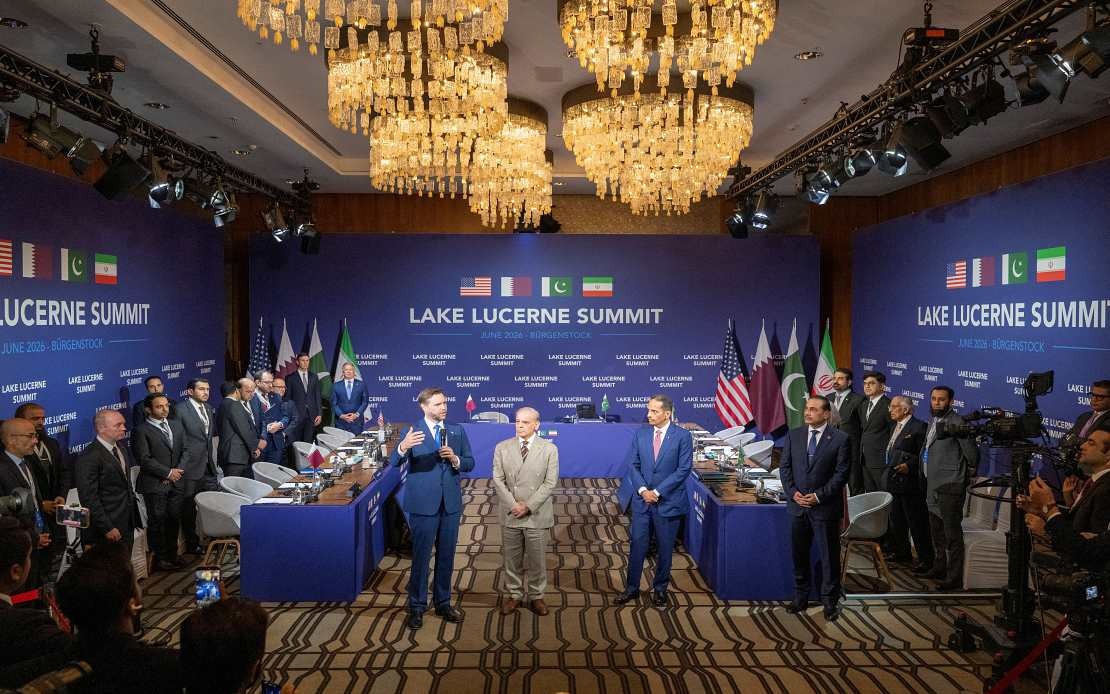
Diplomatic efforts to bridge the divide between the United States and Iran have reached a meaningful inflection point, according to a joint statement issued by Qatar and Pakistan following the conclusion of the inaugural session of talks at the Lake Lucerne Summit in Switzerland. The announcement came early Monday, marking the latest development in a months-long mediation process spearheaded by the two Gulf and South Asian nations as intermediaries seeking to defuse longstanding tensions between Washington and Tehran.
The joint communiqué characterised the opening day of negotiations as having unfolded in a "positive and constructive atmosphere," with both parties reportedly achieving what officials described as "encouraging progress." The tone of the statement contrasts sharply with the acrimony that has characterised much of the relationship between the US and Iran in recent years, suggesting that the mediation channel has succeeded in creating conditions more conducive to substantive dialogue. For Southeast Asian nations with interests in Middle Eastern stability and global energy security, any thaw in US-Iran relations carries implications for regional trade patterns, shipping routes, and the broader architecture of international relations.
Among the most concrete outcomes announced was the establishment of a formal mechanism designed to sustain technical-level discussions between the negotiating teams. This institutional framework addresses a frequent challenge in international diplomacy: maintaining momentum and continuity when high-profile talks conclude. By creating dedicated channels for ongoing technical work, the parties appear to have learned from previous negotiation attempts that faltered during implementation phases. The mechanism underscores a commitment from both sides to move beyond symbolic gestures toward sustained engagement on substantive issues.
A second major structural development involves the formation of a high-level oversight committee tasked with managing the political dimensions of the mediation process. This committee functions as a supervisory body, receiving regular progress reports from the lead negotiators and maintaining oversight of the broader negotiation architecture. Its establishment signals that both the US and Iran view this mediation effort as sufficiently significant to warrant senior-level political attention, rather than relegating the process to technical experts alone. The dual-track approach—combining high-level political direction with specialist technical work—represents a more sophisticated negotiating framework than has typically characterised past US-Iran interactions.
The technical working groups established beneath this high-level committee focus on three discrete areas of critical importance. The Iranian nuclear programme remains the most publicly visible and politically sensitive subject, given decades of international concern about Tehran's atomic capabilities and the ongoing debate over verification and monitoring regimes. Sanctions relief constitutes the second workstream, addressing the comprehensive economic penalties imposed on Iran and the sequenced removal of restrictions that might accompany progress on other issues. The third pillar involves dispute resolution mechanisms, reflecting recognition that effective implementation of any agreement requires clear procedures for addressing disagreements and ambiguities as they inevitably arise during execution.
A particularly significant element of the negotiations involves the circulation of a memorandum of understanding that was signed during the previous week of talks. This document appears to serve as the foundational text upon which current discussions are built, with the technical working groups tasked explicitly with ensuring its effective implementation. The existence of such a memorandum suggests the parties have already achieved sufficient consensus on fundamental principles to warrant codification, even if numerous implementation details remain to be resolved.
The roadmap established during these talks sets an ambitious 60-day timeline for reaching a final agreement, a compressed schedule that reflects the political importance both sides attach to achieving resolution. This timeframe is neither trivially short nor indefinitely prolonged, suggesting that negotiators believe substantive progress is possible within this window while acknowledging the complexity of the issues at stake. For Malaysian stakeholders monitoring these developments—whether in energy markets, shipping sectors, or diplomatic circles—this timeline provides a concrete horizon for assessing whether this mediation effort will yield lasting results or dissolve amid familiar stalemates.
Another practical achievement concerns the establishment of direct communication channels between the US and Iran, specifically calibrated to address maritime safety and commercial shipping through the Strait of Hormuz. This geographic chokepoint handles roughly one-third of global seaborne petroleum trade, making it critically important to stability in Asian energy supply chains. The Strait of Hormuz remains one of the world's most strategically significant waterways, and any mechanism reducing the risk of miscalculation or inadvertent incident carries implications far beyond the immediate US-Iran bilateral relationship. For nations dependent on Middle Eastern energy imports—including Malaysia—predictable and safe passage through this chokepoint directly affects economic security and price stability.
The communication channel established during the summit reflects a lesson learned from decades of US-Iranian tensions: direct lines of communication between military and diplomatic officials can prevent dangerous escalations arising from misunderstandings or accidents at sea. During periods of heightened tension, routine events—such as naval vessels passing in close proximity or commercial shipping incidents—can trigger disproportionate responses if no protocol exists for clarification. By institutionalising communication procedures, the parties attempt to create buffers against the kind of escalatory cycles that have periodically threatened broader regional conflict.
The role played by Qatar and Pakistan as co-mediators merits consideration within the evolving architecture of Middle Eastern diplomacy. Qatar, as a significant economic actor and host of major international forums, brings financial resources and diplomatic credibility. Pakistan, with its complex historical relationships across the Islamic world and strategic positioning between the Middle East and South Asia, contributes a different perspective. Their joint mediation effort reflects a broader pattern wherein smaller or regional powers increasingly position themselves as problem-solvers on major international issues, offering alternatives to traditional superpower-dominated diplomacy.
The progress announced at Lake Lucerne arrives amid a complex international environment where multiple stakeholders hold interests in the outcome. European nations seek to resurrect elements of the Joint Comprehensive Plan of Action, the multilateral nuclear agreement from which the US withdrew in 2018. Asian nations, particularly those dependent on Iranian energy and vulnerable to supply disruptions, have incentives to see tensions reduce. The announcement of encouraging progress suggests that mediation channels can occasionally succeed where confrontation has failed, though the ambitious 60-day timeline means sustained attention will be required to determine whether this latest round of talks produces durable agreements.
The establishment of these various mechanisms and the articulation of a concrete roadmap represent material advances in reducing the temperature of US-Iran relations. Whether these institutional frameworks ultimately prove transformative or merely temporary palliatives will become apparent as the 60-day period unfolds. For Malaysia and other Southeast Asian nations with stakes in Middle Eastern stability and global maritime security, the outcome of this mediation effort warrants close monitoring.

