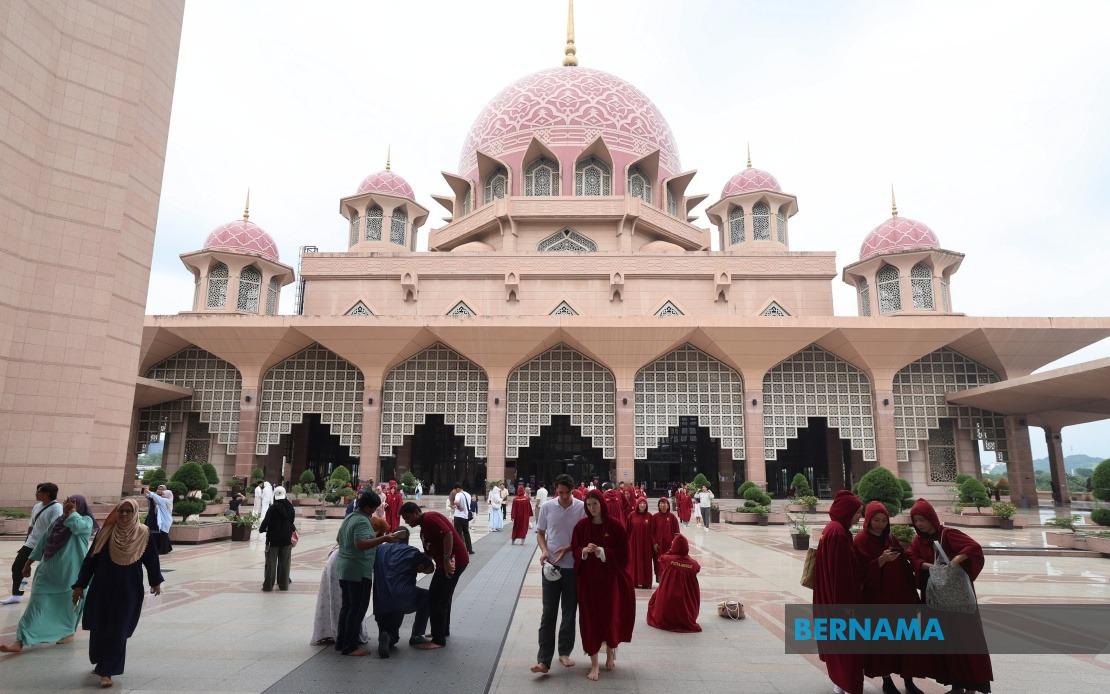
Putrajaya's Putra Mosque is hosting a landmark gathering this morning as Malaysia commemorates the National Maal Hijrah 1448H/2026M, drawing approximately 5,000 participants from across the country and beyond. The significant religious and cultural observance brings together prominent figures from government, diplomacy, and Islamic institutions to mark the Islamic New Year and reflect on Prophet Muhammad SAW's migration to Medina, an event that fundamentally reshaped Islamic history and civilisation.
Sultan of Perak Sultan Nazrin Shah is presiding over the ceremony as the principal officiant, underscoring the event's national significance and the monarchy's continuing role in championing Islamic values across Malaysia. The attendance of Deputy Prime Ministers Datuk Seri Ahmad Zahid Hamidi and Datuk Seri Fadillah Yusof, alongside numerous Cabinet ministers, departmental heads, and senior government officials, reflects the high-level commitment to the observance. International representation at the event further amplifies its regional and global importance, demonstrating Malaysia's position as a bridge between Islamic scholarship and contemporary governance.
The Department of Islamic Development Malaysia (JAKIM) has deliberately crafted this year's theme to encourage the Muslim community to internalise the profound lessons embedded within the Hijrah narrative. Beyond mere historical recollection, the organisers seek to inspire meaningful spiritual transformation among participants, framing Prophet Muhammad SAW's migration as more than a pivotal moment in Islamic chronology but as a perpetual model for positive change and resilience in the face of adversity. This interpretive approach resonates particularly with contemporary Malaysian Muslims navigating the complexities of a pluralistic society whilst maintaining Islamic principles.
A centrepiece of the celebration is Sultan Nazrin Shah's royal address, which will set the tone for national reflection on Islamic values and their application to modern challenges. Following this, the National and International Tokoh Maal Hijrah Awards will be presented to distinguished individuals whose lives embody the spirit of the Hijrah. These recipients have demonstrated exceptional credentials spanning deep expertise within their professional domains, exemplary moral character, and substantial contributions to advancing Islam's interests both domestically and on the global stage. The awards mechanism serves not merely as recognition but as a means of elevating role models whose trajectories can inspire younger generations of Malaysian Muslims.
A significant innovation within this year's programme is the Tausiyyah @ Maal Hijrah initiative, which was held at Putra Mosque the previous day. This initiative transcends conventional ceremonial approaches by prioritising tadabbur—a contemplative engagement with Quranic verses that moves beyond superficial recitation toward profound comprehension of the text's wisdom. Participants were exposed to recitations by accomplished qari whilst simultaneously encouraged to extract practical guidance applicable to their daily circumstances. This pedagogical approach acknowledges that authentic spiritual observance demands intellectual engagement and intentional reflection rather than passive participation.
The Tausiyyah programme demonstrates Malaysia's evolving approach to Islamic education and celebration, one that integrates emotional resonance with cognitive understanding. By foregrounding the messages and moral guidance contained within the Quran, organisers sought to create pathways through which believers might perceive the Hijrah not as distant history but as a living paradigm offering solutions to contemporary dilemmas. This represents a sophisticated understanding of how faith communities sustain relevance across generations—through interpretive frameworks that honour tradition whilst addressing present realities.
The celebrations extend beyond the ceremonial gathering itself. Tomorrow at the Putrajaya Islamic Complex Auditorium, the National and International Tokoh Maal Hijrah Lecture 1448H/2026 will commence at 9 am, providing award recipients with a platform to disseminate their knowledge and experiential insights to assembled audiences. This follow-up engagement transforms the awards ceremony from a singular moment of recognition into a sustained educational initiative, multiplying the impact of the recipients' wisdom across broader constituencies. The lecture format enables direct dialogue between accomplished individuals and those seeking guidance, fostering knowledge transmission that enriches Malaysia's Islamic intellectual landscape.
For Malaysia's diverse population, the National Maal Hijrah celebration holds particular significance as an annual touchstone for Islamic values and national identity. The gathering at Putra Mosque, Malaysia's national mosque, symbolises the state's commitment to providing institutional frameworks through which the Muslim majority can engage in meaningful collective religious observation. The participation of high-ranking government officials sends clear signals about the secular state's respect for and facilitation of religious practice, an important dynamic within Malaysia's constitutional framework.
The international dimension of this year's celebration underscores Malaysia's aspirations as a leading voice within the global Islamic world. By inviting foreign guests and awarding international recipients of the Tokoh Maal Hijrah honour, Malaysian organisers position the nation as both custodian of Islamic tradition and bridge-builder within international religious networks. This stance enhances Malaysia's soft power, particularly within Organisation of Islamic Cooperation circles and amongst Islamic scholars and intellectuals worldwide.
As the Islamic calendar turns with the Maal Hijrah observance, Malaysian Muslims are being encouraged to embrace the transformative potential inherent in the Hijrah narrative. Whether through formal ceremonies, scholarly lectures, or contemplative Quranic engagement, the multi-layered programming ensures that diverse segments of the community can access and internalise the year's central message. The emphasis on positive change, moral character, and institutional contribution creates a distinctly Malaysian interpretation of Islamic renewal—one rooted in tradition yet oriented toward contemporary progress and national development.

