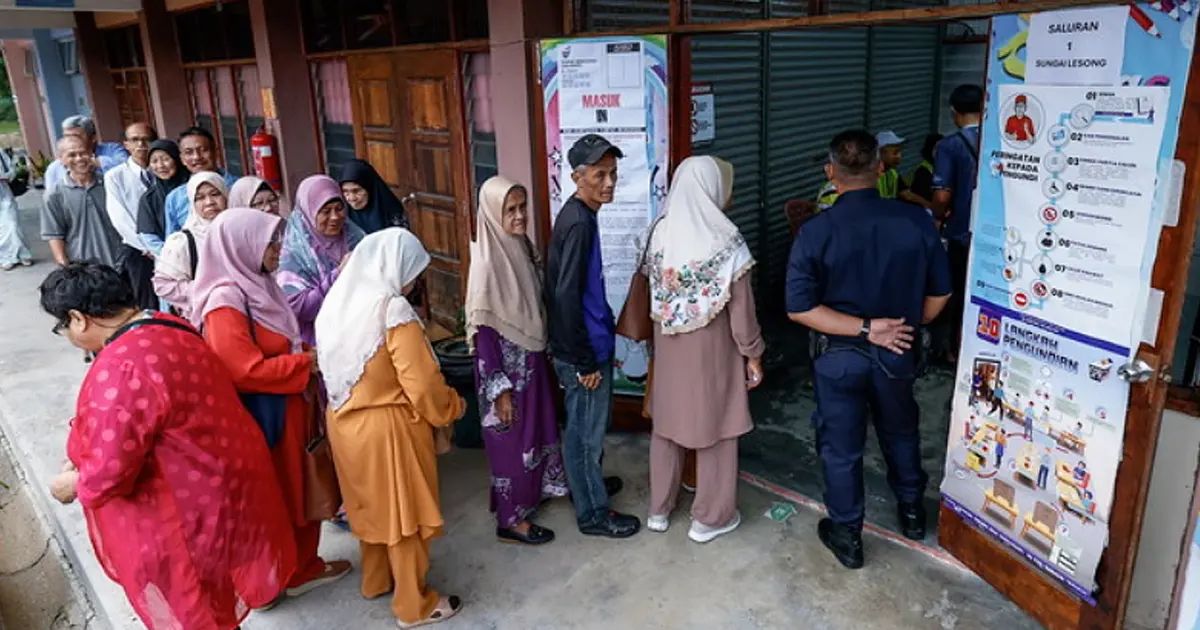
Malay voters risk experiencing fatigue from the persistent focus on 3R-related controversies, potentially undermining electoral engagement if the discourse continues without resolution, according to political analyst Awang Azman Pawi of Universiti Malaya. The scholar's assessment reflects growing concern that an extended preoccupation with these contentious issues may paradoxically diminish their salience at the ballot box, as public attention spans and emotional investment in political narratives fluctuate across election cycles.
The concept of emotional fatigue among voters deserves careful consideration within Malaysia's contemporary political environment. When populations encounter perpetual discussion of divisive themes without apparent movement toward consensus or closure, engagement levels tend to decline rather than intensify. This phenomenon has been documented across multiple democracies, where sustained controversy eventually produces disengagement rather than sustained mobilization. For Malaysia's Malay-Muslim majority, whose voting patterns have historically carried significant weight in national electoral outcomes, such fatigue could reshape coalition-building strategies and campaign messaging approaches.
Awang Azman emphasizes that political parties will ultimately be evaluated not by their rhetorical positioning on contested cultural or religious matters, but by measurable performance in governance and policy delivery. This assertion challenges the assumption that sustained attention to 3R discussions necessarily translates into electoral advantage. Rather, the analyst suggests that voters increasingly calibrate their political preferences based on concrete outcomes affecting their daily existence—a reorientation that has accelerated throughout Southeast Asia as economic pressures mount across the region.
The rise in cost of living presents a compelling case study in how economic grievances can supersede other political concerns. Malaysia has witnessed significant inflation across essential commodities, housing, transportation, and services over recent years. These pressures directly impact household budgets and family planning, creating visceral political motivations that transcend abstract debates. When families struggle to afford schooling, medical care, or food, their electoral calculations gravitate toward parties demonstrating competence in economic management rather than those perceived as fixated on cultural skirmishes.
Political parties across the Malaysian spectrum face a strategic calculation regarding resource allocation and messaging priorities. Those investing disproportionately in 3R discourse may find themselves increasingly disconnected from voter preoccupations. Conversely, parties articulating clear economic blueprints, demonstrating administrative efficiency, and proposing tangible relief measures for household budgetary pressures may capture broader electoral coalitions. This dynamic proves particularly consequential given Malaysia's multiethnic composition, where economic concerns transcend communal boundaries more readily than cultural or religious matters.
The temporal dimension of Awang Azman's analysis carries particular relevance for Malaysia's political calendar. Election cycles concentrate voter attention into specific periods, and parties must maximize resonance during these windows. Extended debate over 3R matters risks consuming campaign oxygen that could be deployed for addressing immediate economic anxieties. Should multiple electoral contests occur within shortened timeframes, fatigue effects may compound, creating electoral openings for parties willing to pivot toward pocketbook issues with concrete policy responses.
Historical patterns in Malaysian electoral behavior suggest voters reward competence in delivery and penalize perceived incompetence, particularly when economic management is at stake. Previous election cycles demonstrated that coalition-building strategies incorporating promises of economic relief, employment generation, and cost reduction often outperform campaigns centered exclusively on identity politics or cultural assertions. The analyst's perspective aligns with this empirical record, suggesting that contemporary Malay voters exhibit sophisticated calculus balancing multiple concerns while ultimately privileging material security and economic opportunity.
The scholar's observation also implies that political parties risk squandering the persuasive potential of 3R issues themselves if they permit these matters to become divorced from governance delivery. Rather than functioning as abstract ideological markers, 3R-related policies and positions carry legitimacy principally insofar as they translate into visible benefits or protections for constituents. A party advancing 3R concerns while simultaneously demonstrating economic incompetence or corruption may find these positions progressively delegitimized through voter skepticism about authenticity and commitment.
The warning from Universiti Malaya's Awang Azman reflects broader currents within Southeast Asian politics, where economic nationalism and tangible development promises have gained salience relative to cultural or religious nationalism alone. Across the region, voters display increasing sophistication in distinguishing between rhetorical positioning and genuine policy capacity. Malaysia's political landscape, characterized by competitive elections, multiple viable coalitions, and increasingly educated and informed electorates, particularly rewards parties capable of integrating values-based appeals with demonstrable economic competence and administrative effectiveness, thereby positioning material welfare and political performance as the ultimate arbiters of electoral success.

