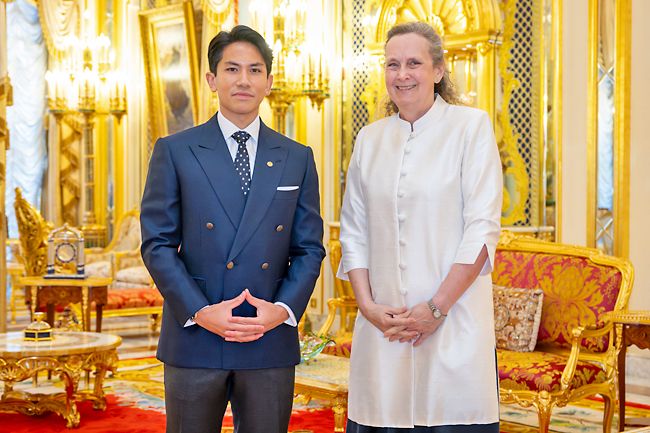
Bandar Seri Begawan welcomed a diplomatic milestone on Saturday when His Royal Highness Prince Abdul Mateen, Brunei's Minister of Foreign Affairs, received outgoing United States Ambassador Caryn R McClelland for a formal farewell ceremony at Istana Nurul Izzah. The audience marked the conclusion of McClelland's tenure representing American interests in the sultanate, reflecting the customary protocol observed when senior diplomatic officials complete their postings in the region.
During the meeting, Prince Abdul Mateen extended formal recognition of McClelland's diplomatic service, acknowledging her efforts in broadening and solidifying the enduring relationship between Brunei Darussalam and the United States. Such farewell audiences serve as important occasions in Southeast Asian diplomacy, allowing host governments to reflect on the outgoing envoy's contributions while signalling continuity in bilateral relations despite personnel changes. The reception underscores Brunei's commitment to maintaining strong ties with Washington across multiple dimensions of statecraft.
McClelland's departure concludes a posting during which both nations expanded their engagement beyond traditional diplomatic channels. The bilateral relationship during her tenure encompassed substantive cooperation in defence and security matters, reflecting broader Indo-Pacific strategic considerations that increasingly preoccupy regional governments. Such defence cooperation typically includes military-to-military exchanges, joint training exercises, and coordination on maritime security—areas of growing importance given geopolitical tensions in Southeast Asian waters.
Educational partnerships between the two countries also expanded during McClelland's time as ambassador. These initiatives facilitate academic exchanges, scholarship programmes, and institutional collaborations that build long-term people-to-people understanding. For Malaysian readers, such educational ties carry particular relevance, as regional university networks and professional linkages increasingly create interconnected diplomatic ecosystems across ASEAN member states.
Trade and investment cooperation constituted another pillar of bilateral relations that received attention during McClelland's tenure. American companies maintain significant commercial interests across Brunei's energy sector and services industries, while Bruneian enterprises explore opportunities in North American markets. These economic connections provide ballast to diplomatic relationships, ensuring that bilateral engagement extends beyond ceremonial protocols to tangible mutual benefit. Enhanced investment frameworks and trade facilitation measures undertaken during this period reflect mutual recognition of shared economic interests.
People-to-people exchanges formed the final significant dimension of expanded cooperation. These programmes encompass cultural initiatives, student travel, professional networking, and tourism promotion activities that cultivate grassroots understanding between populations. In the Southeast Asian context, such exchanges often have ripple effects across multiple countries, as individuals subsequently travel throughout the region and carry forward perspectives shaped by international engagement.
McClelland had formally presented her credentials to His Majesty Sultan Hassanal Bolkiah, Sultan and Yang Di-Pertuan of Brunei Darussalam, on May 24, 2022, initiating her ambassadorial mission. This presentation ceremony, conducted according to longstanding diplomatic protocol, officially commences an ambassador's authority to represent their nation. The interval between credential presentation and the farewell reception brackets the ambassador's complete tour of duty in the host nation.
Brunei's emphasis on ceremonial acknowledgment of diplomatic transitions reflects the sultanate's careful attention to diplomatic propriety and relationship maintenance. As a small nation within ASEAN, Brunei has cultivated a reputation for steady, consistent diplomacy that prioritises relationship continuity even as personnel change. This approach extends to all major diplomatic partners, including the United States, China, and regional neighbours, creating a stable environment for ongoing bilateral engagement.
The timing and formality of McClelland's farewell audience signal that her successor likely remains in transition phases, with the new ambassador either undergoing credential presentation procedures or preparing for official arrival in Bandar Seri Begawan. This interregnum period typically involves coordination between departing and arriving ambassadors to ensure seamless transition in ongoing diplomatic initiatives and relationship management.
For Malaysian observers, Brunei's diplomatic relationship with the United States carries broader regional significance. ASEAN unity and coordination on international matters benefits when member states maintain stable, positive relations with global powers. Brunei's balanced approach to major power engagement serves as a model for how smaller Southeast Asian nations navigate great power competition while advancing national interests.
The expanded cooperation mentioned in official channels—spanning defence, education, trade, and people-to-people engagement—reflects a comprehensive modernisation of bilateral relations tailored to contemporary geopolitical realities. Unlike relationships centred solely on strategic considerations, this multifaceted engagement creates resilient diplomatic foundations less vulnerable to fluctuating security circumstances or political transitions.

