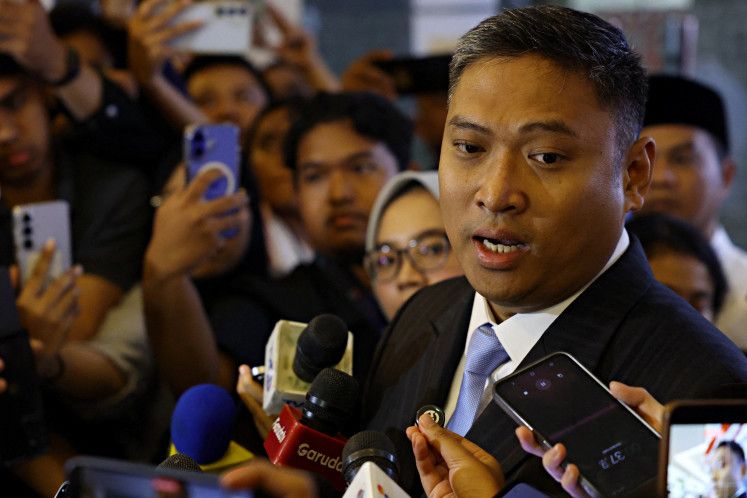
President Prabowo Subianto's signature free nutritious meals programme has been struck by another significant leadership upheaval, with National Nutrition Agency (BGN) chief Nanik Sudaryati Deyang stepping down after just weeks in post. Her abrupt departure exposes deepening institutional fragility within an initiative that has consumed enormous political capital and public resources since its rollout in early 2025. The resignation underscores mounting challenges facing what was intended as a marquee social policy, now shadowed by governance failures, operational missteps and persistent questions about implementation across Indonesia's sprawling archipelago.
Nanik announced her decision to leave the position through Facebook on Wednesday, citing medical grounds that warrant immediate treatment abroad. She informed President Prabowo that a serious cardiac condition—specifically an arterial blockage identified by physicians—had rendered her unable to continue shouldering the responsibility. The psychological toll of overseeing the programme's enormous financial obligations had contributed substantially to her deteriorating health, she explained, creating an intolerable situation where she felt compelled to prioritise personal wellbeing over professional duty. Her candid acknowledgement of the stress generated by managing public funds at such scale offered a rare glimpse into the internal pressures afflicting the agency's leadership.
In a poignant pre-resignation statement posted Tuesday evening, Nanik described her experience administering the free meals initiative as fundamentally traumatic, employing the metaphor of standing precariously atop a precipice where any misstep risked fatal consequences. The weight of protecting taxpayer money from misappropriation had become psychologically unbearable, to the extent that she refused to authorise transactions independently and subjected every policy decision to obsessive scrutiny. Her language conveyed not merely professional stress but existential dread—the sense that her tenure placed her in an impossible position where caution could never fully shield against accusations of complicity should anything unravel. This vulnerability revealed how toxic the atmosphere surrounding the agency had become.
Nanik's abrupt exit continues a disturbing pattern of institutional instability at the BGN. Her predecessor, Dadan Hindayana, was dismissed in early June following his arrest alongside two deputies in a corruption investigation centred on irregularities within the free meals scheme. Allegations involved procurement violations and financial mismanagement spanning the multitrillion-rupiah budget. Nanik herself had served as Dadan's deputy before being elevated to the top role, ostensibly to restore stakeholder confidence after the Attorney General's Office launched its probe. Her appointment was framed as a stabilising move, yet she has now become the second consecutive BGN chief to exit under duress within months, suggesting institutional dysfunction runs deeper than any individual leader can remedy.
Within hours of accepting Nanik's resignation, Prabowo installed Deputy Agriculture Minister Sudaryono as her successor in a ceremony at Jakarta's State Palace on Wednesday. Sudaryono, a politician drawn from Prabowo's own Gerindra Party who previously served as a presidential aide in the 2010s, represents a return to partisan rather than technocratic leadership. His appointment signals a shift in approach: rather than seeking an administrator buffered from political pressures, Prabowo has selected a loyalist embedded within his political network. Sudaryono pledged immediate reforms targeting transparency and accountability, vowing to eliminate opaque manual processes through digitalisation and ensuring governance occurs in the open rather than behind institutional walls. Yet his political background raises questions about whether managerial competence rather than party allegiance will ultimately determine programme direction.
State Secretary Prasetyo Hadi acknowledged the succession of setbacks had fallen short of presidential expectations, confirming that Prabowo had instructed comprehensive administrative overhaul across the BGN following the corruption investigation. Officials justified Sudaryono's selection partly on grounds that he participated in designing the programme during its developmental phase, implying continuity with founding principles. This reasoning, however, sits uneasily alongside the fundamental governance failures the programme has displayed. If Sudaryono was instrumental in the initiative's original conception, his involvement offers no clear reason to expect he can solve the institutional pathologies that have festered since implementation began eighteen months ago. The emphasis on his prior involvement may indicate desperation rather than confident strategy.
The free meals programme has accumulated a troubling record of operational crises since launch. Food safety has emerged as a persistent nightmare, with multiple mass poisoning incidents reported across different regions, casting serious doubt on quality control mechanisms and supplier vetting procedures. These health emergencies galvanised public concern and eroded confidence among beneficiaries and their families. Responding to accumulating criticism, Nanik implemented a moratorium on establishing new kitchen facilities while nearly 28,000 existing sites underwent systematic review nationwide. This defensive measure, though administratively prudent, provoked fierce protests from thousands of prospective operators who had invested heavily in facilities only to see expansion halted indefinitely. The government thus found itself simultaneously battling food safety scandals whilst antagonising potential service providers dependent on programme expansion.
Financial retrenchment now accompanies operational restructuring. The BGN announced Tuesday that it had dramatically reduced the provisional 2026 budget from Rp268 trillion to Rp229 trillion—equivalent to roughly US$12.8 billion—a contraction exceeding 14 percent. More starkly, the agency lowered beneficiary targets to 62.7 million people for the coming year, abandoning earlier ambitions to reach 82.9 million recipients including schoolchildren, toddlers and pregnant women. Initial planning had allocated Rp335 trillion to achieve that broader coverage. These reductions reflect cold institutional acknowledgement that current administrative capacity cannot support the programme's original scope. BGN deputy chief Agustina Arumsari framed the shift as prioritising service quality over beneficiary expansion, effectively converting contraction into policy virtue. Nonetheless, the downscaling represents a substantial retreat from campaign promises regarding the initiative's transformative potential.
Political analyst Wasisto Raharjo Jati identified fundamental deficiencies in programme conception and preparation as root causes of recurring dysfunction. Despite the political prominence Prabowo attached to the free meals initiative as a signature achievement, institutional development never matched political ambition. The scheme was driven fundamentally by political necessity—delivering a visible welfare benefit to mobilise electoral support—rather than by rigorous technocratic groundwork. Wasisto suggested that inadequate planning at foundational stages, insufficient capacity-building among implementing agencies, and insufficient pilot-testing before national rollout had created structural weaknesses that no leadership change could easily remedy. The programme embodied characteristic tensions within Indonesian governance between rapid policy implementation driven by electoral timelines and the institutional development required for sustainable service delivery across a nation of Indonesia's complexity and geographic dispersion.
For Malaysian observers, the BGN crisis offers instructive parallels regarding the political economy of large-scale social programmes. President Prabowo's experience demonstrates that even well-intentioned flagship initiatives can founder when implementation capacity lags behind political commitments. The food safety incidents, budgetary miscalculations and corruption allegations plaguing Indonesia's free meals scheme represent foreseeable risks that careful institutional design and graduated rollout might have mitigated. As Malaysia contemplates various social policy expansions, Indonesian developments suggest that rhetorical commitment to poverty alleviation or nutritional improvement requires matching investments in bureaucratic capacity, transparent procurement systems and rigorous quality assurance mechanisms. The revolving leadership at Indonesia's BGN underscores how political will alone cannot substitute for institutional competence and ethical governance.

