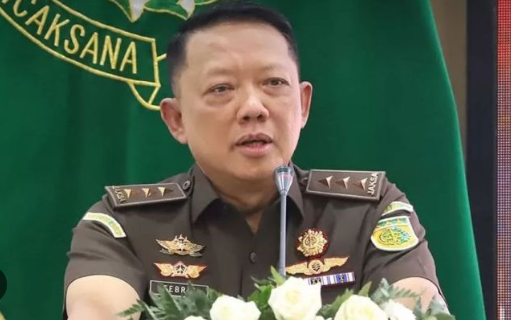
President Prabowo Subianto built much of his political platform on an aggressive anti-corruption agenda, repeatedly warning Indonesian officials that they must "clean themselves up" or face enforcement action. Yet barely eighteen months into his presidency, his signature anti-graft campaign confronts a defining moment: the investigation into Febrie Adriansyah, the nation's recently resigned deputy attorney general and one of Southeast Asia's most influential corruption prosecutors. The case has exposed a fundamental tension in Indonesia's institutional landscape—how to hold powerful law-enforcement officials accountable when the institutions tasked with investigating them have their own institutional interests at stake.
Febrie's fall from power appeared swift and dramatic. Police seized approximately US$26 million in cash and gold bars from a residence he owned, named him a suspect in money-laundering cases, and deployed armed personnel around his South Jakarta home during raids conducted last week. Yet despite these aggressive tactics, Febrie remains at large, technically free to move about though banned from leaving Indonesia for twenty days. The apparent paradox—high-profile seizures coupled with the suspect's continued liberty—has puzzled observers and intensified questions about whether institutional politics rather than legal principle now shapes the investigation's trajectory.
The most controversial decision came when police transferred three related corruption cases to the Attorney General's Office, the very institution where Febrie spent most of his career climbing its hierarchy. Officials justified the move as improving coordination between agencies, but legal scholars and constitutional experts have challenged this rationale. Mahfud MD, a former Constitutional Court chief justice whose voice carries considerable weight in Indonesian legal circles, publicly questioned whether the criminal procedure code even permits such a transfer of an active police investigation. He warned that prosecutors could exploit procedural vulnerabilities to challenge the case before trial, potentially unraveling months of investigative work. This transfer creates what many see as an obvious conflict of interest: asking an institution to investigate one of its most senior former members, someone who personally shaped policies and shaped the careers of prosecutors now potentially evaluating his conduct.
Academics and anti-corruption specialists have articulated deeper concerns about the arrangement. Zaenur Rohman, an anti-corruption scholar at Gadjah Mada University, characterized the transfer as a "political settlement aimed at easing tensions" between competing law-enforcement agencies rather than a decision grounded in legal principle. He argued that Indonesia's Corruption Eradication Commission, which operates within the executive branch and maintains greater institutional independence, would be far better positioned to lead such a sensitive investigation. The question underlying Rohman's critique reflects a larger institutional reality: Indonesia's multiple anti-corruption bodies—police, prosecutors, and the Corruption Eradication Commission—have long competed for jurisdiction, influence, and visibility over high-profile cases, a competition that inevitably shapes investigative outcomes.
To manage public concern about whether prosecutors might protect one of their own, Coordinating Minister Yusril Ihza Mahendra defended the transfer as enhancing investigative efficiency. Yet his statement inadvertently revealed the anxiety underlying the case when he acknowledged public fears that the arrangement amounted to "oranges eating oranges," an Indonesian colloquialism meaning one institution sheltering its own. More revealing still, Yusril disclosed that President Prabowo personally met with both the national police chief and the attorney general to provide "directions" on managing the case transfer. This presidential involvement, intended to ensure proper procedure, instead underscored how thoroughly politicized the case had become and suggested that executive-level considerations might override institutional or legal logic.
Febrie's stature magnifies the case's sensitivity. As head of the Attorney General's Office's Special Crimes Division, he personally directed some of Indonesia's most consequential corruption investigations, overseeing probes into state-owned enterprises like Pertamina and Timah, major airlines, and even Prabowo's signature free-meals programme—an initiative the president championed as poverty relief but which multiple investigations have examined for irregularities. Febrie's investigations also touched senior political figures including former Education Minister Nadiem Makarim. Few prosecutors in modern Indonesian history have wielded comparable influence over cases involving the nation's economic and political elite. This makes the current investigation particularly consequential: failure to conduct it transparently would suggest that even the most powerful legal officials operate above accountability, fundamentally undermining public confidence in anti-corruption efforts.
The investigation's procedural aspects remain opaque. Police have provided no public explanation for why Febrie, named a suspect in money-laundering cases, has not been detained, a standard measure for suspects in serious financial crimes. Instead, Febrie's current status appears quasi-restricted: authorities have disclosed neither his whereabouts nor his movements, ban him from leaving the country, yet permit him relative freedom within Indonesian territory. Meanwhile, another suspect in related cases was arrested the Friday after police conducted raids on Febrie's residence, creating an asymmetry that invites questions about differential treatment. Police claim to retain investigative involvement despite the formal transfer, noting they continue to verify evidence seized during raids and seek international assistance from American and Singaporean authorities to authenticate currency and test precious metals found in Febrie's home.
Parliamentarians have responded to public anxiety by forming a working group to monitor the case, and some have explicitly called for the Attorney General's Office to establish an independent investigative team insulated from ordinary prosecutorial hierarchies. These calls reflect recognition that normal institutional arrangements may prove inadequate to the case's sensitivity. Aditya Perdana, a political lecturer at the University of Indonesia, captured this dilemma succinctly: "The events don't explicitly prove institutional conflict, but the sequence tells a story." That narrative sequence—the timing of case transfers, the asymmetrical detention decisions, the presidential involvement in directing institutional conduct—creates the impression of managed coordination rather than impartial investigation, precisely the opposite of what Prabowo's anti-corruption campaign promised.
The case also illuminates broader shifts in Indonesia's law-enforcement architecture. Recent legislative changes in 2025 expanded the Attorney General's Office's authority to request military protection for prosecutors, a function previously reserved to police, while simultaneously permitting active-duty military officers to serve within prosecutors' ranks without retiring. These changes reflect continuing efforts by successive Indonesian presidents to balance power among competing security institutions—police, prosecutors, military, and the Corruption Eradication Commission. Jacqui Baker, a Southeast Asian politics specialist at Murdoch University, observed that Indonesia's presidents deliberately prevent any single institution from dominating criminal investigations "because they lie at the core of their political and economic power." Prabowo has continued this balancing approach, though the Febrie case suggests the equilibrium remains fragile and vulnerable to institutional self-interest.
Meanwhile, tensions that surfaced publicly during the initial raids appear to have subsided, at least on the surface. The armed military personnel who visibly deployed around Febrie's residence have withdrawn, and senior officials from the police and Attorney General's Office appeared publicly together on Monday to deny any institutional rift. The Attorney General's Office also moved to restrict regional prosecutors' ongoing investigations into Prabowo's flagship meals programme, citing completion of the initial data-collection phase and cautioning against abuse of investigative authority. This move came notably after that same office had named an active police brigadier general as a suspect in related programme investigations, suggesting a strategic decision to reduce institutional friction by throttling back competing investigations. The sequencing of these moves—the transfer of Febrie's case to prosecutors, the arrest of a police general in an unrelated case, the restriction of further prosecutor-led investigations into the meals programme—reveals a carefully choreographed de-escalation.
Yet beneath this managed surface calm lies a fundamental credibility crisis for Prabowo's anti-corruption campaign. The president came to office pledging an "uncompromising fight" against corruption and repeatedly insisted that officials "clean themselves up." The Febrie investigation now demonstrates the limits of that commitment when the official in question is powerful, institutionally well-connected, and capable of mobilizing bureaucratic allies. For Southeast Asian observers watching Indonesia's institutional development, the case offers an uncomfortable lesson: even under a president explicitly committed to combating corruption, institutional self-interest and political calculation can override legal principle when investigating the highest-ranking law-enforcement officials. Whether Indonesia's complex architecture of competing anti-corruption bodies can ultimately produce impartial justice in this case will largely determine whether Prabowo's anti-corruption credentials survive intact or become permanently tarnished by the appearance that even the nation's most powerful prosecutors operate within protective institutional networks.

