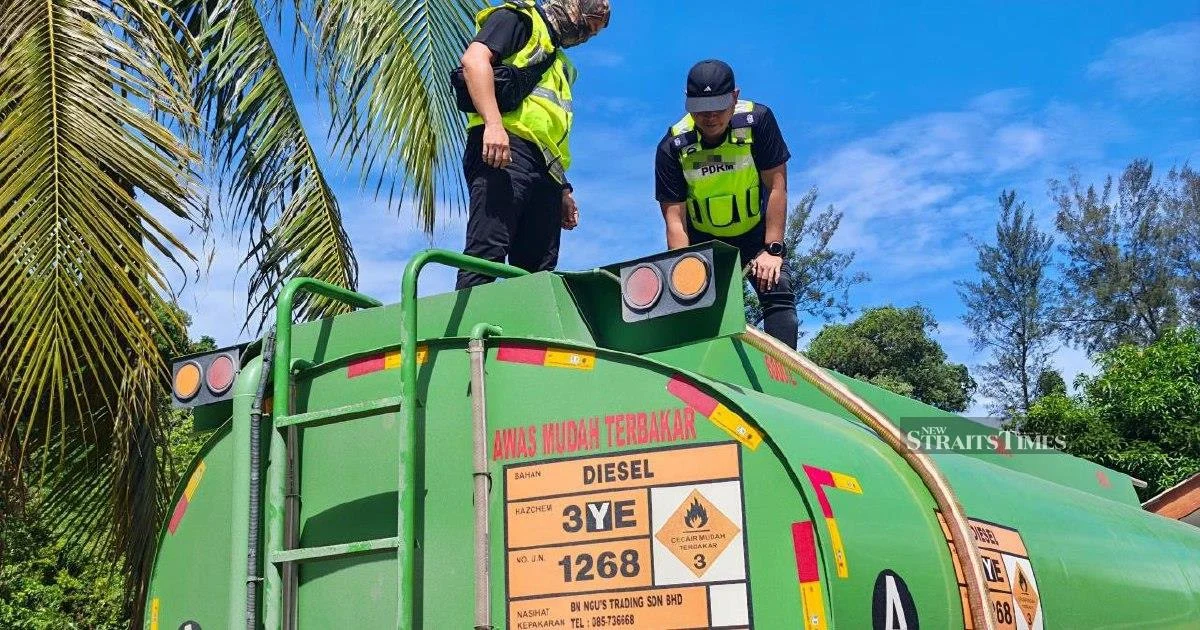
Police in Miri have successfully dismantled a clandestine operation designed to divert subsidised diesel fuel intended for legitimate commercial and domestic use. The breakthrough came during a coordinated enforcement action targeting the Tanjung Lobang area, where authorities discovered that a nondescript bungalow was being utilised as a covert fuel storage and distribution facility. The operation resulted in the confiscation of 15,000 litres of diesel and the arrest of four men believed to be orchestrating the illegal enterprise.
Subsidised fuel diversion has emerged as a persistent challenge across Southeast Asia, particularly affecting Malaysia's downstream fuel sector. When diesel—heavily subsidised by the government to maintain affordability for essential industries and rural communities—is illegally redirected through underground networks, it distorts market dynamics and deprives the treasury of substantial revenue. The Miri operation exemplifies the sophisticated logistical arrangements criminal syndicates have developed to intercept and redistribute fuel destined for authorised retailers and end-users.
The discovery at Tanjung Lobang reveals the adaptability of smuggling networks operating in Sarawak, a state with extensive rural areas and maritime boundaries that create enforcement challenges. Rather than operating from obvious industrial sites, the syndicate chose a residential location designed to avoid attracting attention from routine regulatory patrols. This approach—utilising civilian infrastructure for illegal commodity storage—demonstrates how organised crime adapts operational security protocols to evade detection. The bungalow's remote positioning would have afforded the operators relative anonymity whilst maintaining sufficient accessibility for regular supply replenishment and customer transactions.
The scale of the seizure—15,000 litres—suggests this was not an opportunistic or small-scale theft but rather an established distribution network with regular throughput. The fuel quantities involved indicate the syndicate likely maintained ongoing customer relationships with transporters, small-scale retailers, or industrial users willing to purchase discounted fuel without formal documentation. Each litre diverted represents lost government subsidies and tax revenue whilst simultaneously undercutting legitimate fuel retailers operating within legal frameworks.
The arrest of four individuals provides enforcement agencies with potential entry points into broader criminal networks. Such operations rarely function in isolation; they typically involve suppliers who facilitate the initial diversion from authorised distribution points, logisticians who manage storage and transport, and distributors who connect with end-users. The detained suspects will likely face charges under legislation prohibiting fuel smuggling and unauthorised fuel trade, potentially including provisions addressing organised crime involvement if prosecutors determine the operation involved structured criminal syndicates.
Mari's role as a commercial and industrial hub makes it particularly vulnerable to fuel diversion schemes. The district supports oil and gas activities, shipping operations, and extensive agricultural enterprises—all sectors requiring substantial diesel quantities. Legitimate demand creates market conditions where diversion becomes economically attractive to both suppliers and buyers. The widespread availability of subsidised fuel across official channels should theoretically eliminate incentive for illegal purchase, yet criminal syndicates exploit information asymmetries, payment method flexibility, and absence of documentation requirements to attract customers seeking to evade regulatory oversight or minimise operational costs through informal arrangements.
The enforcement action reflects growing coordination between Malaysian law enforcement agencies tasked with combating fuel smuggling. Such operations typically involve intelligence gathering, surveillance, and coordinated raids requiring cooperation between federal and state authorities. The successful identification and dismantling of the Tanjung Lobang facility demonstrates improved information-sharing and response capabilities within Sarawak's security apparatus, though the frequency of such discoveries suggests the underlying problem remains substantial.
From a policy perspective, this case underscores the tension inherent in fuel subsidisation. Whilst subsidies serve legitimate economic and social objectives—supporting rural communities and maintaining competitiveness for Malaysian industries—they simultaneously create arbitrage opportunities attracting criminal enterprise. Persistent diversion indicates that current enforcement resources, despite recent successes, remain insufficient to eliminate large-scale smuggling networks. The ease with which criminal operators established and sustained a 15,000-litre operation suggests enforcement gaps in monitoring and regulating fuel distribution chains.
The seizure contributes to ongoing government efforts to quantify fuel diversion losses and refine counter-smuggling strategies. Each documented operation provides evidence regarding syndicate methodologies, geographic patterns, and demand sources that inform future interdiction efforts. However, preventing such schemes ultimately requires multi-layered approaches encompassing supply-chain transparency, technological monitoring of fuel movements, intelligence operations targeting distribution networks, and strategic enforcement against major trafficking nodes rather than merely reactive responses to individual discoveries.
Looking forward, the incident will likely prompt authorities to intensify surveillance across Sarawak's rural areas where similar clandestine facilities may operate undetected. The state's geography—characterised by extensive forested regions, limited road infrastructure in certain areas, and proximity to international maritime boundaries—creates persistent operational challenges for enforcement agencies. Disrupting established smuggling networks requires not merely seizing individual fuel caches but systematically targeting the organised crime groups orchestrating diversion operations at source within authorised supply chains, an objective requiring sustained investigation and intelligence-led policing focused on upstream criminal actors rather than street-level fuel transactions.