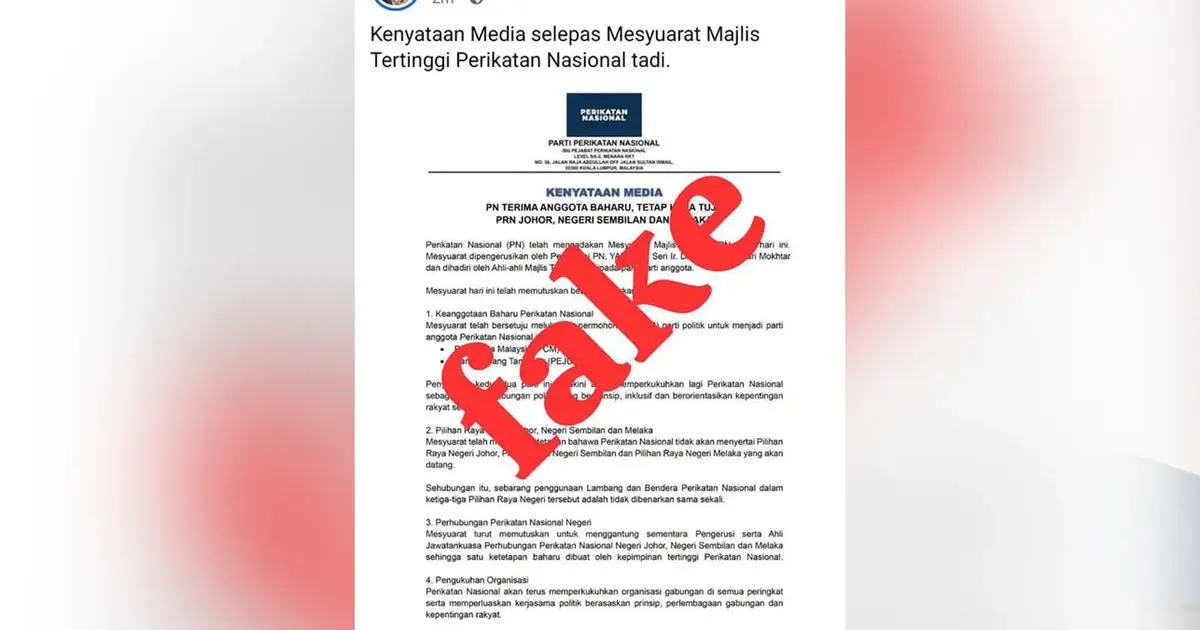
Perikatan Nasional moved swiftly to distance itself from a statement circulating in political circles that alleged the coalition intended to sidestep participation in three state electoral contests. The coalition's categorical denial reflects growing vigilance over misinformation campaigns that appear designed to sow discord within opposition ranks and confuse voters about electoral intentions.
The disputed statement, which originated from unverified sources, claimed PN would withdraw from competing in the three state elections, a move that would have constituted a dramatic departure from the coalition's established strategy of broadening its electoral footprint. By declaring the allegations both false and inaccurate, PN sought to preempt any narrative damage that might arise from widespread circulation of such claims among party members and supporters who rely on official channels for strategic direction.
For Malaysian political observers, the incident underscores an increasingly sophisticated ecosystem of disinformation targeting opposition coalitions ahead of what many anticipate will be a busy electoral cycle. With state elections serving as crucial testing grounds for national political formations, the stakes surrounding coalition participation decisions carry substantial weight. Any genuine withdrawal from major state contests would signal either strategic retrenchment or internal disagreement—developments that would fundamentally alter the competitive landscape across multiple peninsular states.
Peikatan Nasional has positioned itself since the 2022 general election as a significant player capable of challenging Barisan Nasional's dominance in specific regions and demographics. Opting out of state elections would contradict this positioning and potentially alienate grassroots members who have invested considerable effort in building organisational capacity across constituencies. The coalition's explicit rejection of the spurious statement therefore serves not merely as a factual correction but as a reassurance to internal stakeholders that electoral ambitions remain undiminished.
The timing of such misinformation carries particular significance given the periodic nature of Malaysia's state electoral calendar. With various state assemblies operating on different dissolution schedules, there exists perpetual speculation about which states might hold elections next. Opposition coalitions like PN must maintain coherent communication about their readiness to contest any poll, as uncertainty on this question can undermine campaign preparations and donor confidence. False narratives about withdrawal intentions therefore represent material threats to coalition cohesion.
Internally, PN comprises component parties with sometimes divergent interests across different states and regions. Amanah, Bersatu, and PAS each maintain particular strongholds and electoral calculations specific to their circumstances. A coordinated strategy requiring all three component parties to commit to major state contests requires careful negotiation. Denying claims of selective withdrawal becomes essential to preventing component parties from questioning coalition leadership's commitment to their respective turfs.
From a broader Malaysian perspective, the steady emergence of fabricated political statements reflects the changing nature of electoral contestation. Rather than confining campaigns to traditional media and direct engagement, political actors increasingly contend with a parallel information space populated by unverified claims, coordinated narrative attacks, and strategically timed disinformation. Election commissions and civil society observers have raised concerns about such tactics potentially undermining the integrity of democratic processes.
For voters attempting to understand coalition strategies and electoral intentions, distinguishing genuine policy announcements from fraudulent statements has become progressively harder. Official denials help, but they often reach smaller audiences than the original false claim. PN's response therefore represents only one component of a broader communications challenge facing opposition coalitions seeking to maintain voter and supporter confidence across decentralised, digitally-mediated information environments.
The specific targeting of state election participation decisions suggests someone with political sophistication crafted the false statement, recognising that uncertainty about electoral readiness creates disproportionate damage. Credible observers of Malaysian politics immediately questioned the fabricated claim's authenticity, yet its circulation nonetheless served to inject doubt into public discussion. This dynamic—where false claims achieve some measure of their intended effect even when subsequently debunked—characterises modern political disinformation across most democracies.
Moving forward, PN will likely intensify efforts to communicate electoral strategies through verified channels and official statements, seeking to outpace rumour and speculation. The coalition's rapid response to the false statement demonstrates awareness that timely denial matters. However, combating systematic disinformation ultimately requires broader ecosystem changes involving digital platforms, media literacy initiatives, and institutional accountability—challenges that extend well beyond any single coalition's capacity to address independently.
For Malaysian voters and stakeholders monitoring opposition coalition development, the incident serves as a reminder that electoral information increasingly requires critical evaluation of source credibility. While PN's denial provides clarity on this particular matter, the underlying vulnerability to misinformation campaigns—and the potential damage such campaigns can inflict on political discourse—warrants serious attention from governance institutions and civil society organisations committed to preserving democratic authenticity.

