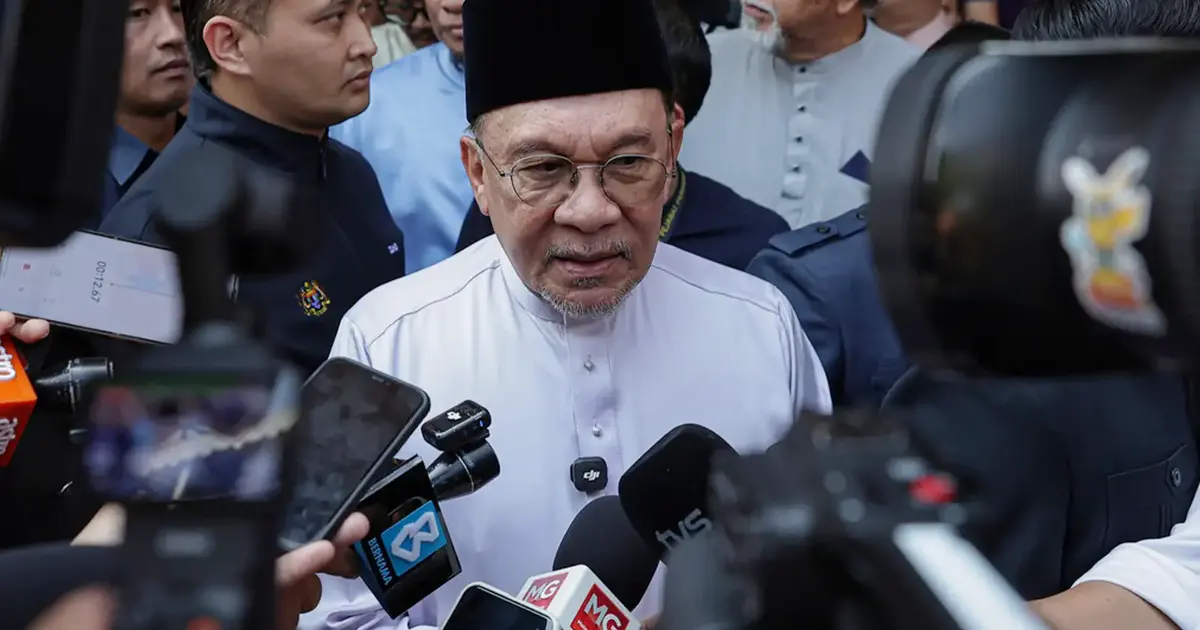
Prime Minister Anwar Ibrahim has pledged that positive public sentiment reflected in recent survey data will motivate his administration to intensify its policy delivery rather than rest on its laurels. The Merdeka Center survey, which ranked the government favourably among Malaysian voters, prompted the premier to issue a measured response that balanced acknowledgement of public support with a call for renewed diligence across all governmental functions.
Anwar's remarks represent a deliberate rhetorical positioning that recognises the political momentum his administration has built while simultaneously distancing the government from accusations of complacency or overconfidence. This approach is particularly significant given Malaysia's volatile political landscape, where public sentiment can shift rapidly in response to economic pressures, policy missteps, or rival political narratives. The Prime Minister's emphasis on continued hard work signals to both his coalition partners and the electorate that approval ratings do not translate into a mandate for reduced effort or diminished accountability.
The Merdeka Center, Malaysia's longest-established independent polling organisation, conducts regular tracking surveys that measure public approval of governmental performance across multiple dimensions including economic management, delivery on campaign promises, and leadership credibility. These surveys carry substantial weight in Malaysian political discourse because they are viewed as methodologically rigorous and relatively insulated from partisan influence. When a sitting government performs well in such metrics, it typically strengthens the administration's position within its own coalition and provides political cover for contentious policy decisions.
Anwar's cautionary stance may reflect broader strategic considerations within the Pakatan Harapan-led government and its complex coalition dynamics. With multiple parties holding ministerial positions and competing interests, maintaining public approval provides important leverage for the Prime Minister in internal negotiations and policy coordination. Conversely, allowing that approval to translate into complacency could create openings for rival political actors to challenge governmental legitimacy or for public dissatisfaction to accumulate unaddressed.
Malaysian voters have demonstrated in recent election cycles a willingness to punish governments perceived as arrogant or disconnected from ground-level concerns. The 2022 general election, which produced a fragmented parliament requiring coalition-building, underscored the volatility of the electoral environment. For any administration operating within such constraints, public approval functions as a temporary asset rather than a permanent political holding. Anwar's rhetoric acknowledges this fundamental reality of contemporary Malaysian governance.
The Prime Minister's emphasis on translating survey results into intensified effort also addresses a perennial challenge facing Malaysian governments: the implementation gap between policy announcements and tangible outcomes. High approval ratings can erode quickly if citizens perceive that announced initiatives fail to materialise or that promised improvements in public services remain unrealised. By explicitly linking positive survey results to obligations for enhanced performance, Anwar attempts to establish benchmarks against which his government can be measured.
Economic performance will likely prove decisive in determining whether current approval ratings prove durable or ephemeral. Malaysia faces persistent challenges including inflation's impact on household budgets, the cost of living crisis affecting urban and rural populations alike, and questions about long-term fiscal sustainability. Survey approval that reflects recent policy adjustments or improved sentiment could evaporate if economic headwinds intensify. Anwar's insistence on continued effort implicitly acknowledges that maintaining public confidence requires sustained delivery on economic and social fronts.
The regional context also shapes how Malaysian political actors interpret and respond to approval data. Neighbouring governments face analogous challenges in maintaining public legitimacy amid economic uncertainty and competing demands for public resources. How Malaysia's administration translates public approval into effective governance will influence regional perceptions of the country's political stability and economic management capacity. International investors and regional partners monitor these signals closely when assessing Malaysia's political reliability.
Anwar's response also reflects lessons drawn from recent Malaysian political history, where governments that appeared to take public support for granted faced erosion of that support through seemingly minor incidents or accumulated frustrations. The Prime Minister's explicit rejection of complacency may serve partly as internal messaging to his own cabinet and party machinery, ensuring that subordinate officials do not interpret approval ratings as permission for reduced accountability or effort. Such internal messaging is often as important as public-facing rhetoric in maintaining governmental discipline.
Moving forward, the crucial test for Anwar's administration will be whether it can translate current goodwill into sustained policy achievements across priority areas including education, healthcare delivery, infrastructure development, and anti-corruption efforts. The Merdeka Center survey provides a snapshot of current opinion, but the trajectory of public approval will depend on how effectively government institutions respond to citizen expectations and on the broader economic conditions that shape household welfare and political sentiment throughout the nation.

