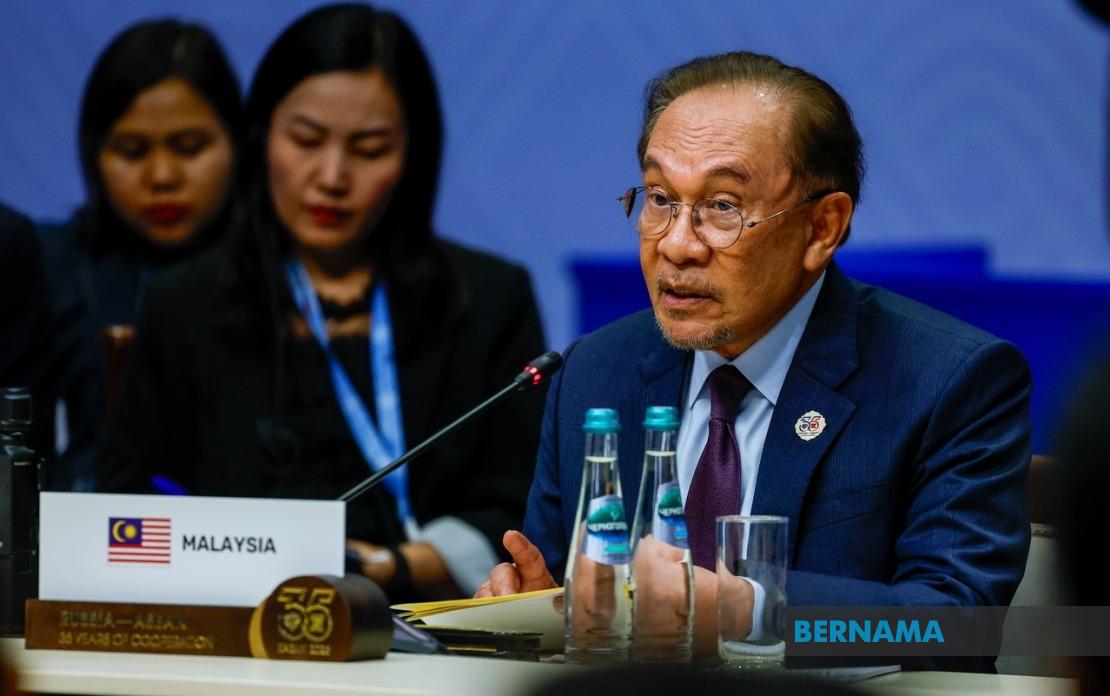
Prime Minister Datuk Seri Anwar Ibrahim has called for a significant deepening of strategic cooperation between ASEAN and Russia, leveraging what he described as a pivotal moment in their shared relationship. Speaking during the plenary session of the ASEAN-Russia Commemorative Summit in Kazan on June 18, Anwar underscored the critical importance of dialogue and diplomatic channels as the bedrock for managing escalating geopolitical tensions and international conflicts. His remarks reflected Malaysia's longstanding commitment to multilateral engagement and peaceful resolution of disputes, positioning both regional blocs as stabilising forces in an increasingly fragmented global order.
The summit itself represents a significant milestone, marking the 35th anniversary of formal ASEAN-Russia relations, which traces its origins to 1991 in Kuala Lumpur. Beyond ceremonial significance, this anniversary provides both parties with an opportunity to assess three and a half decades of cooperation and to recalibrate their partnership framework for the decade ahead. The gathering brings together regional heavyweights including Philippines President Ferdinand Marcos Jr, who chairs ASEAN this year, alongside leaders and representatives from all member states. This high-level participation underscores the institutional weight both sides attach to the relationship, particularly as global power dynamics continue to shift and regional powers seek to maintain autonomous foreign policy positions.
Anwar identified several priority areas where ASEAN and Russia should concentrate their collaborative efforts. Trade and investment linkages form the economic foundation, with both blocs recognising untapped potential in bilateral commerce. The digital economy and technological advancement represent another critical frontier, where ASEAN's rapidly expanding tech ecosystems could complement Russian expertise in certain sectors. Artificial intelligence emerged as a specific focus area, reflecting global recognition of AI's transformative potential across economies. Energy cooperation carries particular relevance for Southeast Asia, a region with diverse energy needs and growing renewable energy ambitions, where Russian technical knowledge and resources could prove complementary.
Food security featured prominently in the prime minister's agenda, underscoring anxieties throughout Southeast Asia about supply chain resilience and agricultural sustainability. The halal industry merits special attention as a strategic economic sector where ASEAN's leadership—particularly Malaysia's prominence—intersects with Russian market opportunities and production capabilities. Beyond institutional cooperation, Anwar emphasised people-to-people exchanges as the connective tissue binding both communities, recognising that sustained partnerships require grassroots understanding and cultural familiarity alongside official channels.
Malaysia's positioning on West Asia conflicts revealed the delicate balance Southeast Asian nations navigate between maintaining strategic relationships and advocating for humanitarian principles. Anwar reiterated Malaysia's demand for an immediate cessation of violence in Gaza, unimpeded humanitarian assistance, and protection of Palestinian self-determination rights. Malaysia further condemned the expansion of Israeli military operations into Lebanon and any attacks on the United Nations Interim Force in Lebanon. These positions reflect broader Southeast Asian sentiment, where Muslim-majority nations feel particular responsibility toward Palestinian and Lebanese populations, even as they maintain complex relationships with various global powers.
The strategic architecture emerging from Kazan reflects evolving global multipolarity. Rather than choosing sides in great power competitions, ASEAN and Russia are attempting to forge an autonomous partnership rooted in mutual respect and reciprocal benefits. This approach aligns with ASEAN's cherished principle of non-alignment, allowing the bloc to engage Russia substantively while maintaining relationships with Western powers and China. For Malaysia specifically, such engagement demonstrates commitment to strategic autonomy and resistance to binary geopolitical frameworks.
The summit is expected to produce four significant outcome documents. The Kazan Declaration commemorates the 35-year relationship milestone and sets the diplomatic tone for renewed commitment. Separate joint statements on energy and cultural cooperation provide targeted frameworks for specific sectoral engagement. Most substantively, a comprehensive plan of action for implementing the ASEAN-Russia Strategic Partnership through 2030 maps concrete deliverables and institutional mechanisms. These documents collectively represent more than symbolic gestures; they establish measurable commitments and implementation pathways that will shape bilateral relations throughout the remainder of the decade.
The 2026-2030 strategic partnership framework carries particular importance for Malaysian interests. As a middle power deeply invested in regional stability and Southeast Asian prosperity, Malaysia benefits from Russia's engagement with ASEAN institutions rather than bilateral relationships with individual states. Russia's participation in regional architecture helps distribute geopolitical competition across multilateral channels rather than concentrating it in bilateral dyads. This diffusion of engagement reduces pressure on individual ASEAN members to make exclusive strategic choices.
Energy cooperation deserves particular emphasis given Malaysia's positioning as both a hydrocarbon producer and increasingly an energy transition leader. Russian expertise in hydrocarbon production and emerging interest in renewable technologies could support Malaysia's dual objectives of maintaining current energy revenues while investing in clean energy infrastructure. Similarly, ASEAN's growing digital economy and technological sophistication present genuine opportunities for Russian participation in Southeast Asian development rather than being confined to traditional commodity exchanges.
The emphasis on dialogue and diplomacy in Anwar's remarks carries weight beyond rhetorical flourish. In Southeast Asia's immediate environment, where maritime disputes, territorial concerns, and competing claims create friction, multilateral platforms that prioritise negotiation over coercion provide essential pressure-relief mechanisms. Russia's engagement through ASEAN channels, rather than bilateral military posturing, contributes to this stabilising function, even as Russia maintains its own strategic interests in the Indo-Pacific.
Looking forward, the success of ASEAN-Russia cooperation depends partly on whether both sides translate high-level statements into sustained institutional engagement and visible benefits for populations. Trade flows, investment commitments, technology transfers, and people-to-people exchanges must materialise beyond summits. For Malaysia, demonstrating concrete gains from ASEAN-Russia partnership strengthens the case for continued multilateral engagement and validates the principle that strategic autonomy compatible with alignment to universal principles remains achievable in practice.
The Kazan summit ultimately reflects a world where traditional alignments have become increasingly fluid and where middle powers possess greater agency than cold war bipolarity permitted. ASEAN's cultivation of the Russia relationship, balanced alongside engagement with China, the United States, and European powers, demonstrates how regional blocs can maintain strategic flexibility while adhering to principled positions on international law and peaceful resolution of disputes. For Malaysia's leadership, this approach represents both continuity with established foreign policy traditions and adaptation to contemporary multipolar realities.

