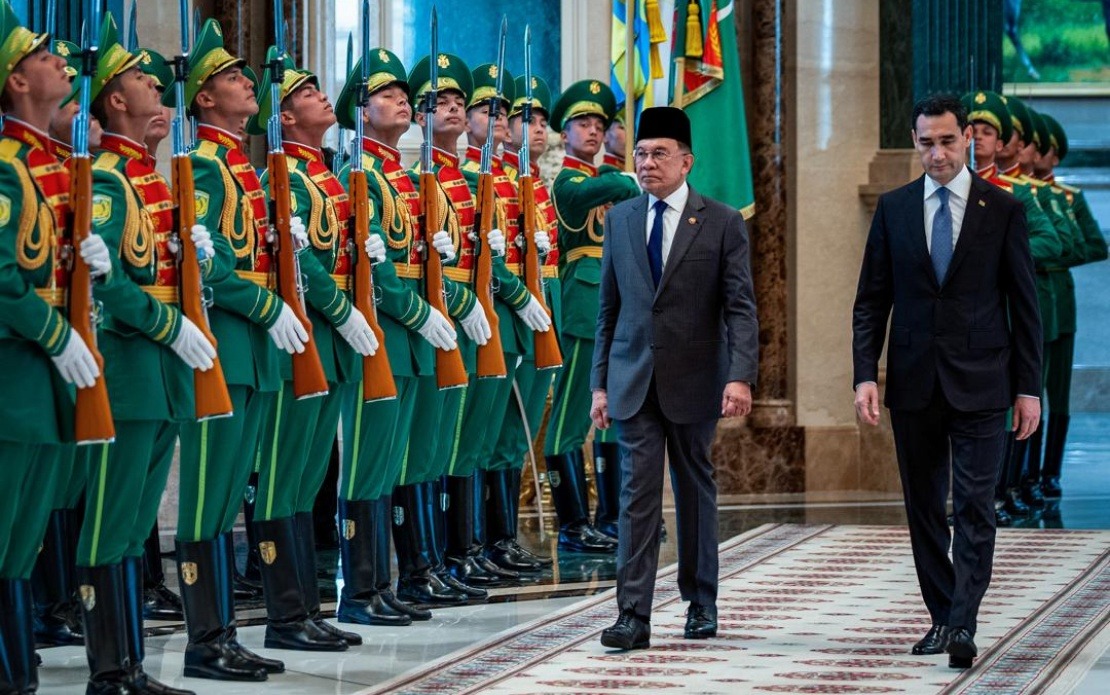
Prime Minister Datuk Seri Anwar Ibrahim was accorded full ceremonial protocol during his arrival at the Turkmenistan Presidential Palace in Ashgabat on June 19, underscoring the significance of Malaysia's strengthening engagement with Central Asia. The official welcome marked a historic moment as this constitutes Anwar's first visit to Turkmenistan since his assumption of office as Malaysia's 10th Prime Minister in November 2022, arriving at the personal invitation of Turkmenistan President Serdar Berdimuhamedov.
The ceremonial reception included all traditional diplomatic courtesies befitting a state visit of this calibre. President Berdimuhamedov personally greeted the Malaysian leader upon his arrival, followed by the formal presentation of a guard of honour. The playing of both national anthems—those of Malaysia and Turkmenistan—created a symbolic moment emphasising the mutual respect and recognition between the two nations as they deepen their bilateral relationship.
Following the formal reception protocol, Anwar was introduced to the assembled Turkmenistan Cabinet ministers and senior government officials, a gesture that facilitates broader institutional connections beyond the leadership level. The Malaysian delegation accompanying the Prime Minister was subsequently presented to President Berdimuhamedov, establishing direct contacts between Malaysian and Turkmenistan officials across multiple governmental departments and agencies.
The diplomatic agenda moved swiftly into substantive discussions as both leaders engaged in a private four-eyed meeting before transitioning to a formal bilateral session. These discussions were structured to address matters of mutual concern and to identify opportunities for strengthening cooperation across multiple sectors. Such engagements typically cover trade and investment frameworks, cultural and educational exchanges, defence and security considerations, and technological collaboration.
Turkmenistan's strategic location along the ancient Silk Road and its substantial energy reserves position it as a significant player in Central Asian geopolitics. For Malaysia, developing robust ties with Turkmenistan opens avenues for regional influence and economic partnership within a region increasingly important to global supply chains and energy security. The bilateral framework allows Malaysian enterprises to explore opportunities in energy, manufacturing, and services sectors whilst positioning Malaysia as a reliable partner for Turkmenistan's own developmental ambitions.
The two-day visit, which commenced on June 18, reflects Malaysia's strategic pivot towards deepening engagement with Central Asian nations. This represents part of a broader diplomatic initiative to expand Malaysia's footprint beyond its traditional Southeast Asian sphere and to tap into emerging opportunities in regions with complementary economic interests. Turkmenistan, with its significant natural gas reserves and developing infrastructure projects, represents an attractive partner for Malaysian investment and technical expertise.
The timing of this visit signals Malaysia's commitment to diversifying its international partnerships and strengthening South-South cooperation. Central Asian countries have increasingly sought partnerships with Asian nations, and Malaysia's outreach reflects both the region's growing importance and the mutual benefits available through substantive engagement. The visit demonstrates that Malaysia is actively positioning itself as an important player capable of engaging meaningfully with diverse regions and partners.
Beyond the immediate bilateral context, this visit carries implications for Southeast Asia's broader relationships with Central Asia. As ASEAN member states develop independent foreign policies whilst maintaining regional cohesion, Malaysia's engagement with Turkmenistan may serve as a model for deeper regional cooperation. The visit also reflects changing global alignments as Asian nations increasingly interact directly rather than through traditional Western intermediaries.
The Malaysian delegation's composition and the breadth of official representation indicate that multiple sectors of the Malaysian economy and governance are expected to benefit from enhanced cooperation with Turkmenistan. Government-to-government engagement at this level typically precedes significant commercial contracts and institutional partnerships that materialise over subsequent months.
From Turkmenistan's perspective, welcoming Anwar with full state honours reflects the country's interest in strengthening ties with Malaysia specifically and with Southeast Asian nations more broadly. As Central Asian countries navigate complex geopolitical environments, developing relationships with stable, strategically positioned Asian partners provides valuable diplomatic flexibility and economic opportunities.
The structure of Anwar's visit, progressing from ceremonial reception through bilateral discussions, follows established protocols designed to build momentum for concrete outcomes. Subsequent announcements regarding trade agreements, investment memoranda, or cultural exchange programmes would likely emerge from these discussions, translating diplomatic goodwill into tangible benefits for both nations' citizens and enterprises.

