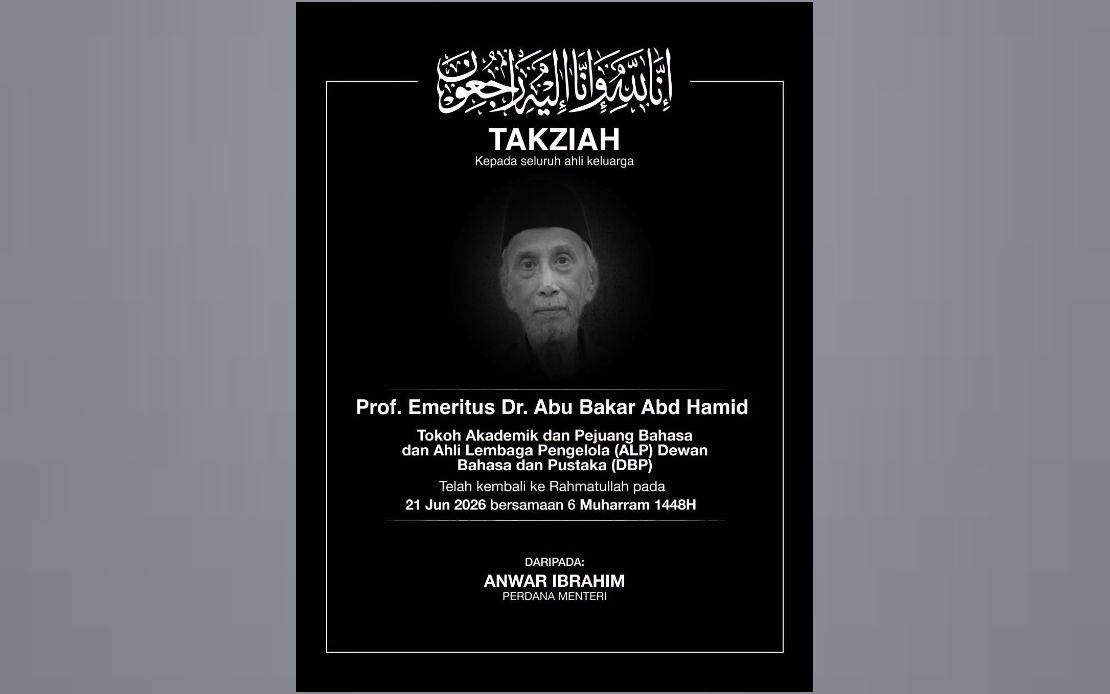
Prime Minister Datuk Seri Anwar Ibrahim has paid tribute to the life and legacy of Professor Emeritus Datuk Abu Bakar Abd Hamid, one of Malaysia's most influential literary scholars and educational institution builders, following his death last Sunday. In a statement shared on social media, Anwar reflected on the profound impact the venerated academic had on his own intellectual development and expressed deep sorrow at the loss of a figure whose contributions shaped multiple generations of Malaysian scholars and leaders.
Abu Bakar, a native of Johor, passed away on June 21 at approximately 10:30 pm at his home in Petaling Jaya after experiencing sudden respiratory distress. His death marks the end of a remarkable career spanning several decades, during which he established himself as a commanding presence in Malay literary studies and played a foundational role in the institutional architecture of Malaysian higher education. The scholarly community has acknowledged him as instrumental in elevating the standards and scope of literary discourse within the region.
Having served as deputy vice-chancellor at Universiti Malaya, one of the nation's premier institutions, Abu Bakar was deeply embedded in Malaysia's academic establishment. His tenure in this senior position allowed him to influence educational policy and curriculum development at a critical juncture in the country's post-independence development. Beyond his administrative responsibilities, he maintained an active engagement with literary scholarship, earning recognition for his original contributions to understanding and promoting Malay literature as a serious field of intellectual inquiry.
Abu Bakar's fingerprints are particularly evident on the founding of Universiti Kebangsaan Malaysia, where he served as joint secretary of the committee tasked with establishing the institution in 1968. This role positioned him at the center of a transformative moment in Malaysian education, when the government committed to expanding tertiary opportunities and creating universities dedicated to advancing knowledge in Southeast Asian contexts. The university he helped establish has since grown to become a major research institution, reflecting the long-term vision that leaders like Abu Bakar brought to the project.
The reach of his influence extended beyond the university setting. From 1996 to 2000, Abu Bakar chaired the Board of Governors of the Malaysian National News Agency, Bernama, an organization that serves as the backbone of Malaysia's official news distribution infrastructure. His stewardship during this period underscored the respect he commanded across multiple sectors and his commitment to maintaining high standards of information dissemination in the nation.
Anwar's personal connection to Abu Bakar as a former student adds an intimate dimension to his public tribute. In his Facebook statement, the Prime Minister recalled not merely the formal relationship between educator and pupil, but rather a deeper bond forged through shared intellectual passion and mutual regard. Anwar emphasized that Abu Bakar earned affection not simply through his role as a conveyor of academic content, but through his evident passion for knowledge itself and his consistent ability to kindle intellectual curiosity in those around him.
Recognizing the magnitude of Abu Bakar's contributions, the Malaysian government and academic institutions have accorded him numerous honors and accolades throughout his lifetime. These awards reflected genuine appreciation for his scholarship, his administrative acumen, and his broader role as a custodian of literary and intellectual standards during a formative period in the nation's educational development.
For the Malaysian literary community, Abu Bakar's death represents the loss of a scholar whose work helped establish Malay literature as a sophisticated field worthy of serious academic attention and international recognition. At a time when regional literature sometimes struggled for institutional legitimacy, figures like him provided the intellectual scaffolding and institutional platforms necessary to advance the discipline. His publications and critical interventions contributed materially to how generations of students and scholars understood the historical development and contemporary significance of Malay literary traditions.
The passing of such a foundational figure also prompts reflection on the continuities and transformations within Malaysia's higher education sector. Abu Bakar belonged to a cohort of nation-builders who conceived of universities not merely as credential-dispensing institutions but as engines of cultural and intellectual advancement. His commitment to linking scholarly rigor with a broader vision of national development remains relevant as Malaysian institutions navigate contemporary pressures toward commercialization and internationalization.
Abu Bakar was accorded a funeral service in keeping with Islamic tradition, with his interment taking place at Bukit Kiara Muslim Cemetery on Monday, the day following his death. His passing closes a chapter in Malaysian intellectual history, though his imprint remains visible across multiple institutions and in the work of scholars he mentored or influenced. The tributes from senior figures like Prime Minister Anwar underscore the enduring appreciation for his contributions and the recognition that his legacy will continue to inform Malaysia's engagement with literature, education, and scholarly inquiry for years to come.

