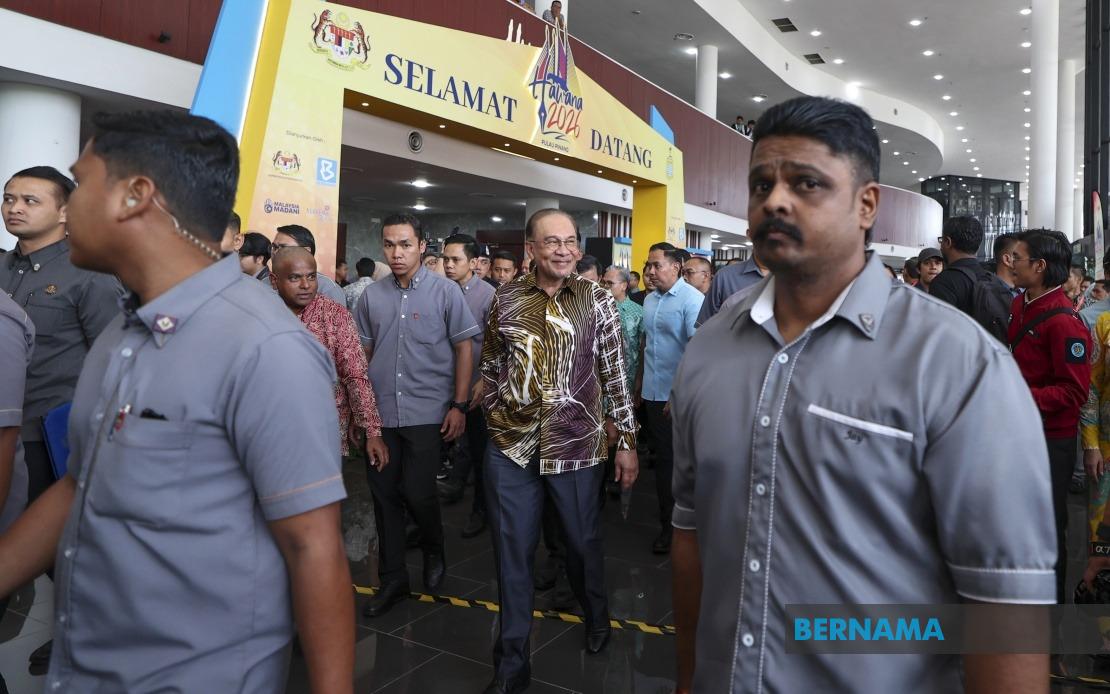
Prime Minister Datuk Seri Anwar Ibrahim has officially inaugurated the HAWANA 2026 celebration, Malaysia's premier annual recognition of journalism excellence, at the PICCA Convention Centre @ Butterworth Arena in Penang. The event, held under the theme 'Media Integrity Strengthens Credibility', represents a significant moment for Southeast Asian media professionals gathered to reflect on their profession's evolving responsibilities in an increasingly complex information landscape.
Arrivals at the venue on June 20 included Penang Chief Minister Chow Kon Yeow, Communications Minister Datuk Fahmi Fadzil, and Communications Ministry secretary-general Datuk Abdul Halim Hamzah, underscoring the government's commitment to supporting press freedom and journalistic standards. The Prime Minister's early engagement with exhibition booths and the HAWANA 2026 Photo Gallery demonstrated immediate interest in the day's substantive content, signalling high-level political backing for media sector initiatives.
The gathering drew representatives from across Southeast Asia, reflecting the region's interconnected media landscape and shared professional challenges. Delegations from Timor-Leste, Cambodia, Laos, Indonesia, and Vietnam participated, alongside representatives from major regional news agencies including Indonesia's Antara News Agency, the Vietnam News Agency, and China's Xinhua. This international dimension underscores how journalism challenges—from misinformation to editorial independence—transcend borders and demand collaborative solutions among ASEAN nations.
Timor-Leste's contingent, led by Secretary of State for Social Communication Expedito Loro Dias Ximenes and accompanied by officials from the national news agency TATOLI, reflects the small nation's growing engagement with regional media governance frameworks. Cambodia's participation through its Ministry of Information representative signals broader Southeast Asian commitment to strengthening press infrastructure, an increasingly critical concern as digital platforms reshape news consumption patterns across the region.
The ceremonial programme scheduled for the Prime Minister included presentation of HAWANA Awards and Special HAWANA Awards, honouring journalists whose work has meaningfully contributed to public discourse and the profession's credibility. Beyond individual recognition, the event featured distribution of financial support from the Kasih@HAWANA Fund, a welfare mechanism addressing the economic vulnerabilities many media workers face—particularly important in Malaysia where freelance journalists and regional correspondents often operate without institutional safety nets.
With approximately 1,000 media practitioners converging on Butterworth, the event functions as more than ceremonial gathering. It serves as a strategic forum where journalists, editors, and news organisation leaders can exchange approaches to sustaining quality reporting amid fragmented audiences, algorithmic content distribution, and declining traditional advertising revenue. For Malaysian outlets, such convening spaces matter considerably given the nation's complex media regulatory environment and the ongoing tension between press freedom principles and government oversight concerns.
The HAWANA 2026 edition reflects broader regional anxieties about media integrity. Across Southeast Asia, journalists confront mounting pressures: governments deploying defamation suits against critical reporting, business interests weaponising legal threats, and digital platforms algorithmically promoting sensational content over substantive reporting. Malaysia's media sector specifically navigates distinct challenges including licensing requirements for print publications, ongoing debates about online content regulation, and economic consolidation within news organisations, all factors that make professional solidarity forums increasingly valuable.
Organised by the Ministry of Communications with the Malaysian National News Agency (Bernama) as implementing partner, HAWANA represents government-endorsed recognition of journalism's public importance—a significant positioning in a region where media-state relations remain contentious. Bernama chairman Datuk Seri Wong Chun Wai, alongside chief executive officer Datin Paduka Nur-ul Afida Kamaludin, shaped the event architecture around the integrity theme, directly addressing widespread public concern about news credibility. Opinion polling across Malaysia and the region consistently shows declining trust in media institutions, making strategic focus on credibility foundations both timely and necessary.
The regional composition of attendees illuminates how ASEAN journalism shares structural similarities despite different political systems. Vietnamese, Indonesian, Cambodian, Laotian, and Malaysian journalists navigate comparable questions about independence versus state influence, commercial pressures, digital transformation, and professional standards maintenance. International professional exchanges at events like HAWANA allow practitioners to recognise both distinct national contexts and universal professional challenges requiring shared problem-solving approaches.
For Malaysian stakeholders specifically, the event's prominence signals government recognition that media sector health matters for broader political legitimacy and public confidence. Prime ministerial attendance at journalism-focused events carries symbolic weight, communicating that editorial independence and professional standards deserve high-level political respect. This positioning becomes particularly relevant given Malaysia's history of media-government tensions and periodic press freedom concerns highlighted by international monitoring organisations.
The emphasis on media integrity rather than mere celebration of journalism reflects contemporary realities. Audiences increasingly question news sources' reliability, partially due to viral misinformation, partially due to legitimate concerns about editorial bias and ownership influence on coverage. By anchoring HAWANA 2026 around credibility foundations, organisers positioned the event as addressing substantive professional challenges rather than offering self-congratulatory recognition divorced from public concerns.
Looking forward, the participation of younger journalists and digital-native news operators at HAWANA events becomes crucial. Malaysia's media landscape increasingly fragments as audiences migrate toward social media and alternative news sources. Traditional newsrooms, where editorial gatekeeping historically ensured baseline standards, now compete with citizen journalists, influencers, and activist accounts. Professional forums like HAWANA help establish shared norms across these fragmented spaces, though their effectiveness depends on whether insights generated at such gatherings translate into sustainable business models and editorial practices across the sector.

